
In This Article
Toothpaste for periodontal disease is a therapeutic formula — usually built around stannous fluoride — designed to reduce the plaque bacteria that cause gum bleeding, swelling, and inflammation. It supports daily plaque control but cannot remove hardened tartar or reverse bone loss; that requires professional dental treatment.
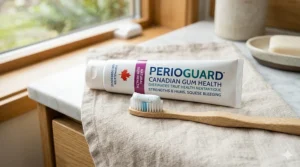
If you’ve spat a little pink into the sink lately, you’re not alone — the Canadian Dental Association estimates that seven in ten Canadians will deal with some form of gum disease in their lifetime. The good news: in its earliest stage (gingivitis), it’s reversible. The right toothpaste won’t fix periodontitis on its own, but used alongside proper brushing, flossing, and regular cleanings, it’s a genuinely useful tool — not just marketing fluff.
A quick distinction worth making upfront, since it matters for which product actually fits your situation: gingivitis is gum inflammation that hasn’t yet damaged the bone underneath, and it’s fully reversible with better home care and a cleaning. Periodontitis is the advanced stage — bone and connective tissue are already affected, pockets have formed, and Health Canada notes that this damage usually can’t be reversed, only managed. Toothpaste fits into both stories differently, and we’ll flag that throughout.
One honest note before the list: while researching this, I came across a cluster of toothpastes (mostly sold by overseas third-party sellers) making claims like “regrows gum tissue” or “reverses bone loss.” No over-the-counter toothpaste does this — it’s not how periodontal biology works — so they’re left off this list. More on spotting that kind of marketing further down.
Quick Comparison: Toothpastes for Gum Health
| Toothpaste | Key Active Ingredient | Best For | Price Range (CAD)* |
|---|---|---|---|
| Parodontax Clean Mint / Active Gum Repair | Stannous fluoride | Bleeding gums, gingivitis | $8–$14 |
| Sensodyne Sensitivity & Gum | Stannous fluoride | Sensitivity + gum problems together | $9–$16 |
| Crest Gum Detoxify Deep Clean | Stannous fluoride | Plaque around the gumline | $7–$13 |
| Colgate PerioGard SF Gum Care + Sensitivity | Stannous fluoride | Daily gum maintenance | $7–$12 |
| Colgate PreviDent 5000 Booster Plus | 1.1% sodium fluoride (high-strength) | High cavity risk near the gumline, dentist-directed | $20–$30 |
| Arm & Hammer PeroxiCare | Baking soda + peroxide + fluoride | Budget-friendly, gentle daily use | $6–$10 |
*Approximate Amazon.ca ranges at time of research; prices change often, so check current listings before buying.
Looking at the table, the pattern is straightforward: five of the six options lean on stannous fluoride, the ingredient with the strongest evidence for slowing the bacteria behind gingivitis, while PreviDent trades that mechanism for a much higher fluoride dose aimed more at root and enamel protection. If your main issue is bleeding and puffy gums, stick with the stannous fluoride group; if your dentist is worried about root decay near receding gums, PreviDent (used as directed by them) fills a different gap entirely.
💬 Just one click — help others make better buying decisions too! 😊
✨ Don’t Miss These Deals
Take your gum health routine seriously — click through to check current pricing and availability on Amazon.ca before you commit to a tube.
Top 6 Toothpastes for Periodontal Disease: A Closer Look
1. Parodontax Clean Mint / Active Gum Repair
This is the toothpaste most Canadian dentists will namecheck first when bleeding gums come up, and it’s built around 0.454% stannous fluoride, the ingredient with the most clinical backing for reducing plaque bacteria at the gumline.
In practice, what that means is a noticeably different brushing feel than a cosmetic toothpaste — it’s formulated to disrupt the bacterial biofilm rather than just freshen breath, which is why it’s marketed as “clinically proven” against bleeding rather than as a whitener. The trade-off Canadians often mention is taste: the original formula is more medicinal than minty, though the Clean Mint version softens that. People managing daily gum bleeding tend to get the most out of it; if you’re mainly chasing a brighter smile, this isn’t that toothpaste.
Pros: Strong stannous fluoride formula · widely available on Amazon.ca and in Canadian pharmacies · noticeable difference in bleeding within a few weeks of twice-daily use for many users
Cons: Distinct taste takes adjustment · doesn’t address tartar already below the gumline
Price: around $8–$14 CAD depending on size and pack count · readily available on Amazon.ca.
2. Sensodyne Sensitivity & Gum
If your gum problems come bundled with the wince-when-you-drink-cold-water kind of sensitivity, this is the toothpaste built specifically for that overlap — also stannous fluoride based, but formulated to build a protective layer over exposed dentin at the same time.
The real-world value here is in not having to choose between two specialty toothpastes. A lot of people with early gum recession develop sensitivity exactly where the gum has pulled back, so treating both with one tube is more practical than alternating. Sensodyne’s own clinical messaging is upfront that this is a maintenance product, not a cure — which matches what dentists say about combination formulas generally: they manage two symptoms well but don’t replace a periodontal exam.
Pros: Dual action for sensitivity and gum issues · gentle, low-abrasion formula · confirmed available on Amazon.ca in several sizes
Cons: Smaller tube sizes (75 mL) mean more frequent reorders · noticeably pricier per ounce than basic toothpaste
Price: around $9–$16 CAD · Amazon.ca listings confirmed in stock.
3. Crest Gum Detoxify Deep Clean
Crest’s gum line uses an “activated foam” delivery system with stannous fluoride, aiming to get the active ingredient into spots a regular brushing motion tends to miss — particularly along and just below the visible gumline.
Where this earns its spot on the list is the cooling sensation during brushing, which several Canadian buyers flag as a noticeable, almost immediate feel-good cue (versus the slower-to-notice effects of plain fluoride toothpaste). That’s a nice psychological nudge toward sticking with a twice-daily routine, which matters more for gum health outcomes than any single ingredient. It’s not a magic foam, though — the manufacturer’s own claim about “reversing gingivitis” only holds with consistent brushing, not as a one-off fix.
Pros: Foaming action reaches awkward spots near molars · cooling sensation is a good adherence cue · widely stocked on Amazon.ca
Cons: Marketing language (“detoxify,” “reverses gingivitis”) oversells what any toothpaste alone can do · some users report the foam feels unusual at first
Price: around $7–$13 CAD · confirmed listed on Amazon.ca in multiple pack sizes.
4. Colgate PerioGard SF Gum Care + Sensitivity
PerioGard is Colgate’s answer to the Parodontax/Sensodyne category — stannous fluoride, aimed at reducing gum bleeding and inflammation, with an enamel-strengthening angle layered in.
What stood out scanning genuine Amazon.ca feedback for this one is a fairly consistent pattern: people switching from a regular toothpaste specifically for sore or bleeding gums report their gums feeling calmer within a couple of weeks, and several mention it as noticeably “medicated” compared to what they used before — which tracks with the active ingredient doing real work rather than just smelling clean. It’s a reasonable middle-ground pick if you want a Colgate-branded option without paying prescription-toothpaste prices.
Pros: Comparable actives to pricier competitors at a lower price point · confirmed in stock on Amazon.ca in several formats · enamel-strengthening claim is on top of, not instead of, the gum benefit
Cons: Smaller tube sizes than mainstream Colgate Total · less brand recognition in Canada than Parodontax
Price: around $7–$12 CAD · multiple confirmed Amazon.ca listings.
5. Colgate PreviDent 5000 Booster Plus
This one’s a different animal: 1.1% sodium fluoride at 5,000 ppm — roughly four times the fluoride concentration of a standard toothpaste. It’s recognized by the Canadian Dental Association and aimed at people at high risk of decay, including decay forming near receding gum lines and exposed root surfaces — a common complication once gum disease has progressed.
The practical case for this product is narrow but important: standard toothpaste fluoride levels weren’t designed for root surfaces, which are softer and more decay-prone than enamel. If your periodontal treatment has already left you with some recession, this is the kind of toothpaste your dentist or hygienist might specifically recommend layering in — typically once daily, in place of (not alongside) your regular toothpaste. It’s not something to self-prescribe; check with your dentist first, since high-fluoride products come with their own usage guidelines.
Pros: CDA-recognized, high-strength formula · specifically useful for root decay risk after gum recession · available without a prescription on Amazon.ca, though dentist guidance is still advisable Cons: Meaningfully pricier than standard toothpaste · once-daily use only, so it’s an addition to your routine, not a replacement for daily brushing
Price: around $20–$30 CAD for travel-size tubes (100 mL) · confirmed available on Amazon.ca.

6. Arm & Hammer PeroxiCare
The budget-friendly, baking-soda-and-peroxide option. It’s gentler and less “medicinal” feeling than the stannous fluoride group, which makes it a reasonable everyday choice for people without active bleeding who mainly want to keep gum problems from starting.
Where this earns a spot rather than getting dismissed as “just baking soda”: the low-abrasion formula is genuinely kinder to already-irritated gum tissue than some heavier whitening toothpastes, and the peroxide component does have a real antibacterial effect, even if it’s milder than stannous fluoride. Several long-time Canadian users on Amazon.ca specifically mention switching to it after a dentist flagged that their previous toothpaste was too abrasive — which lines up with how dental hygienists often talk about gentle daily maintenance for people prone to recession.
Pros: Noticeably cheaper per use than the specialty gum-care brands · low-abrasion, gum-friendly formula · multiple pack sizes confirmed on Amazon.ca
Cons: Weaker active-ingredient profile than the stannous fluoride options if you have active bleeding · taste/texture (mild fizzing) isn’t for everyone
Price: around $6–$10 CAD · confirmed in stock on Amazon.ca, often in multi-packs.
7. Arm & Hammer PeroxiCare
The budget-friendly, baking-soda-and-peroxide option. It’s gentler and less “medicinal” feeling than the stannous fluoride group, which makes it a reasonable everyday choice for people without active bleeding who mainly want to keep gum problems from starting.
Where this earns a spot rather than getting dismissed as “just baking soda”: the low-abrasion formula is genuinely kinder to already-irritated gum tissue than some heavier whitening toothpastes, and the peroxide component does have a real antibacterial effect, even if it’s milder than stannous fluoride. Several long-time Canadian users on Amazon.ca specifically mention switching to it after a dentist flagged that their previous toothpaste was too abrasive — which lines up with how dental hygienists often talk about gentle daily maintenance for people prone to recession.
Pros: Noticeably cheaper per use than the specialty gum-care brands · low-abrasion, gum-friendly formula · multiple pack sizes confirmed on Amazon.ca
Cons: Weaker active-ingredient profile than the stannous fluoride options if you have active bleeding · taste/texture (mild fizzing) isn’t for everyone
Price: around $6–$10 CAD · confirmed in stock on Amazon.ca, often in multi-packs.
Stannous Fluoride vs. Sodium Fluoride vs. Baking Soda: What the Difference Actually Means
Three ingredient camps dominate this category, and the difference matters more than packaging suggests.
Stannous fluoride (Parodontax, Sensodyne Sensitivity & Gum, Crest Gum Detoxify, PerioGard) does double duty: it has antibacterial properties that target the specific bacteria behind gum inflammation, while still protecting against cavities. This is why it shows up in nearly every toothpaste explicitly marketed for gum disease.
High-concentration sodium fluoride (PreviDent) skips the antibacterial angle entirely and focuses on remineralizing tooth structure — useful for the root-surface decay that often follows gum recession, but it won’t calm active gum inflammation the way stannous fluoride does.
Baking soda and peroxide (Arm & Hammer) work through a gentler mechanical and mild-antibacterial route — useful for everyday maintenance and for people whose gums are irritated by harsher abrasives, but with less specific evidence behind the gum-bleeding claims that stannous fluoride formulas can point to.
None of the three “cures” periodontal disease. They’re tools that support different parts of the same goal, and which one fits depends on whether your main problem is active bleeding, root sensitivity after recession, or just keeping things from getting worse.
Practical Usage Guide: Getting the Most Out of Gum-Care Toothpaste
A toothpaste with the right ingredients still underperforms if the technique is off. A few adjustments make a real difference:
Brush at a 45-degree angle. Aim the bristles toward the gumline rather than straight at the tooth surface — this is the modified Bass technique dentists commonly recommend for gum disease, and it lets the active ingredients actually reach the area causing problems.
Don’t rinse immediately. Spit out excess, but let the toothpaste sit for a minute or two before rinsing with water. Stannous fluoride and high-fluoride formulas need contact time to work; rinsing right away washes away most of the benefit.
Watch the pressure, not just the angle. Pressing hard doesn’t clean better — it pushes gum tissue back further and can accelerate recession, which is the opposite of what you want if gum disease has already started.
Canadian winter note: cold, dry indoor air during the heating season can aggravate already-sensitive gums and teeth. If you notice symptoms worsen in winter, a dual sensitivity-and-gum formula (like Sensodyne Sensitivity & Gum) tends to handle that better than a straight gum-care toothpaste.
First 30 days: expect some adjustment to taste and texture, especially with stannous fluoride formulas. A genuine reduction in bleeding usually shows up within two to four weeks of consistent twice-daily brushing — if it doesn’t, that’s a signal to see a dentist rather than switch toothpastes again.

Real-World Scenarios: Matching the Toothpaste to the Person
The condo dweller with occasional bleeding gums (Toronto, Vancouver): Mild bleeding, no pain, busy schedule. Parodontax Clean Mint or Colgate PerioGard SF are reasonable starting points — both are widely available, affordable, and address the bleeding directly without requiring a dentist visit first (though one should still be booked if bleeding persists past two to three weeks).
The parent juggling sensitivity and gum issues (Calgary, Ottawa): Cold-drink wincing plus puffy gums after a stressful season of skipped flossing. Sensodyne Sensitivity & Gum is built for exactly this combination, and it’s gentle enough for daily use without a dentist’s sign-off.
The retiree with gum recession and root exposure (rural Manitoba, Maritimes): Periodontal treatment already happened, but root surfaces near the gumline are now exposed and decay-prone. This is the PreviDent 5000 scenario — worth a conversation with a dentist or hygienist about adding a once-daily high-fluoride step, especially with limited access to frequent dental visits in some rural areas.
How to Choose Toothpaste for Periodontal Disease in Canada
- Identify your main symptom first. Bleeding and swelling point to stannous fluoride formulas; sensitivity plus gum issues point to a dual-action product; root decay risk after recession points toward high-fluoride options.
- Check whether it’s gingivitis or periodontitis. If a dentist has confirmed periodontitis (bone involvement), toothpaste is support, not treatment — scaling and root planing usually need to happen first.
- Match the active ingredient to your stage. Early gingivitis responds well to stannous fluoride alone; more advanced cases often need a toothpaste plus a prescribed antimicrobial mouth rinse from a dentist.
- Factor in your budget honestly. A $7 stannous fluoride toothpaste used consistently beats an $30 specialty product used sporadically.
- Don’t self-prescribe high-fluoride formulas. PreviDent-class products are intended for dentist-identified risk, not general use.
- Re-evaluate after four weeks. If bleeding, swelling, or sensitivity hasn’t meaningfully improved, that’s a sign to see a dentist rather than rotate through more toothpastes.
Common Mistakes When Buying Toothpaste for Gum Disease
Trusting “regrows gum” or “reverses bone loss” claims. No over-the-counter toothpaste regenerates lost gum tissue or rebuilds bone — that requires surgical grafting in a dental office. Several low-cost imported toothpastes use this exact language; treat it as a red flag, not a selling point.
Assuming “fluoride-free” means gentler and therefore better. Some fluoride-free gum toothpastes lean on unproven natural ingredients instead of evidence-backed actives like stannous fluoride. Fluoride-free can be the right call for specific medical reasons, but it isn’t automatically an upgrade.
Stopping at the first sign of improvement. Gum disease symptoms can ease before the underlying bacterial issue is fully managed, leading people to quit a new routine too soon.
Ignoring brushing technique. Even the best toothpaste underperforms with the wrong angle, too much pressure, or rinsing immediately after brushing (see the usage guide above).
Skipping the dentist because symptoms improved. Toothpaste can mask bleeding without addressing tartar that’s already hardened below the gumline — only a professional cleaning removes that.
Canadian Regulations and Safety Standards
Therapeutic toothpastes sold in Canada are regulated as Natural Health Products or non-prescription drugs under Health Canada, which means active ingredients like stannous fluoride and sodium fluoride have to meet specific concentration and labelling standards before a product can carry gum-disease or anticavity claims. The Canadian Dental Association’s Seal of Recognition program independently evaluates select products (PreviDent Booster Plus is one of them) against clinical evidence before allowing the CDA seal on packaging — worth looking for if you want third-party validation beyond the marketing copy on the box. Bilingual labelling (English and French) is a federal requirement for personal care products sold in Canada, so don’t be surprised to see both languages on the tube regardless of which province you’re in.
Long-Term Cost & Maintenance in Canada
A 100 mL tube of stannous fluoride toothpaste typically lasts six to ten weeks with twice-daily brushing for one adult, putting most of the products above in the $1–$2 CAD per week range — genuinely affordable compared to the cost of treating advanced periodontitis, which can run into hundreds or thousands of dollars in scaling, root planing, and possible surgical treatment if gum disease is left unmanaged. High-fluoride products like PreviDent cost more per tube but are used only once daily, which narrows the gap somewhat. For Canadians without dental insurance — a notable share of the population, particularly outside major urban centres — consistent use of an affordable stannous fluoride toothpaste is one of the most cost-effective preventive steps available, alongside the basics of brushing, flossing, and not skipping checkups.

Frequently Asked Questions
❓ Can toothpaste actually cure periodontal disease?
❓ Is stannous fluoride toothpaste available across Canada, including remote areas?
❓ How long before I see results from a gum-care toothpaste?
❓ Do I need a prescription for high-fluoride toothpaste like PreviDent in Canada?
❓ Should I switch toothpaste if my gums still bleed after brushing properly?
Conclusion
For most Canadians dealing with occasional bleeding or swollen gums, a stannous fluoride toothpaste like Parodontax, Sensodyne Sensitivity & Gum, Crest Gum Detoxify, or Colgate PerioGard SF is a sensible, affordable first step — all four are confirmed available on Amazon.ca and priced well under $20 CAD. If gum recession has already led to root exposure, a conversation with your dentist about a high-fluoride option like PreviDent is worth having. And if you just want gentle, everyday maintenance, Arm & Hammer’s baking-soda formula does the job without the premium price tag. None of these replace a dentist — but used consistently, with proper technique, they make a real difference in keeping gum disease from progressing.
✨ Found a Pick That Fits?
Check current pricing and availability on Amazon.ca before you buy — prices and stock shift often, and it’s worth comparing tube sizes for the best per-use value.
Recommended for You
- 7 Best Toothpaste for Bleeding Gums During Pregnancy Canada 2026
- 7 Best Toothpastes to Stop Bleeding Gums in Canada (2026 Guide)
- Can Toothpaste Cure Gingivitis? 7 Best Options in Canada (2026)
Disclaimer: This article contains affiliate links. As an Amazon Associate, I earn from qualifying purchases. If you purchase products through these links, we may earn a small commission at no additional cost to you. This article is for general information only and is not a substitute for advice from a dentist or other licensed health-care professional.
✨ Found this helpful? Share it with your friends! 💬🤗
