In This Article
Tooth powder for whitening is a dry, finely milled oral-care product built on gentle mineral abrasives such as calcium carbonate, clay or activated charcoal. You dip a damp toothbrush into it and polish away surface stains from coffee, tea and red wine. It buffs rather than bleaches, and that distinction runs through everything below.
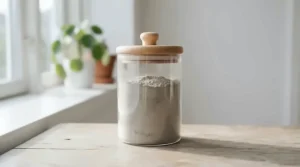
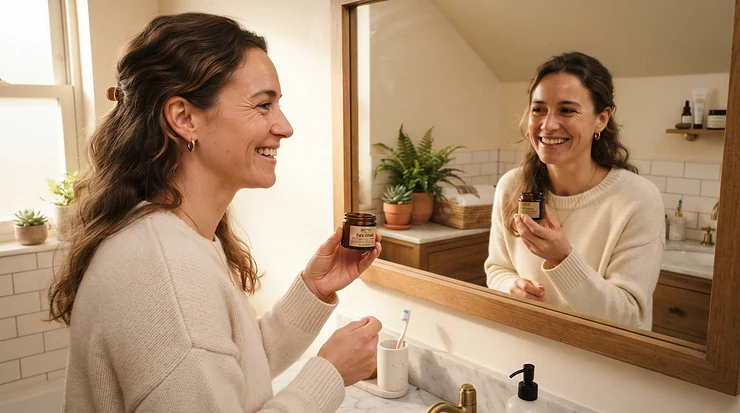
Tooth powder is one of the oldest oral-care formats there is, and it has been making a comeback. Part of the appeal is nostalgia and part is the plastic-free jar. Part of it is the promise of a brighter smile without peroxide, which is what makes people’s teeth zing.
The hype has outrun the evidence, though. CBC reported that the Canadian Dental Association describes activated charcoal as abrasive enough to lift surface stains. The same report notes that the CDA had not approved any oral products containing charcoal, and that the American Dental Association says there is no evidence charcoal dental products are safe or effective.
So can tooth powder for whitening earn a spot in your routine? Yes, with realistic expectations. A good powder polishes extrinsic stain. It will not change the natural shade of your tooth, and it won’t touch crowns, veneers or fillings.
Here is how this guide works. I haven’t brushed with any of these products, and I won’t pretend otherwise. Everything below comes from ingredient lists, published research and the patterns visible in real customer reviews. Where I couldn’t verify something, I say so.
Prices are approximate Canadian-dollar ranges, so check current pricing and availability on amazon.ca before you buy. We cover seven picks, then dig into activated charcoal tooth powder, kaolin clay, mineral abrasives and stain polishing. We also settle the toothpaste powder vs toothpaste tablets question.
Tooth Powder for Whitening: Quick Comparison Table
| Product | Format | Main Stain-Fighting Approach | Approx. Price Range (CAD) | Best For |
|---|---|---|---|---|
| Primal Life Organics Dirty Mouth Toothpowder | Clay powder | Kaolin, bentonite and French green clay polishing | C$20–C$30 | Primal Life Organics Dirty Mouth Toothpowder suits gentle daily polishing |
| Black Pearl Activated Charcoal Teeth Whitening Powder | Charcoal powder | Coconut charcoal plus bentonite abrasion | C$15–C$25 | Black Pearl Activated Charcoal Teeth Whitening Powder suits occasional coffee-stain lifting |
| Hismile PAP+ Whitening Powder | Add-on powder | PAP oxidation plus mild abrasives | C$20–C$30 | Hismile PAP+ Whitening Powder suits upgrading your current toothpaste |
| Frau Fowler Power Mint Tooth Powder | Salt-and-soda powder | Calcium carbonate and baking soda | C$20–C$30 | Frau Fowler Power Mint Tooth Powder suits everyday natural brushing |
| Bite Toothpaste Bits | Tablets | Mild abrasives with nano-hydroxyapatite | C$40–C$60 (multi-month jar) | Bite Toothpaste Bits suit travellers and low-waste fans |
| Spotlight Oral Care Teeth Whitening Powder Diamond PAP | Add-on powder | PAP-based oxidation | Low-to-mid C$10s to C$20 | Spotlight Oral Care Teeth Whitening Powder Diamond PAP suits budget experimenting |
| Moody Zook Charcoal Teeth Whitening Powder | Charcoal powder | Fine coconut charcoal | Under C$15 | Moody Zook Charcoal Teeth Whitening Powder suits the lowest-risk wallet trial |
Looking at the comparison above, the real divide isn’t price, it’s mechanism. Clay and charcoal powders physically polish stains, the PAP powders (Hismile PAP+ Whitening Powder and Spotlight Oral Care Teeth Whitening Powder Diamond PAP) lean on chemistry, and Bite Toothpaste Bits is mostly a format swap. If you want the gentlest polishing, Primal Life Organics Dirty Mouth Toothpowder is the more considered formula, while Moody Zook Charcoal Teeth Whitening Powder is the cheapest way to find out whether powder suits you.
💬 Just one click — help others make better buying decisions too!😊
Top 7 Tooth Powder for Whitening Picks: Expert Analysis
Every pick below is judged on what its ingredients actually do, what review patterns suggest, and who should skip it. Price figures are rough ranges that move constantly, so confirm current pricing on amazon.ca.
1. Primal Life Organics Dirty Mouth Toothpowder — best kaolin clay formula
Most powders rely on one blunt abrasive. Primal Life Organics Dirty Mouth Toothpowder blends three clays instead. The unflavoured version combines kaolinite (white clay), bentonite and French green clay with sodium bicarbonate and nano-hydroxyapatite.
In practice, clay particles tend to be softer than many industrial abrasives. The design aim is to lift surface film without scouring enamel, and the baking soda adds a little extra grip. The brand says the nano-hydroxyapatite helps remineralize. Treat that as plausible but not independently proven for this exact formula.
Based on the ingredients, this suits stain-prone adults who prefer fluoride-free care and want a gentle, daily-use polish. It isn’t ideal if you’re cavity-prone and want fluoride on board.
Reviewers frequently describe a clean feel, and several report reduced sensitivity. Common complaints are the price, a faint clay taste, no lather, and one reviewer who felt less clean than with conventional paste. The listing claims 200+ brushings from the 28 g (1 oz) jar.
Pros:
- ✅ Three-clay blend polishes without heavy scouring
- ✅ Many reviewers report cleaner feel and calmer sensitivity
- ✅ Small amount per brushing stretches the jar
Cons:
- ❌ Fluoride-free, so no proven cavity protection
- ❌ Premium price and noticeable clay taste for some
Expect roughly C$20–C$30 for the small jar. It’s a strong value for gentle daily use, less so if you want dramatic whitening.
2. Black Pearl Activated Charcoal Teeth Whitening Powder (One Living Earth) — best charcoal pick for coffee stains
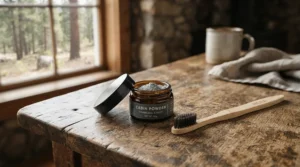
Charcoal is the dramatic one, black powder and a smile that looks whiter by contrast. Black Pearl Activated Charcoal Teeth Whitening Powder (One Living Earth) pairs organic coconut charcoal with bentonite clay, which is a sensible softening move.
Here is what the spec sheet won’t tell you. Charcoal whitens through abrasion, not magic. A lab study using bovine enamel found the charcoal powder caused the most enamel wear of all tested products, while charcoal pastes landed in the middle. That tells you how to use it: sparingly, with a soft brush, and not daily.
This pick suits occasional use by someone who drinks a lot of coffee or tea and wants a periodic reset. It’s a poor choice for anyone with thin enamel, gum recession or sensitivity.
The review summaries I could find were secondhand and skew positive, praising fresh feel and gentleness. That’s a reason for caution rather than confidence, because I couldn’t verify a clean sample of individual reviews.
Pros:
- ✅ Bentonite blended in to temper charcoal’s bite
- ✅ Fluoride-free and mint-free for flavour-sensitive users
- ✅ Affordable way to test activated charcoal tooth powder
Cons:
- ❌ Messy black residue on sinks and grout
- ❌ Highest abrasion-risk category in published testing
Budget about C$15–C$25. It offers fair value as an occasional treat and poor value as a daily driver.
3. Hismile PAP+ Whitening Powder — turns any toothpaste into a whitener
Hismile PAP+ Whitening Powder is the odd one out, because it markets oxidation over abrasion. The active ingredient is phthalimidoperoxycaproic acid (PAP), supported by calcium carbonate and sodium bicarbonate. It also contains nano-hydroxyapatite and xylitol.
The idea is to dip a toothpaste-loaded brush into the jar and brush for two minutes. You keep your fluoride paste and add a whitening layer. That’s smart design if you don’t want to abandon fluoride.
Now the honest bit. Consumer NZ reported that a 2019 study found a PAP product whitened worse than saline, and CHOICE quoted a dental professor saying there is no independent evidence the hydroxyapatite in a Hismile gel remineralizes. I couldn’t confirm any Canada-specific regulatory ruling on PAP, so check the label.
I couldn’t verify review data for this powder specifically. Retailer reviews for the brand’s whitening pen are mixed, with some praise and some “lacklustre” verdicts.
Pros:
- ✅ Works on top of your existing fluoride toothpaste
- ✅ Non-peroxide approach avoids typical peroxide zing
- ✅ Small jar travels easily
Cons:
- ❌ Independent evidence for PAP whitening is thin
- ❌ Not for children, pregnancy or breastfeeding per the label
Expect roughly C$20–C$30 for the 12 g jar. It’s a reasonable experiment, not a proven shade-changer.
4. Frau Fowler Power Mint Tooth Powder — best salt-and-mint everyday option
Frau Fowler Power Mint Tooth Powder keeps things refreshingly simple. Its base is salts, xylitol, calcium carbonate and baking soda, with essential oils for flavour. It’s marketed as fluoride-free.
Calcium carbonate is a classic mild abrasive, and baking soda offers modest polishing plus pH buffering. Xylitol is a sweetener that bacteria can’t ferment, so it keeps the powder from being sugary in effect. You’re getting honest, old-school stain polishing without a mystery ingredient.
This suits fluoride-free brushers who like a minimal ingredient list and don’t mind adapting to a no-foam routine.
Reviewers describe the mint as present but not overpowering, and some taste saltiness from the baking soda. Others say it feels like it cleans well after a few weeks, and I noticed no verified claims of dramatic whitening. The brand’s own positioning is “convenient and natural,” which is a fair summary.
Pros:
- ✅ Short, recognisable ingredient list
- ✅ Mild calcium carbonate and soda polishing
- ✅ Light, compact jar travels well
Cons:
- ❌ Noticeable saltiness for some brushers
- ❌ Fluoride-free with no foam to guide you
Budget roughly C$20–C$30. Good value for everyday maintenance, modest for whitening ambition.
5. Bite Toothpaste Bits — best tablets for travel and low waste
If powder feels fiddly, Bite Toothpaste Bits is the tidy alternative. You chew a tablet, wet the brush and go. The nano-hydroxyapatite formula lists erythritol, xylitol, calcium carbonate, nano-hydroxyapatite and sodium bicarbonate, plus a surfactant (sodium cocoyl glutamate) and zinc citrate.
That surfactant is the practical edge. Tablets foam a little, which many people find psychologically more “clean.” Calcium carbonate and silicon dioxide provide the gentle stain polishing. A 248-tablet jar covers roughly four months of twice-daily brushing, and the brand sells fluoride and fluoride-free versions.
The honest caveat: whitening isn’t its core strength. Aggregated reviews are mixed. Fans love the travel-readiness and clean feel. Critics mention grittiness, weak foam, crumbling tablets and underwhelming whitening.
Pros:
- ✅ Fluoride and fluoride-free versions available
- ✅ Mess-free, plastic-light and carry-on friendly
- ✅ Lightly foams, which eases the switch from paste
Cons:
- ❌ Highest upfront cost on this list
- ❌ Tablets are sensitive to humidity and heat
Expect roughly C$40–C$60 for a multi-month jar. It’s strong value for convenience, weaker for pure whitening.
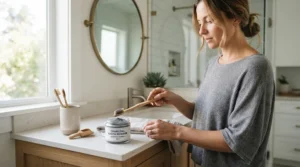
6. Spotlight Oral Care Teeth Whitening Powder Diamond PAP — lowest-risk budget experiment
Spotlight Oral Care Teeth Whitening Powder Diamond PAP was listed by a Canadian retailer in Canadian dollars from about C$13. I couldn’t confirm live amazon.ca availability, so check the listing.
PAP is the same chemistry story as Hismile PAP+ Whitening Powder, with the same evidence caveat. It’s an oxidiser, designed to lift stain without peroxide’s reputation for sensitivity, and it needs consistent use before you judge it.
Based on the format, this suits someone curious about non-peroxide whitening who doesn’t want to spend much. The practical appeal is price. At this level, you’re not betting much.
I couldn’t verify a meaningful set of customer reviews for this specific product, so I won’t characterize them. Read recent buyer feedback on the listing before ordering.
Pros:
- ✅ Very low cost of entry
- ✅ Works as a topper over fluoride toothpaste
- ✅ Non-peroxide approach for sensitivity-wary users
Cons:
- ❌ Limited independent evidence for PAP whitening
- ❌ Review and availability data I could verify are thin
Budget low-to-mid C$10s up to around C$20. It’s cheap enough to try, but judge it after four weeks, not four days.
7. Moody Zook Charcoal Teeth Whitening Powder — cheapest charcoal trial
Moody Zook Charcoal Teeth Whitening Powder (the Sage Coconut version) is marketed as a fine, natural charcoal powder for sensitive teeth. A pinch on a damp brush is the whole routine.
“Fine” matters here. Smaller particles generally scratch less, but the same bovine-enamel research that flagged charcoal powder suggests you should still ration use. Think once or twice a week, not daily.
This suits budget shoppers who want to test activated charcoal tooth powder cheaply and understand the trade-offs. It’s not for anyone with thinning enamel.
Shoppers on a deal forum were split between enthusiasm and caution about the lack of long-term studies. That mirrors the professional debate neatly.
Pros:
- ✅ Among the cheapest ways to trial charcoal
- ✅ Fine powder texture reduces grittiness
- ✅ Simple one-ingredient-style routine
Cons:
- ❌ Charcoal abrasion concerns apply fully here
- ❌ Fluoride-free and messy
Expect under C$15. It’s solid value as an occasional stain-lifter and risky as a daily habit.
Activated Charcoal Tooth Powder: What the Evidence Says
Activated charcoal tooth powder is the most photogenic option and the most controversial. The pitch is adsorption, the idea that charcoal’s porous surface traps stain particles. Reality is simpler: any whitening effect appears to come from abrasion.
The professional picture is consistent. Dr. John Brooks’s 2017 review in the Journal of the American Dental Association concluded the evidence for charcoal products is thin. The ADA has not granted its Seal of Acceptance to any charcoal toothpaste. In the bovine-enamel study mentioned earlier, charcoal dentifrices matched conventional toothpaste at limiting staining. The powder, though, produced the greatest enamel roughness and wear after 100,000 brushing cycles.
Why does that matter? Enamel doesn’t regrow. Once it thins, the yellowish dentin beneath shows through, which defeats the entire exercise.
Who might still use it? Someone with healthy, thick enamel and a coffee habit might use it once or twice a week with a soft brush and light pressure. Who should skip it? People with sensitivity, recession, thin enamel or existing erosion.
My practical rule is to treat charcoal as a rinse-and-reset, never as a daily toothpaste. Pair it with fluoride toothpaste on other days, and stop if you notice new sensitivity.
Kaolin Clay in Tooth Powder: Gentle Polish or Marketing Mud?
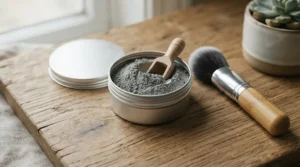
Kaolin clay is the quiet workhorse of tooth powder. It’s a soft white clay (kaolinite) that has been used as an abrasive in toothpaste formulations for decades. One 2026 Erbil Dental Journal study tested a dentifrice using calcined kaolin with perlite, hydroxyapatite and calcium carbonate. It reported strong cleaning with relative dentin abrasivity (RDA) of about 95 and relative enamel abrasivity of about 57.
Both numbers are inside accepted safety limits. For context, the ISO standard referenced in the paper treats RDA up to 250 as acceptable for lifetime use. A formula at 95 is comfortably gentle.
Before you get excited, remember that this was a lab-designed formulation, not your retail jar. Particle size and grade matter, and I couldn’t find published RDA values for the consumer powders reviewed here. Primal Life Organics Dirty Mouth Toothpowder uses kaolinite alongside bentonite, but its abrasivity hasn’t been publicly measured as far as I could verify.
The practical takeaway is that kaolin clay is a reasonable, well-understood polishing ingredient. It’s especially appealing if you prefer fewer synthetic abrasives. Just don’t treat the word “clay” as a guarantee of gentleness, because grade, fineness and the other ingredients decide the real abrasivity.
Mineral Abrasives and Stain Polishing: How Powders Really Work
Strip away the marketing and tooth powder for whitening is a stain-polishing system. The abrasives are mostly minerals: calcium carbonate, baking soda, silica, clays and, in some cases, charcoal. Each is ground to a particle size meant to scrub away pellicle, the thin film where coffee and tea pigments cling.
The Canadian Dental Association describes these surface whiteners as products using special abrasives to improve stain removal. Because those abrasives are often only finer versions of what regular toothpastes use, the CDA considers them unlikely to cause excessive wear. It also notes that peroxide-based bleaches are the products that can actually alter tooth colour itself.
That distinction is your reality check. Mineral abrasives can restore your tooth’s natural shade by removing extrinsic stain. They can’t whiten beyond it. Healthline notes that tooth powders lack ingredients to tackle intrinsic stains, which come from medications, excess fluoride or decay.
Stain polishing also has a ceiling. Brush harder or more often and you don’t gain whiteness, you gain wear. The best mineral abrasives balance cleaning power against abrasivity, which is why the RDA number matters more than the word “natural.”
Toothpaste Powder vs Toothpaste Tablets: Which Wins for Whitening?
The toothpaste powder vs toothpaste tablets debate comes down to ritual versus convenience, because the whitening ingredients overlap heavily. Both rely on mild mineral abrasives such as calcium carbonate and sodium bicarbonate. Bite Toothpaste Bits adds a gentle surfactant, so you get a little foam. A powder like Frau Fowler Power Mint Tooth Powder gives you more control over how much abrasive you load on the brush.
| Format | How It Whitens | Mess & Travel | Typical Cost | Best For |
|---|---|---|---|---|
| Tooth powder | Mineral abrasion (clay, carbonate, charcoal) | Dusty; jar travels fine | Lowest | Tooth powder suits minimalists who want control |
| Toothpaste tablets | Mild abrasion plus gentle surfactant | Cleanest and TSA-friendly | Highest | Tablets suit travellers and low-waste fans |
| Whitening toothpaste | Abrasives plus polishing agents | Familiar tube | Low–mid | Paste suits foam lovers who want fluoride |
| Peroxide strips or gels | Bleach changes tooth colour | Tidy but timed | Mid–high | Peroxide suits people wanting real shade change |
On paper, powders win on cost and customization, while tablets win on tidiness and consistency. Neither bleaches. If you genuinely want your teeth lighter than their natural shade, peroxide products or a dentist are the tools, and the powders and tablets above are maintenance. For stain polishing alone, either format works, so choose the one you’ll actually keep using.
How to Choose Tooth Powder for Whitening (5 Steps)
- Decide your goal. If you want stain maintenance, any gentle powder works. If you want a lighter shade, you need peroxide, so powder alone will disappoint.
- Check the abrasive. Calcium carbonate and kaolin clay are generally milder than charcoal. Avoid stacking several harsh abrasives in one jar.
- Decide on fluoride. Mainstream dentistry backs fluoride for cavity prevention, and most powders skip it. If yours does, consider fluoride toothpaste for your other brushing sessions.
- Match your sensitivity. If you have sensitive teeth or gum recession, choose clay or carbonate over charcoal, and ask your dentist first.
- Judge the claims. Treat “remineralizing” and “detoxifying” as marketing unless independent evidence exists. A short ingredient list and honest labelling beat big promises.
The lesson running through all five steps is that the best tooth powder for whitening is the gentlest one that still removes your particular stains.
✨ Don’t Miss These Exclusive Deals!
🔍 Take your tooth powder for whitening routine to the next level with these carefully selected products. Click on any highlighted item to check current pricing and availability. These picks will help you create a brighter, cleaner smile you’ll feel good about!
How to Use Tooth Powder for Whitening: A Practical 30-Day Guide
Week 1: set the baseline. Switch your toothbrush to a soft-bristled head. Brush with the powder just two or three times, using a pea-sized pinch rather than a full dip. Keep fluoride toothpaste for your other sessions.
Week 2: refine your technique. Use light pressure and short circular strokes for two minutes. Powders work through contact time, not force. If you use Hismile PAP+ Whitening Powder or Spotlight Oral Care Teeth Whitening Powder Diamond PAP, dip a toothpaste-loaded brush and brush gently.
Weeks 3 to 4: audit your results. Compare your smile in daylight with a photo from day one. If you see no change, the stain may be intrinsic and no powder will fix it.
Common mistakes in the first 30 days are worth avoiding:
- Brushing right after acidic foods. Wait about 30 minutes, because softened enamel wears faster.
- Using charcoal daily. Limit Black Pearl Activated Charcoal Teeth Whitening Powder (One Living Earth) or Moody Zook Charcoal Teeth Whitening Powder to once or twice a week.
- Letting moisture in. Keep jars dry and closed. Store Bite Toothpaste Bits somewhere cool and dry, since the brand notes humidity and heat affect tablets.
Maintenance is pleasantly boring. Use a clean, dry scoop or a dry brush tip, wipe the jar rim, and replace the brush every three months.
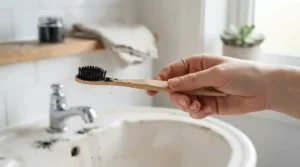
Real-World Scenarios: Which Pick Fits Which Person?
Picture three users, and notice how budget, environment and frequency change the answer.
The coffee-a-day commuter (budget under C$30, brushing at home and at work). Staining is the enemy, and enamel looks healthy. A gentle daily powder such as Primal Life Organics Dirty Mouth Toothpowder, plus an occasional Black Pearl Activated Charcoal Teeth Whitening Powder (One Living Earth) session, covers maintenance and the occasional reset. Charcoal stays at once a week.
The frequent flyer with sensitive teeth (budget C$40+, constantly on the move). Mess and sensitivity are the pain points. Bite Toothpaste Bits solves the carry-on problem, and its nano-hydroxyapatite formula is fluoride-free while the fluoride version is available. This user should skip charcoal and talk to a dentist about whether fluoride-free is wise.
The frugal experimenter (budget under C$20, curious). Start with Spotlight Oral Care Teeth Whitening Powder Diamond PAP or Moody Zook Charcoal Teeth Whitening Powder, keep expectations low and track results for a month. If nothing improves, the stains are likely intrinsic, and your money is better spent on a dental consult.
The common thread is matching the abrasive to the enamel and the format to the lifestyle.
Problem → Solution Guide: Messy, Gritty or No Results?
Problem: black dust everywhere. Brush over a towel or into a damp sink and rinse immediately. Wetting the brush first helps charcoal cling. Better yet, switch to a lighter powder like Frau Fowler Power Mint Tooth Powder.
Problem: it feels gritty. Gritty usually means too much powder or too much pressure. Use a pinch, brush gently, and consider a finer product. Some Bite Toothpaste Bits reviewers also report chalkiness, so tablets aren’t immune.
Problem: new sensitivity. Stop the powder and see a dentist. Abrasion-sensitive teeth are a red flag, especially with charcoal.
Problem: no whitening after a month. Your stains may be intrinsic. Healthline notes powders can’t tackle those, so a dental consult is the efficient next step.
Problem: the taste is off. Clay and baking-soda formulas can taste earthy or salty, and several reviewers of Primal Life Organics Dirty Mouth Toothpowder and Frau Fowler Power Mint Tooth Powder mention it. A flavoured version or a toothpaste topper smooths this out.
Tooth Powder for Whitening in Canada: Safety and Regulations
In Canada, whitening claims sit in cosmetic territory. Health Canada states that tooth whitening products are considered cosmetics unless they contain fluoride. Health Canada also notes that whitening products only affect natural teeth, not crowns, veneers, fillings or dentures.
Cosmetics aren’t pre-approved. Manufacturers and importers must notify Health Canada within ten days of first sale, and Health Canada does not approve cosmetic products for sale. That puts the burden on you to read labels and check ingredients.
A few practical safeguards follow:
- Look for clear ingredient lists and plain claims.
- Respect age and pregnancy warnings, such as those on Hismile PAP+ Whitening Powder.
- Remember that powders rarely contain fluoride, and fluoride toothpaste remains the best-evidenced cavity protection in mainstream dentistry.
- Tell your dentist what you’re using, especially if you have restorations.
If you notice sensitivity, gum irritation or visible enamel changes, stop and book a dental appointment.
Long-Term Cost and Maintenance: What Tooth Powder Really Costs
The jar price misleads, because per-brushing cost is what counts. These are rough estimates built from the approximate price ranges above and each brand’s stated usage.
| Product | Rough Cost per Brushing | Maintenance | Best For |
|---|---|---|---|
| Primal Life Organics Dirty Mouth Toothpowder | Roughly C$0.10–C$0.15 | Keep dry and sealed | Best for gentle everyday users |
| Bite Toothpaste Bits | Roughly C$0.15–C$0.25 | Cool, dry storage; refill pouches | Best for travellers |
| Frau Fowler Power Mint Tooth Powder | Low | Dry scoop, closed lid | Best for minimalists |
| Moody Zook Charcoal Teeth Whitening Powder | Very low | Rinse sink after use | Best for occasional charcoal trials |
Looking at the numbers, powders are generally cheap per use, while Bite Toothpaste Bits charges for convenience and packaging. The costliest mistake isn’t the jar, it’s enamel wear from over-polishing, which no budget can undo. A cheap powder used twice weekly is better value than a premium one used aggressively.
FAQ: Tooth Powder for Whitening
❓ Is tooth powder for whitening worth buying in Canada?
❓ How often should I use activated charcoal tooth powder?
❓ Can I use tooth powder with fluoride toothpaste?
❓ Do toothpaste tablets whiten better than powder?
❓ How long does a jar of tooth powder last?
Conclusion
Tooth powder for whitening can be a smart, low-waste way to keep surface stains in check. It can’t change your natural tooth shade, and it comes with one non-negotiable rule: gentle beats aggressive every time.
If you want my analytical shortlist, Primal Life Organics Dirty Mouth Toothpowder is the most considered kaolin clay formula and the one I’d weigh first for daily polishing. Frau Fowler Power Mint Tooth Powder is the simple everyday choice. Bite Toothpaste Bits wins on travel convenience, and Hismile PAP+ Whitening Powder or Spotlight Oral Care Teeth Whitening Powder Diamond PAP let you experiment while keeping fluoride toothpaste. For charcoal, Black Pearl Activated Charcoal Teeth Whitening Powder (One Living Earth) and Moody Zook Charcoal Teeth Whitening Powder are occasional tools, not daily habits.
Remember the guardrails. Respect your enamel, keep fluoride in the picture, and see a dentist if stains don’t budge or sensitivity appears.
✨ Ready to brighten your smile the smart way?
🪥 Click through to check current pricing and availability on amazon.ca, pick the gentlest formula that fits your teeth, and start your 30-day stain-polishing plan today!
Recommended for You
- Toothpaste Tablets For Travel: 7 Best Picks; Buying Guide 2026
- Toothpaste Tablets vs Traditional Toothpaste: 7 Smart Picks (2026)
- Best Toothpaste Tablets 2026: 7 Top Picks Ranked
Disclaimer: This article contains affiliate links. As an Amazon Associate, I earn from qualifying purchases. If you purchase products through these links, we may earn a small commission at no additional cost to you.
✨ Found this helpful? Share it with your friends! 💬🤗
