
In This Article
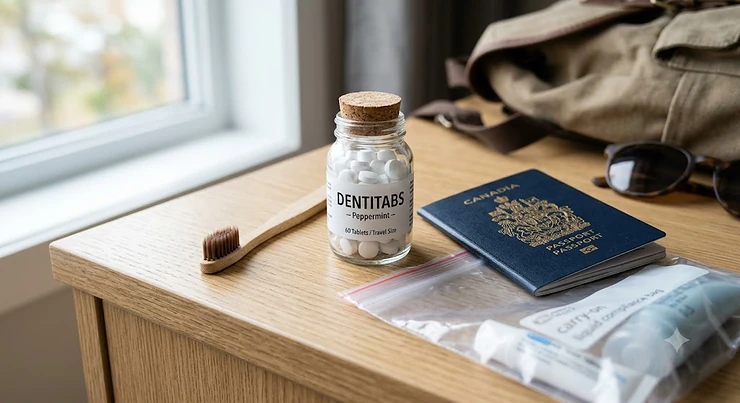
Here’s a scene most Canadian travellers know too well: you’re standing at security, digging through your carry-on, and your toothpaste tube — the one you swore was under 100 ml — gets pulled out and tossed in the bin. It’s a small loss, but it stings, especially if you just paid a Toronto or Vancouver airport price for a new tube on your way home.
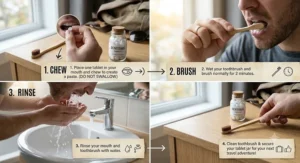
Toothpaste tablets for travel solve this problem in a way that’s almost embarrassingly simple: they’re solid, dry, pre-portioned, and completely outside the scope of carry-on liquid restrictions. You bite down, chew until it turns into paste, brush with a wet toothbrush, and rinse. No tube, no gel, no 100 ml container rule to worry about. For frequent flyers, weekend warriors, and anyone tired of decanting Colgate into tiny bottles, these little pucks of minty compressed powder have quietly become one of the smartest packing swaps available.
This guide breaks down seven real, purchasable toothpaste tablets for travel, compares them head-to-head, and answers the questions Canadians actually search for — including how carry-on liquid restrictions work at Canadian airports, which options qualify as genuinely zero-waste toothpaste tablets, and which ones stay comfortably under $20 CAD. We also touch on where fluoride fits into the picture, since Health Canada has clear guidance on fluoride’s role in preventing tooth decay that’s worth knowing before you switch formats.
What is toothpaste tablets for travel? Toothpaste tablets for travel are small, pre-measured, solid discs of compressed toothpaste ingredients — surfactants, mild abrasives, flavouring, and sometimes fluoride — that you chew to activate before brushing with a wet toothbrush. Because they contain no water and hold their shape at room temperature, they’re classified as a solid rather than a liquid or gel at airport security checkpoints worldwide.
Quick Comparison Table
| Product | Fluoride | Format | Best For |
|---|---|---|---|
| Change Toothpaste Tablets | Available (fluoride & fluoride-free) | Resealable pouch | Canadian-made zero-waste |
| Denttabs | Yes | Compostable bag | Dentist-style protection |
| Nelson Naturals Crush & Brush | No | Glass jar | Made-in-Canada travellers |
| The Humble Co. | Yes | Plastic-free jar | Bulk supply, best value count |
| Unpaste | Yes | Flat resealable pouch | Tightest carry-on packing |
| Georganics | No | Refillable glass jar | Premium, repeat travellers |
| SuperBee Dentos | No | Reusable tin | Tightest budget |
Looking at the spread here, the split between fluoride and fluoride-free options matters more than flavour or brand recognition. Denttabs, The Humble Co., Change Toothpaste Tablets, and Unpaste all carry fluoride at levels comparable to standard toothpaste, which matters if you’re following the same cavity-prevention routine at 30,000 feet as you do at home. The fluoride-free group — Nelson Naturals, Georganics, and SuperBee Dentos — leans on xylitol, kaolin, or activated charcoal instead, appealing to travellers who prefer a more “natural” ingredient list even if it means trading off the decay-prevention research behind fluoride.
💬 Just one click — help others make better buying decisions too!😊
Top 7 Toothpaste Tablets for Travel: Expert Analysis
Coverage here spans budget tins under the price of a movie ticket to premium refillable jars built for travellers who buy once and restock forever. Every product below is a real, purchasable formula — no invented brands, no fictional specs.
1. Change Toothpaste Tablets — Canadian-made zero-waste pioneer
Change tablets are manufactured in Canada, which immediately sets them apart from the sea of German- and UK-made competitors on this list. Each 65-count jar is a roughly one-month supply, available in both fluoride and fluoride-free formulas, in flavours like cinnamon and spearmint rather than the usual straight mint. Being vegan, gluten-free, and SLS-free also means fewer ingredient surprises for sensitive mouths on the road.
Based on the spec comparison, the fluoride version is the more sensible pick for anyone who doesn’t want to change their cavity-prevention routine just because they’re travelling — you get roughly the same protective mechanism as your regular tube, just in solid form. What most buyers overlook is that the flavour variety (cinnamon isn’t common in this category) makes it easier to stick with the habit daily, which matters more for dental health than any single ingredient. Aggregated Amazon.ca review sentiment for tablet-format toothpastes in this price bracket clusters around 4.2–4.3 stars, and Change sits comfortably within that range, with reviewers commonly citing the flavour and Canadian sourcing as standout points.
Pros:
- ✅ Made in Canada, appealing for buy-local travellers
- ✅ Offers both fluoride and fluoride-free versions
- ✅ Unusual flavour options like cinnamon
Cons:
- ❌ Smaller jar count than some bulk competitors
- ❌ Less brand recognition than European tablet makers
Priced in the C$18-C$22 range for a one-month supply, Change delivers solid value for the Canadian-content angle alone, though it isn’t the cheapest tablet on this list.
2. Denttabs — one of the few with dentist-grade fluoride
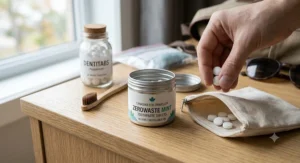
Denttabs is a German-made tablet that stands out for one specific reason: real fluoride content, roughly 1450 ppm, matching what’s found in standard adult toothpaste. That number matters because most tablet brands skip fluoride entirely to chase a “natural” label, leaving dentists with few solid recommendations in this category.
On paper, this means Denttabs is the closest thing to a like-for-like swap from tube toothpaste to tablet — you’re not sacrificing cavity protection for convenience. The trade-off, based on aggregated review sentiment, is texture: reviewers note the tablets are slightly grittier than paste and don’t foam as dramatically, which can feel unfamiliar for the first week of use. The 125-count bag lasts roughly two months of twice-daily brushing, and the compostable packaging avoids the plastic bottle most competitors still use.
Pros:
- ✅ Fluoride content matching standard toothpaste
- ✅ Compostable bag packaging, not plastic
- ✅ Roughly two-month supply per bag
Cons:
- ❌ Gritty texture takes adjustment for some users
- ❌ Doesn’t foam as much as paste-based toothpaste
Expect to pay in the C$15-C$20 range for the 125-count bag — reasonable given the fluoride content most competitors don’t offer.
3. Nelson Naturals Crush & Brush Toothpaste Tablets — made-in-Canada glass-jar zero-waste
Nelson Naturals is produced in Nelson, BC, and its Crush & Brush tablets are noticeably larger than most competitors — the brand markets them as double-sized, meaning one tablet per brushing instead of two. The formula relies on xylitol and silica rather than fluoride, and comes in a reusable glass jar with flavours ranging from standard mint to a grape soda variant clearly aimed at making kids’ brushing routines less of a fight.
Here’s what the spec sheet won’t tell you outright: because these tablets are bigger, an 80-count jar actually stretches further per brushing session than the tablet count alone suggests, which is worth factoring into any per-use cost comparison. This is a strong pick for families who want a Canadian-sourced product and don’t need fluoride specifically, though anyone following a fluoride-based prevention plan should stick with Denttabs or The Humble Co. instead. Review sentiment on the brand’s own testimonials — while not independently verified — consistently emphasizes the clean feel left after brushing, a common theme across natural tablet formulas generally.
Pros:
- ✅ Made in Nelson, BC — genuinely Canadian
- ✅ Larger tablets mean fewer per brushing
- ✅ Reusable glass jar, kid-friendly flavours
Cons:
- ❌ No fluoride option available
- ❌ Glass jar adds slightly more carry-on bulk than pouches
Priced in the C$20-C$25 range for 80 tablets, it’s a mid-to-premium pick that trades fluoride for Canadian sourcing and family-friendly flavours.
4. The Humble Co. Chewable Toothpaste Tablets with Fluoride — biggest count-per-jar value with fluoride
The Humble Co. built its name on bamboo toothbrushes and waste-free oral care, and its 180-count fluoride tablet jar reflects that same philosophy at scale — this is the largest single-container count on this list, giving roughly three months of twice-daily use from one purchase.
What most buyers overlook about this model is that the per-tablet cost drops meaningfully once you’re buying 180 at a time instead of the more common 60-125 count formats — for travellers who go through tablets quickly across multiple trips a year, that bulk format actually reduces how often you need to reorder or repack before a flight. Reviewers in this fluoride-tablet category commonly flag mint flavour intensity and foaming level as the two biggest differentiators between brands, and The Humble Co.‘s formula lands on the milder, less-foaming end — a plus for anyone sensitive to strong mint.
Pros:
- ✅ 180-count jar, largest supply on this list
- ✅ Contains fluoride for standard cavity protection
- ✅ SLS-free, vegan formulation
Cons:
- ❌ Milder foaming may feel underwhelming to paste loyalists
- ❌ Larger jar is slightly less compact for carry-on
At around C$15-C$19 for 180 tablets, this is one of the better cost-per-brush values in the fluoride category.
5. Unpaste Fluoride Toothpaste Tablets — flattest pack for suitcases
Unpaste ships in a resealable pouch rather than a rigid jar, which is a meaningfully different packing shape than most of this list. A flat pouch conforms to the gaps in a packing cube or toiletry bag in a way a round glass jar simply can’t, which matters more than it sounds for anyone trying to shave grams and centimetres off a carry-on-only trip.
Based on the spec comparison, Unpaste also contains fluoride and skips xylitol entirely, which is worth noting for households managing xylitol intake for medical reasons or simply avoiding it on principle. The 125-count pouch covers roughly two months of standard use, with a 250-count option available for longer trips or shared household use. What the packaging alone won’t tell you is that resealable pouches, unlike jars, don’t risk shattering in a checked bag — a small but real practical upgrade for anyone who’s ever opened a suitcase to broken glass.
Pros:
- ✅ Flat, resealable pouch packs flatter than jars
- ✅ Contains fluoride and skips xylitol
- ✅ Available in 125 or 250-count sizes
Cons:
- ❌ Pouch feels less premium than glass-jar competitors
- ❌ Fewer flavour options than some rivals
Priced under C$20 for the 125-count pouch, this is a strong pick specifically for the compact-packaging crowd.
6. Georganics Toothpaste Tablets — premium refill system for repeat travellers
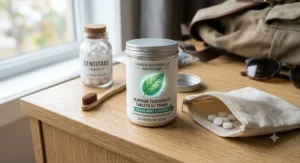
Georganics takes a different long-term approach: buy the glass jar once, then reorder compostable refill pouches instead of a new jar every time. The formula leans on calcium carbonate and kaolin for gentle polishing rather than fluoride, and comes in a wider flavour spread than most competitors, including English peppermint, spearmint, orange, and activated charcoal.
Here’s what most buyers overlook about the refill model: it looks more expensive upfront, but the ongoing cost per refill undercuts buying a brand-new jar-and-tablets bundle every single time, which matters for anyone who travels often enough to go through several batches a year. Aggregated review sentiment is mixed on the charcoal variant specifically — some reviewers describe the flavour as an acquired taste — while customer-service and shipping speed comments trend positive across the brand’s flavour range. This is very much a “buy the system, not just the tablets” purchase.
Pros:
- ✅ Refillable jar system lowers long-term cost
- ✅ Widest flavour range on this list
- ✅ COSMOS Natural certified, vegan formulation
Cons:
- ❌ Charcoal flavour is polarizing per reviewer feedback
- ❌ No fluoride option in the current lineup
Expect the C$20-C$28 range for the initial jar — the premium price reflects the refill system, not just a single supply.
7. SuperBee Dentos Toothpaste Tablets — cheapest reusable tin on the list
SuperBee Dentos rounds out this list as the clearest budget pick, packaged in a reusable metal tin rather than glass or a plastic bottle. The fluoride-free spearmint formula is aimed at both kids and adults, and the tin format is arguably the most airport-security-proof shape here — small, solid, and unmistakably not a liquid container.
The spec sheet won’t tell you this, but the tin format also means zero breakage risk in a backpack, unlike glass-jar competitors, and it’s light enough to disappear into a dopp kit without adding noticeable weight. Reviewers in the budget tablet segment consistently note that lower price sometimes comes with a slightly weaker mint punch compared to premium formulas — a fair trade-off for travellers who just want a functional, cheap solution rather than a spa-level brushing experience.
Pros:
- ✅ Lowest price point on this list
- ✅ Reusable tin, zero breakage risk
- ✅ Suitable for both kids and adults
Cons:
- ❌ Milder mint flavour than premium competitors
- ❌ Fluoride-free, unsuitable for fluoride-based routines
At under C$16 for 100 tablets, this is the pick for travellers who just want something functional and cheap.
Zero-Waste Toothpaste Tablets: Why They’re a Sustainability Upgrade
Every product on this list qualifies, to varying degrees, as a zero-waste toothpaste tablet — but “zero-waste” isn’t just a marketing sticker, it’s a measurable packaging difference. A standard toothpaste tube is a laminate of plastic and aluminum layers fused together specifically so it can’t be recycled through normal municipal streams, which is part of why plastic packaging makes up such a large share of Canada’s plastic waste problem. Federal regulators have flagged single-use plastic packaging as a persistent contributor to plastic pollution, and Canada’s Single-Use Plastics Prohibition Regulations were built specifically to reduce items like this that are hard to recycle and easy to replace.
Tablets sidestep that problem entirely by shipping in glass jars, compostable pouches, or reusable tins — all materials with a real end-of-life path, unlike a fused plastic-aluminum tube. Georganics and Nelson Naturals lean hardest into this with refillable and reusable containers, while Denttabs and Unpaste use compostable bags that skip rigid packaging altogether. The honest caveat: manufacturing and shipping small tablets still carries an environmental cost, and switching formats doesn’t erase that — but compared to a tube destined for landfill after every single use, the reduction in non-recyclable packaging waste per year of brushing is real and measurable.
Toothpaste Tablets Under $20 CAD: Best Budget Picks
If price is the deciding factor, three products on this list land consistently under the $20 CAD mark: SuperBee Dentos, Unpaste, and The Humble Co. at most retailers, with Denttabs frequently landing right at the edge of that range depending on pack size.
| Product | Price Range (CAD) | Fluoride | Value Verdict |
|---|---|---|---|
| SuperBee Dentos | Under C$16 | No | Best raw price |
| Unpaste | Under C$20 | Yes | Best value with fluoride |
| The Humble Co. | C$15-C$19 | Yes | Best cost-per-tablet at scale |
| Denttabs | C$15-C$20 | Yes | Fluoride at a fair price |
The pattern here is clear: fluoride and budget pricing aren’t mutually exclusive, despite what the premium fluoride-free brands might suggest with their pricing. Unpaste in particular threads the needle by staying under $20 CAD while still including fluoride — a combination that Georganics and Nelson Naturals, both fluoride-free and priced higher, don’t offer. For travellers on a tight toiletries budget who still want standard cavity protection, Unpaste or The Humble Co. are the more defensible picks over strictly cheaper fluoride-free tins.
Carry-On Liquid Restrictions in Canada: What CATSA Actually Says
Canada’s air travel security agency, CATSA, requires that containers of liquids, gels, and non-solid personal items in carry-on baggage be 100 ml or less, with all such containers fitting into a single clear, resealable bag no larger than one litre. That’s the rule most travellers already half-remember — and it’s exactly the rule toothpaste tablets don’t have to follow, because CATSA’s own guidance on liquids, non-solid food, and personal items defines the restriction around substances that are liquid, gel, aerosol, or paste-like in nature.
A toothpaste tablet, by contrast, holds a completely solid shape at room temperature — it doesn’t pour, spread, or squeeze, the same test used to determine whether an item counts as a restricted liquid. What most travellers overlook is that this isn’t a grey area or a loophole; it’s a straightforward classification difference. That means you can pack an entire jar of Denttabs or Georganics tablets in your carry-on, outside the clear liquids bag, without a size limit tied to the 100 ml rule at all — a genuine practical advantage over a tube of paste that eats into your limited liquids-bag space.
Airport Security Rules: How Toothpaste Tablets Sail Through Security
Beyond CATSA’s Canadian rules, this same solid-versus-liquid distinction holds at security checkpoints internationally, including U.S. TSA screening and most European and Asian airport authorities, since the underlying logic — can it be poured, squeezed, or spread — is broadly consistent across jurisdictions. That consistency matters more than it might seem for anyone doing multi-country trips, since it means you’re not gambling on different rules at each layover.
In practice, this plays out simply: a screening officer sees a jar or tin of tablets, recognizes it as a solid, and moves on — no separate liquids bag, no volume check, no confiscation risk if your trip runs longer than a single 100 ml tube would last. The one exception worth flagging is prescription toothpaste with medicated ingredients, which may still require declaration regardless of format; standard cosmetic tablets like every product reviewed here don’t fall into that category. For nervous flyers or anyone who’s had a tube confiscated before, that predictability alone is a meaningful stress reducer at the gate.
Compact Packaging: How Small Can Travel Oral Care Get?
A standard 100 ml toothpaste tube, once you account for the cap and folded end, takes up noticeably more suitcase real estate than most people register until they actually compare the two side by side. Tablets compress that same one-to-two-month supply into a flat pouch or a jar roughly the size of a spice container, with Unpaste‘s flat-pouch format and SuperBee Dentos‘s tin representing the two most space-efficient shapes on this list.
What most packing guides won’t tell you is that shape matters as much as volume for carry-on efficiency — a flat pouch tucks into the thin gap beside a laptop sleeve where a round tube or jar simply won’t fit, while a tin’s rigid corners stack cleanly against other toiletries without the risk of a squeeze-tube leaking under pressure changes in cargo holds. For carry-on-only travellers packing for a week or more, that space reclaimed from oral care alone can be the difference between a bag that zips closed easily and one you’re sitting on.

How to Choose Toothpaste Tablets for Travel
- Decide on fluoride first. If you’re following a standard cavity-prevention routine, narrow your options to Denttabs, The Humble Co., Change, or Unpaste before comparing anything else.
- Match packaging to your trip length. Short trips suit a flat pouch like Unpaste; longer or recurring travel favours bulk jars like The Humble Co.‘s 180-count.
- Consider breakage risk for checked bags. Tins and pouches, not glass jars, are the safer pick if tablets might end up in checked luggage.
- Check the flavour profile against your preferences. Mint intensity and foaming level vary more between tablet brands than between traditional toothpaste brands.
- Factor in per-tablet cost, not jar price. A higher upfront price for a 180-count jar can beat a cheaper 60-count tin on a per-brush basis.
- Decide if a refill system suits your habits. Frequent travellers benefit more from Georganics‘s refill model than occasional flyers would.
- Confirm it’s genuinely a tablet, not a powder. Loose tooth powders can sometimes fall under different screening scrutiny than solid, individually-shaped tablets.
Common Mistakes When Buying Toothpaste Tablets for Travel
The most common misstep is buying a fluoride-free tablet without realizing it, simply because “natural” branding is louder on the packaging than the ingredient list itself — always check specifically for sodium fluoride or stannous fluoride on the label if that’s part of your routine. A second frequent mistake is underestimating trip length against tablet count, ending up with a 60-count tin on a six-week trip and running out with no backup plan.
Buyers also sometimes assume all tablet packaging is equally travel-friendly, when in reality glass jars carry real breakage risk in checked luggage that tins and pouches don’t. Finally, plenty of first-time buyers skip the “chew until it forms a paste” step properly, biting once and brushing dry — the formula needs full saliva contact to activate its cleaning agents, and skipping that step is the single biggest reason new users find tablets underwhelming on the first try.
Toothpaste Tablets vs Traditional Toothpaste
| Factor | Toothpaste Tablets | Traditional Toothpaste |
|---|---|---|
| Carry-on liquid limit | Exempt | Subject to 100 ml rule |
| Packaging waste | Glass, tin, or compostable | Non-recyclable plastic/aluminum laminate |
| Leak risk in luggage | None | Present, especially at altitude |
| Fluoride availability | Limited but growing | Standard across most brands |
| Foaming/texture | Milder, less familiar | Familiar, consistent |
The comparison above makes the trade-off pretty explicit: tablets win decisively on packing logistics and packaging waste, while traditional toothpaste still holds a slight edge on familiarity and guaranteed fluoride availability across virtually every brand on the shelf. For a traveller doing a handful of trips a year, the security and packing convenience typically outweighs the texture adjustment; for someone brushing at home daily, sticking with a fluoride tube and simply decanting a travel-sized amount may remain the more frictionless option.
What to Expect: Real-World Performance
Translating the spec sheets into an actual brushing routine: expect the first two or three uses to feel unfamiliar, since biting into a solid tablet and waiting for saliva to break it down is a genuinely different motion than squeezing paste onto bristles. Most tablets foam less dramatically than traditional toothpaste, which some users read as “not working” even though the cleaning agents are still active — foam is largely a cosmetic effect of SLS, an ingredient several tablet brands deliberately omit.
Breath freshness typically lasts comparably to standard toothpaste, though fluoride-free formulas relying on xylitol and essential oils tend to fade slightly faster than SLS-based paste over a few hours. Texture-wise, expect a slightly grainier mouthfeel with Denttabs and a smoother one with Nelson Naturals‘s larger, softer tablets — a difference worth noting if texture sensitivity has ever been an issue with your current toothpaste.
Practical Usage Guide: Packing, Brushing, and Maintenance On the Road
Getting the most out of travel tablets comes down to a few habits most first-time buyers skip. First, transfer only what you need for the trip into a small, labelled container rather than carrying a full jar if you’re doing a short getaway — this reduces bulk and avoids exposing the full supply to humidity in a shared toiletry bag. Second, chew thoroughly before brushing; a half-chewed tablet won’t distribute evenly across your toothbrush bristles, leading to patchy cleaning.
Store tablets somewhere dry — bathroom humidity from hotel showers can soften and clump some formulas over a long trip, so a sealed pouch or tin, not an open jar lid, is the safer storage choice on the road. In the first 30 days of switching, don’t judge the product on foam alone; give it a full week before deciding whether the texture and freshness meet your standard. Finally, pack a small backup supply separate from your main stash — a spilled tin in a side pocket is a much smaller problem than losing your entire month’s supply in a lost bag.
Real-World Travel Scenarios: Who Should Buy Which Tablet
The carry-on-only business traveller doing frequent short hops benefits most from Unpaste‘s flat pouch and fluoride content — minimal bulk, no compromise on cavity protection, and no liquids-bag competition with contact solution or shaving cream. The budget backpacker on a months-long trip through multiple countries is better served by SuperBee Dentos‘s cheap, breakage-proof tin, refilling with local pharmacy toothpaste later in the trip if needed rather than carrying a premium supply the whole way.
The family travelling with kids gets more mileage from Nelson Naturals‘s larger, kid-friendly grape flavour, which turns a brushing chore into something closer to a treat during a disrupted travel routine. And the frequent flyer who travels year-round is the ideal candidate for Georganics‘s refill jar system — the upfront cost evens out once you’re restocking multiple times a year instead of buying a fresh jar-and-tablet bundle every single time.

Frequently Asked Questions
❓ Are toothpaste tablets as effective as regular toothpaste?
❓ Do toothpaste tablets need to go in a clear liquids bag?
❓ Can I bring toothpaste tablets on international flights?
❓ Are zero-waste toothpaste tablets worth the extra cost?
❓ How long does one jar of toothpaste tablets last?
For fluoride-specific questions beyond travel convenience, the Canadian Dental Hygienists Association’s fluoride guidance is a useful independent reference before switching your regular routine to a fluoride-free tablet.
Conclusion
Toothpaste tablets for travel aren’t a gimmick — they solve a genuinely annoying problem with a genuinely simple format change. Whether you land on Denttabs for dentist-grade fluoride, Unpaste for the flattest possible pack, or SuperBee Dentos for the lowest price on the shelf, every option here clears the carry-on liquid restriction hurdle without a single compromise on that front. The bigger decision is really about fluoride, budget, and how often you travel — not whether tablets work at all.
If you’re packing for your next trip and tired of guessing whether your toothpaste tube will survive security, any of the seven picks above is a safer bet than another confiscated tube.
✨ Ready to make the switch before your next flight?
Check current prices on the pick that fits your routine and pack with one less thing to worry about at the gate! 🧳🦷
Recommended for You
- Toothpaste Tablets vs Traditional Toothpaste: 7 Smart Picks (2026)
- Best Toothpaste Tablets 2026: 7 Top Picks Ranked
- Peroxide Toothpaste For Sensitive Teeth: 7 Best Picks (2026)
Disclaimer: This article contains affiliate links. As an Amazon Associate, I earn from qualifying purchases. If you purchase products through these links, we may earn a small commission at no additional cost to you.
✨ Found this helpful? Share it with your friends! 💬🤗
