In This Article
Here’s a sentence you’ve probably muttered through gritted teeth at some point: “Why does my morning coffee feel like a lightning bolt?” If a sip of anything hot, cold, or borderline sweet sends a jolt through your molars, you already know that not all toothpaste is created equal. The right baking soda toothpaste for sensitive teeth does two jobs at once — it gently buffers the acids that wear down enamel, and it works overtime to calm the exposed nerve endings underneath. That’s a tall order for a tube that costs less than a fancy coffee.

We dug into the real ingredient panels, the aggregated review sentiment, and the current Canadian retail landscape to shortlist seven baking soda formulas actually worth your bathroom shelf space. Some lean into fluoride and potassium nitrate for maximum desensitizing punch. Others go fluoride-free with arginine or calcium carbonate for a gentler, more “natural aisle” approach. All seven share one thing: real sodium bicarbonate doing real work, not just a marketing sticker on the box.
Along the way, we’ll also tackle three things Canadian shoppers ask constantly — whether baking soda toothpaste actually helps with plaque control, why some formulas leave gums feeling raw instead of relieved, and which desensitizing ingredients are backed by more than a hopeful label. Grab a coffee (carefully) and let’s get into it.
What Is Baking Soda Toothpaste for Sensitive Teeth?
Baking soda toothpaste for sensitive teeth is a dentifrice that combines sodium bicarbonate — a mild alkaline abrasive that neutralizes acid and lifts surface stains — with a desensitizing agent such as potassium nitrate, arginine, or stannous compounds that calm the nerve signals inside exposed dentin. In plain terms: the baking soda cleans and buffers, while the second ingredient does the actual pain-blocking.
That distinction matters more than most shoppers realize. Baking soda alone has been shown in clinical comparisons to remove more surface stains than toothpaste without it, but it isn’t a sensitivity treatment on its own — it’s the polish, not the painkiller. According to the Ontario Dental Association, sensitivity happens when enamel wears thin and exposes the dentin underneath, which is riddled with microscopic tubules leading straight to the tooth’s nerve. Hot coffee, cold ice cream, and sour candy all send a jolt down those tubules. A good baking soda toothpaste is basically trying to plug or numb that pathway while it cleans.
Sodium bicarbonate itself is a genuinely interesting compound chemically — it’s a weak base that reacts with acid to form water, carbon dioxide, and salt, which is exactly why it’s been a kitchen and bathroom staple for over a century (you can read more about its chemistry on Wikipedia). In a toothpaste tube, that mild alkalinity helps counteract the acidic environment created by plaque bacteria, which is part of why baking soda formulas show up so often in both sensitivity and plaque-control conversations.
Quick Comparison Table
| Product | Best For | Price Range (CAD) | Fluoride |
|---|---|---|---|
| Arm & Hammer Sensitive Teeth & Gums | Fastest budget relief | C$5–C$8 | Yes |
| Colgate Baking Soda and Peroxide Whitening | Plaque control under C$10 | C$4–C$7 | Yes |
| Arm & Hammer PeroxiCare | Gum health & plaque | C$6–C$9 | Yes |
| Arm & Hammer Complete Care Baking Soda & Peroxide | All-round whitening + sensitivity | C$5–C$8 | Yes |
| Tom’s of Maine Rapid Relief Sensitive | Fast fluoride-free relief | C$8–C$11 | No |
| Tom’s of Maine Baking Soda with Propolis & Myrrh | Gum irritation, natural formula | C$8–C$12 | No |
| Arm & Hammer 100% Natural Baking Soda | Everyday minimalist clean | C$5–C$8 | Yes |
Looking at the spread above, the budget lane is dominated by mainstream fluoride formulas from Arm & Hammer and Colgate, while the fluoride-free, “shorter ingredient list” crowd from Tom’s of Maine sits a little higher in price. If sensitivity relief speed is your top priority, the potassium-nitrate-based options — Arm & Hammer Sensitive Teeth & Gums and Tom’s of Maine Rapid Relief Sensitive — earn their spot at the top of this table for a reason.
💬 Just one click — help others make better buying decisions too!😊
Top 7 Baking Soda Toothpastes for Sensitive Teeth: Expert Analysis
1. Arm & Hammer Sensitive Teeth & Gums Toothpaste — fastest budget relief for cold and hot pain
This is the toothpaste most Canadian pharmacists point to first, and for good reason: it pairs actual baking soda with potassium nitrate and sodium fluoride in a low-abrasion formula built specifically for sensitivity, not as an afterthought bolted onto a whitening line.
The 5% potassium nitrate works by calming the nerve fibre inside the tooth over repeated use, while the sodium fluoride adds an anticavity layer most fluoride-free sensitivity pastes skip entirely. In practice, that combination means the low-abrasion baking soda base won’t scrub away what little enamel you have left, which matters if your sensitivity stems from erosion rather than just plaque buildup.
Based on the ingredient profile, this is the toothpaste for someone who wants pharmacy-grade sensitivity control without pharmacy-grade pricing — beginners to the “desensitizing toothpaste” category tend to start here, and dentists often recommend it as a first-line, no-prescription option. Reviewers consistently report noticeable improvement within two to four weeks of twice-daily use, though a smaller subset mention that relief plateaus if used inconsistently — which tracks, since potassium nitrate needs a build-up period to work.
Pros:
- ✅ Budget-friendly relief with real clinical-style ingredients
- ✅ Low-abrasion formula safe for already-thinned enamel
- ✅ Fluoride adds cavity protection sensitivity-only pastes lack
Cons:
- ❌ Relief builds over weeks, not instantly
- ❌ Mint flavour can feel intense for some users
At around C$5–C$8 depending on tube size and retailer promotions, this sits comfortably in the “grab two and don’t think twice” price bracket — genuinely one of the best value entries on this whole list.
2. Colgate Baking Soda and Peroxide Whitening Toothpaste — best oxygen-bubble plaque scrub under C$10 CAD
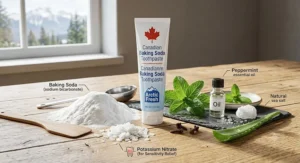
If your priority tilts more toward plaque and surface stains than acute nerve pain, this is where Colgate earns its spot. The formula pairs sodium bicarbonate with calcium peroxide, which releases small oxygen bubbles as you brush.
That fizzing sensation isn’t just theatre — the combined mechanical and chemical action helps lift surface staining and disrupt the sticky biofilm where plaque bacteria set up shop. What most buyers overlook here is that this isn’t marketed or formulated as a dedicated sensitivity toothpaste; it contains standard sodium monofluorophosphate for cavity protection but no potassium nitrate or arginine, so it’s better framed as a “plaque and whitening” pick that happens to be gentle enough for mild sensitivity, rather than a heavy-duty desensitizer.
Aggregated review sentiment skews positive on the fresh, “just left the dentist” feeling and stain removal, with a recurring complaint about the taste being harsher than Colgate’s non-baking-soda lines. For someone whose main complaint is a dull ache rather than sharp cold-water pain, and who wants brighter teeth without paying extra for a specialty tube, this is a smart everyday pick.
Pros:
- ✅ Genuinely effective at lifting surface stains
- ✅ Reliably priced under C$10 CAD at most retailers
- ✅ Familiar, trusted brand with wide availability
Cons:
- ❌ No dedicated desensitizing ingredient like potassium nitrate
- ❌ Brisk mint flavour reads as strong to some users
Expect to pay in the C$4–C$7 range for a standard tube, which makes it one of the cheapest ways to get real baking soda plaque control into your routine.
3. Arm & Hammer PeroxiCare Baking Soda & Peroxide Toothpaste — best for gum health and plaque control
PeroxiCare leans harder into gum health than any other product on this list, combining baking soda with sodium carbonate peroxide in a patented formula built to release tiny oxygen bubbles that reach between teeth and along the gumline.
Here’s the real-world meaning of that spec sheet: the oxygenating action is designed to disrupt anaerobic bacteria — the kind that thrive in low-oxygen pockets along the gumline and contribute to gingivitis. Paired with 0.24% sodium fluoride, this formula does double duty as a cavity fighter and a gum-focused plaque control toothpaste. It’s not marketed for sensitivity specifically, so someone whose main issue is sharp nerve pain should pair it with a dedicated desensitizing routine rather than expecting it to carry that job alone.
User reports consistently mention fresher-feeling gums and less visible tartar buildup between cleanings, which lines up with the ingredient rationale. A smaller but recurring theme in aggregated feedback is that the foaming, slightly fizzy texture takes some getting used to compared to standard pastes.
Pros:
- ✅ Targets gumline bacteria, not just tooth surfaces
- ✅ Fluoride protection layered on top of baking soda cleaning
- ✅ Strong reputation specifically for gum health maintenance
Cons:
- ❌ Fizzy oxygen-bubble texture isn’t for everyone
- ❌ Not formulated as a dedicated sensitivity toothpaste
Priced around C$6–C$9 CAD, it sits mid-pack — a reasonable premium over the most basic Arm & Hammer line for the added gum-health angle.
4. Arm & Hammer Complete Care Baking Soda & Peroxide Whitening Toothpaste — best all-rounder for whitening plus sensitivity
Complete Care is Arm & Hammer’s “why choose” answer, combining baking soda, sodium carbonate peroxide, and 0.24% sodium fluoride into one whole-mouth formula that markets itself on whitening, plaque removal, tartar control, and fresh breath simultaneously.
What that combination means in practice is a low-abrasion base that won’t aggressively wear enamel — a real concern with some whitening toothpastes — while the peroxide component works on surface stains and the fluoride keeps cavity protection in the mix. It’s not billed as a dedicated sensitivity formula the way the Sensitive Teeth & Gums line is, but the same gentle-on-enamel philosophy makes it a safer everyday whitening option for people whose sensitivity is mild rather than severe.
Reviewers frequently describe it as their long-term “default” toothpaste rather than a specialty purchase, which tracks with its positioning as an all-in-one rather than a targeted treatment. A common thread in feedback is that people expecting dramatic whitening results in days are disappointed — this is a maintenance formula, not a whitening treatment.
Pros:
- ✅ Balances whitening, plaque control, and fluoride protection
- ✅ Low-abrasion baking soda base is gentle on worn enamel
- ✅ Widely available in both gel and paste formats
Cons:
- ❌ Whitening results are gradual, not dramatic
- ❌ Lacks a dedicated desensitizing ingredient like potassium nitrate
At roughly C$5–C$8 CAD per tube, it’s an easy pick for anyone who wants one toothpaste to cover most bases without paying specialty prices.
5. Tom’s of Maine Rapid Relief Sensitive Toothpaste — best fluoride-free pick for fast nerve relief
Tom’s of Maine takes a different chemical route entirely. Instead of potassium nitrate, Rapid Relief pairs arginine and calcium carbonate with sodium bicarbonate to physically seal the dentinal tubules that carry pain signals to the nerve, rather than sedating the nerve chemically.
The practical difference matters: arginine-calcium carbonate technology is designed to build a protective plug at the tubule opening within about a minute of direct application, which is where the “rapid relief” claim comes from. Because it’s fluoride-free, it appeals heavily to buyers who specifically avoid fluoride, whether for personal preference or because they’re managing fluorosis concerns for older household members. Based on the spec comparison with the fluoride-containing options on this list, this formula trades cavity-fighting fluoride for a faster-acting, more direct approach to blocking pain pathways.
Aggregated customer sentiment is notably strong on the “brush directly onto the sore tooth” application method actually delivering fast comfort, with the most common complaint being that without fluoride, some users feel they need a separate cavity-protection toothpaste in rotation.
Pros:
- ✅ Arginine technology targets the pain pathway directly
- ✅ Fluoride-free formula for those avoiding it
- ✅ No artificial preservatives, colours, or flavours
Cons:
- ❌ No fluoride means no built-in cavity protection
- ❌ Priced higher than the mainstream drugstore options
Expect roughly C$8–C$11 CAD, a step up from the drugstore standards but justified for shoppers specifically shopping the natural aisle.

6. Tom’s of Maine Baking Soda with Propolis & Myrrh Toothpaste — best natural pick for irritated gums
This is the toothpaste to reach for when gum irritation, not just tooth sensitivity, is the real complaint. It combines baking soda with propolis and myrrh — two ingredients with a long history in traditional oral care for soothing inflamed tissue — alongside xylitol for added antibacterial support.
Here’s what the label doesn’t spell out: propolis and myrrh are included specifically for their traditional gum-soothing reputation rather than as clinically dosed active drugs, so this formula reads more as a gentle, tartar-preventing daily paste than an aggressive medicinal treatment. The fluoride-free, SLS-free formulation is worth flagging for anyone whose gum irritation might actually be linked to a harsh surfactant in their current toothpaste rather than sensitivity itself — more on that connection in the gum irritation section below.
Review sentiment consistently highlights the noticeably gentler brushing experience compared to foaming, SLS-heavy competitors, with fewer complaints about that raspy, “just brushed too hard” feeling some sensitive-gum users describe. The trade-off reviewers mention most is a milder foam and less dramatic whitening compared to the peroxide-based options above.
Pros:
- ✅ Propolis and myrrh support traditionally soothing gum care
- ✅ SLS-free formula reduces one common irritation trigger
- ✅ Xylitol adds antibacterial, cavity-fighting support
Cons:
- ❌ Milder foaming action than mainstream formulas
- ❌ Premium pricing compared to drugstore baking soda pastes
At approximately C$8–C$12 CAD, it’s priced for the natural-care shopper who’s willing to spend a little more for a gentler daily routine.
7. Arm & Hammer 100% Natural Baking Soda Toothpaste — best minimalist natural everyday formula
Rounding out the list is Arm & Hammer’s answer to the “natural but still effective” crowd. This formula puts baking soda front and centre as the primary cleaning agent, supported by calcium carbonate and a standard dose of sodium fluoride for cavity protection.
The brand’s own clinical claims note that its baking soda toothpastes can remove up to five times more plaque in hard-to-reach areas compared to non-baking-soda formulas, and while that figure comes from the manufacturer rather than independent third-party testing, it lines up with the broader dental literature on baking soda’s mechanical stain- and plaque-lifting properties. What that means day-to-day is a toothpaste that leans on baking soda’s natural abrasive-and-buffering action rather than heavy chemical additives, while still keeping fluoride in the mix for anyone unwilling to give that protection up.
Reviewers frequently describe the taste as “cleaner” and less artificially sweet than mainstream mint pastes, with a smaller group noting the salty undertone from the baking soda takes some adjustment. It’s a solid middle-ground pick for someone who likes the idea of a “natural” toothpaste but isn’t ready to give up fluoride entirely.
Pros:
- ✅ Simple formula with baking soda as the star ingredient
- ✅ Keeps fluoride for cavity protection unlike fully natural lines
- ✅ Noticeably less artificial taste profile
Cons:
- ❌ Salty baking soda taste isn’t for everyone
- ❌ Not formulated specifically for acute sensitivity relief
Pricing typically lands around C$5–C$8 CAD, making it another easy entry point for testing whether a baking-soda-forward formula suits your routine.
How to Choose Baking Soda Toothpaste for Sensitive Teeth
Picking the right tube isn’t about grabbing whatever has “sensitive” printed in the biggest font. Work through these criteria in order and you’ll land on the right pick faster than reading forty review pages.
- Identify your actual trigger. Cold-air winces point toward exposed dentin; sharp pain when biting down suggests a cracked tooth or cavity that needs a dentist, not a toothpaste.
- Check for a named desensitizing agent. Potassium nitrate, arginine, or stannous fluoride should appear on the ingredient list — “sensitive” on the front label with none of these behind it is a marketing claim, not a mechanism.
- Decide on fluoride or fluoride-free. Fluoride adds cavity protection most desensitizing pastes benefit from; fluoride-free formulas rely more heavily on physical tubule-sealing ingredients like arginine.
- Match abrasiveness to your enamel condition. If erosion caused your sensitivity in the first place, a low-abrasion formula protects what enamel remains rather than wearing it down further.
- Factor in SLS sensitivity. If you’re prone to canker sores or find foaming toothpaste irritating, look toward SLS-free formulas rather than assuming all “gentle” claims are equal.
- Budget for consistency, not a single tube. Most desensitizing ingredients need two to four weeks of twice-daily use to show results, so price per month matters more than price per tube.
- Confirm it carries recognized dental association endorsement where possible, since that signals the manufacturer’s claims have been independently reviewed rather than self-certified.
Desensitizing Ingredients Explained: What Actually Calms Nerve Pain
“Desensitizing” gets slapped on a lot of packaging, but only a handful of ingredients actually have a documented mechanism behind that word. Potassium nitrate is the most established: it diffuses through the dentinal tubules and reduces the excitability of the nerve fibre itself, which is why it needs repeated use to reach full effect rather than working instantly. Arginine and calcium carbonate take a more mechanical route, forming a physical plug at the tubule opening that blocks the fluid movement responsible for pain — this is the theory behind Tom’s Rapid Relief’s fast-acting claim.
Stannous fluoride, while not the headline ingredient in most of the pastes on this list, deserves a mention because it does double duty: it protects against cavities while also helping occlude tubules over time. What most shoppers overlook is that baking soda itself isn’t a desensitizing ingredient at all — it’s the cleaning and buffering agent, working alongside whichever pain-blocking ingredient the formula actually contains.
According to the Ontario Dental Association, persistent sensitivity that doesn’t improve after a few weeks of consistent desensitizing toothpaste use can be a sign of a more serious underlying issue, including gum recession or early decay — which is exactly why the association recommends telling your dentist about ongoing sensitivity rather than treating toothpaste as a permanent workaround.
Baking Soda Toothpaste for Plaque Control
Plaque control and sensitivity relief aren’t the same job, even though they often show up on the same tube. Baking soda’s role in plaque control comes down to two mechanisms: its mild alkalinity helps neutralize the acidic byproducts plaque bacteria produce, and its gentle abrasive texture physically disrupts the sticky biofilm before it hardens into tartar.
Among the seven products above, Arm & Hammer PeroxiCare and Colgate Baking Soda and Peroxide Whitening lean hardest into this use case, both pairing baking soda with a peroxide component specifically to target plaque along the gumline and between teeth. Based on the spec comparison, the added peroxide is doing meaningfully more plaque-disrupting work than baking soda alone would — which is why a straight sensitivity formula like Tom’s of Maine Rapid Relief Sensitive isn’t the strongest plaque-control pick on this list, even though it excels at its actual job.
Here’s what most drugstore shelf tags don’t explain: plaque control is a long-game metric. A single brushing with any baking soda formula won’t visibly change your gumline; it’s the twice-daily, weeks-to-months habit that determines whether tartar buildup slows down. If plaque control is your primary goal rather than sensitivity, prioritize formulas with an added peroxide or antibacterial component over a straight desensitizing agent.
Understanding Gum Irritation: Causes and How Your Toothpaste Plays a Role
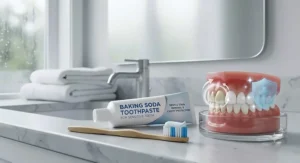
Gum irritation and tooth sensitivity get lumped together constantly, but they’re often driven by different culprits — and sometimes, the toothpaste itself is part of the problem rather than the solution. A recurring theme in the oral care literature centres on sodium lauryl sulfate (SLS), the foaming agent in most mainstream toothpastes. A peer-reviewed literature review found that while SLS improves plaque control and foam sensation for many users, it can also act as a risk factor for prolonged oral wound healing and recurrent aphthous ulcers in people prone to them.
What that means practically: if your gums feel raw, stinging, or unusually tender after brushing — separate from the classic cold-drink zing of tooth sensitivity — your toothpaste’s surfactant, not its baking soda content, may be the trigger. This is exactly why Tom’s of Maine Baking Soda with Propolis & Myrrh earns its “gentle on gums” reputation: it’s formulated without SLS, removing one of the most commonly cited irritation triggers while keeping baking soda’s cleaning benefits intact.
Gum irritation can also stem from brushing too hard, using a hard-bristled brush, or early-stage gum disease unrelated to any toothpaste ingredient at all. If switching to an SLS-free, baking soda formula doesn’t calm ongoing irritation within a couple of weeks, that’s a signal to loop in a dentist rather than keep cycling through toothpaste tubes.
Baking Soda Toothpaste Under C$10 CAD: Best Value Picks
Good news for budget-conscious brushers: most of the effective options here don’t require premium pricing. Four of the seven products land comfortably under C$10 CAD at most Canadian retailers, and none of them sacrifice a real desensitizing or plaque-fighting mechanism to hit that price point.
| Product | Typical Price Range (CAD) | Core Strength |
|---|---|---|
| Colgate Baking Soda and Peroxide Whitening | C$4–C$7 | Plaque and stain removal |
| Arm & Hammer Sensitive Teeth & Gums | C$5–C$8 | Fast sensitivity relief |
| Arm & Hammer Complete Care Baking Soda & Peroxide | C$5–C$8 | All-round whitening + protection |
| Arm & Hammer 100% Natural Baking Soda | C$5–C$8 | Minimalist natural clean |
Interpreting the table above: the under-C$10 CAD tier isn’t a compromise tier — Arm & Hammer Sensitive Teeth & Gums genuinely competes with pricier specialty pastes on desensitizing performance, it’s simply sold at mainstream drugstore margins rather than natural-aisle markups. The premium formulas from Tom’s of Maine cost more largely because they’re fluoride-free and use costlier natural actives like arginine, propolis, and myrrh — not because the budget options are formulated with less care.
For anyone stretching a household budget across multiple family members’ oral care, buying two tubes of a proven under-C$10 formula outlasts a single premium tube at a similar total cost, while covering more bathrooms in the house.
Practical Usage Guide: Getting Real Results in the First 30 Days
Buying the right tube is half the job — using it correctly determines whether you actually feel a difference. Here’s how to set yourself up properly.
Week one: Apply a pea-sized amount and brush gently for a full two minutes, twice daily. If you’re using an arginine-based formula like Tom’s Rapid Relief, apply a small amount directly to the specific sensitive tooth with a clean fingertip first, massage for about a minute, then brush normally — this targets the tubule-sealing action right where you need it most.
Weeks two through four: This is when potassium-nitrate-based formulas typically start showing measurable improvement, since the ingredient needs to build up in the nerve tissue. Don’t switch products prematurely just because week one didn’t feel dramatically different — that’s normal, not a sign of a bad pick.
Common first-30-days mistakes: Brushing too aggressively in an attempt to “scrub away” sensitivity actually worsens enamel wear and gum recession, compounding the original problem. Rinsing immediately and thoroughly after brushing also washes away the thin protective layer these formulas are trying to build — a quick spit without a big water rinse lets the active ingredients keep working.
Maintenance beyond month one: Once sensitivity improves, most dentists recommend staying on a desensitizing formula indefinitely rather than switching back to a standard toothpaste, since the underlying enamel or gum condition that caused sensitivity in the first place usually hasn’t reversed — you’ve just managed the symptom.
Real-World Scenarios: Which Pick Fits Your Life
The ice-water flincher on a budget. You’re a university student living on a tight grocery-and-textbooks budget, and an accidentally-too-cold water bottle sip makes you audibly gasp in the library. Arm & Hammer Sensitive Teeth & Gums is the obvious pick here — proven potassium nitrate relief at a price that survives a student budget, with fluoride thrown in since you’re probably not flossing as religiously as you should be.
The natural-aisle shopper with gum sensitivity. You’ve read the ingredient panels on your current toothpaste and didn’t love what you found, and your gums have felt tender and reactive lately rather than just your teeth. Tom’s of Maine Baking Soda with Propolis & Myrrh fits this profile precisely — SLS-free, fluoride-free if that’s a priority, and formulated around traditionally soothing actives rather than foaming detergents.
The parent managing a whole household’s oral care. You’re buying toothpaste for multiple family members with varying needs — one teenager obsessed with whiter teeth, one partner with mild sensitivity, and a budget that has to stretch. Arm & Hammer Complete Care Baking Soda & Peroxide works as the household default: gentle enough for mild sensitivity, whitening enough to satisfy the teenager, and priced low enough that buying it in bulk doesn’t hurt.
Common Mistakes When Buying Baking Soda Toothpaste for Sensitive Teeth
The biggest mistake is trusting the word “sensitive” on the box without checking for an actual named active ingredient behind it — plenty of formulas use the word as a soft, gentle-flavour marketing cue rather than a clinical claim. A close second is assuming fluoride-free automatically means gentler; fluoride-free formulas can still contain SLS and other potentially irritating surfactants, so gum irritation isn’t solved by fluoride-free alone.
Buyers also frequently underestimate how long desensitizing ingredients take to work, abandoning a genuinely effective product after a few days because they expected instant relief. On the flip side, some shoppers over-brush with a stiff-bristled toothbrush thinking more scrubbing equals more cleaning, which actively worsens the enamel erosion and gum recession that caused sensitivity in the first place. Finally, don’t assume a higher price tag guarantees a stronger desensitizing effect — as this comparison shows, some of the most clinically grounded formulas sit at the cheapest end of the shelf.
Baking Soda Toothpaste vs Regular Fluoride Toothpaste
The difference isn’t as simple as “baking soda good, regular bad.” Standard fluoride toothpastes typically use hydrated silica as their primary abrasive and cleaning agent, which is engineered specifically for consistent, gentle polishing without the alkaline buffering action baking soda provides. Baking soda toothpaste adds that acid-neutralizing property on top of standard cleaning, which is where its plaque and staining advantages come from.
| Factor | Baking Soda Toothpaste | Regular Fluoride Toothpaste |
|---|---|---|
| Acid neutralization | Yes, mild alkaline buffering | Minimal to none |
| Stain and plaque lifting | Generally stronger | Standard, silica-based |
| Taste profile | Salty, distinctive | Neutral, sweetened mint |
| Availability of sensitivity formulas | Strong (5 of 7 picks here) | Also widely available |
Interpreting this comparison: baking soda’s real advantage is in the acid-neutralizing, plaque-disrupting department, not in some inherent superiority for sensitivity itself — the desensitizing ingredient (potassium nitrate, arginine, and so on) is doing that job regardless of whether baking soda is present. For someone whose main concern is a mouth that feels acidic after meals or coffee, baking soda toothpaste offers a real, measurable edge. For someone purely chasing the smoothest possible sensitivity relief with zero interest in the flavour trade-off, a standard fluoride sensitivity toothpaste without baking soda remains a perfectly valid alternative.
Long-Term Cost & Maintenance: The Real ROI of Desensitizing Toothpaste
Run the numbers and desensitizing toothpaste is one of the cheapest recurring health investments in a Canadian household budget. A single C$5–C$8 tube of Arm & Hammer Sensitive Teeth & Gums, used twice daily by one adult, typically lasts four to six weeks — working out to well under fifty cents a day for sustained relief that would otherwise mean over-the-counter pain relievers, avoided foods, or a dentist visit for in-office fluoride varnish treatments.
Compare that to the premium natural picks: Tom’s of Maine formulas cost roughly 40–60% more per tube, but they’re also typically used in smaller amounts per brushing thanks to their more concentrated actives, which partially offsets the sticker price over a full month. The real long-term cost consideration isn’t the toothpaste at all — it’s what happens if sensitivity goes untreated. Persistent sensitivity that progresses to exposed dentin or root surfaces can eventually require professional bonding, sealants, or a gum graft, all of which cost dramatically more than a lifetime supply of desensitizing toothpaste. Treating the C$5–C$12 monthly toothpaste line item as preventive maintenance, rather than an optional upgrade, is the financially smarter framing.
Safety, Regulations & Health Canada Compliance
Toothpaste sold in Canada isn’t a regulatory free-for-all — where it lands depends heavily on whether it contains fluoride. Fluoride-containing toothpastes are classified as natural health products in Canada, requiring a product licence and an assigned Natural Product Number before sale, while most fluoride-free formulas are classified as cosmetics, requiring a notification filing rather than pre-market approval.
On the fluoride safety side specifically, Health Canada’s guidelines note that fluoride use in dental products remains endorsed by dozens of national and international health organizations, with recommendations tied mainly to using only a pea-sized amount for young children who are more likely to swallow toothpaste than spit it out. For adults choosing between the fluoride and fluoride-free options on this list, the regulatory record supports both paths as safe when used as directed — the decision comes down to personal preference and whether you’re getting fluoride protection from another source, like fluoridated municipal water.
Look for CDA (Canadian Dental Association) recognition where available, since that seal specifically verifies that a manufacturer’s stated claims — sensitivity relief, cavity protection, plaque reduction — have been independently reviewed rather than simply asserted on the box.
✨ Don’t Miss These Exclusive Deals! 🔍
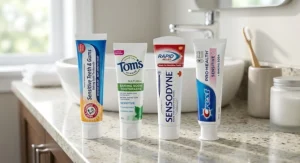
Take your oral care routine to the next level with one of these carefully selected picks. Click on any highlighted item to check current pricing and availability!
FAQ
❓ Is baking soda toothpaste bad for sensitive teeth?
❓ Does baking soda toothpaste help with plaque?
❓ Can baking soda toothpaste cause gum irritation?
❓ What's the best desensitizing ingredient in toothpaste?
❓ Is baking soda toothpaste safe to use every day in Canada?
Conclusion
Sensitive teeth don’t have to mean permanently avoiding your morning coffee or wincing through every scoop of ice cream. Across these seven picks, the pattern is clear: baking soda handles the cleaning and acid-buffering side of the equation, while a named desensitizing ingredient — potassium nitrate, arginine, or fluoride — does the actual pain relief. Arm & Hammer Sensitive Teeth & Gums remains the easiest all-round recommendation for anyone wanting proven relief at a drugstore price, while Tom’s of Maine Rapid Relief Sensitive and Baking Soda with Propolis & Myrrh give the natural-aisle crowd genuinely credible alternatives rather than watered-down substitutes.
Whichever tube ends up in your bathroom, give it the full two-to-four-week runway before judging results, and don’t ignore sensitivity that doesn’t improve — that’s your body’s way of asking for a proper dental check-up, not just a different toothpaste.
✨ Ready to stop wincing at cold drinks? Pick your favourite from the list above and give your teeth the relief they deserve! 🦷
Recommended for You
- Baking Soda Toothpaste for Whitening: 7 Best Picks (2026)
- 7 Best Nano Hydroxyapatite Toothpaste Picks for Canada
- Baking Soda Toothpaste: 7 Top Picks for Canadians in 2026
Disclaimer: This article contains affiliate links. As an Amazon Associate, I earn from qualifying purchases. If you purchase products through these links, we may earn a small commission at no additional cost to you.
✨ Found this helpful? Share it with your friends! 💬🤗
