In This Article
Here’s the plot twist nobody warns you about: the same jet-black paste that’s supposed to make your smile Instagram-ready can also leave your teeth screaming at a sip of iced coffee. If you’ve landed here, you’re probably trying to solve two problems at once — you want the stain-lifting reputation of charcoal toothpaste for sensitive teeth without waking up every cold morning dreading your first bite of cereal. Fair goal, and a trickier one than the marketing copy on most tubes lets on.
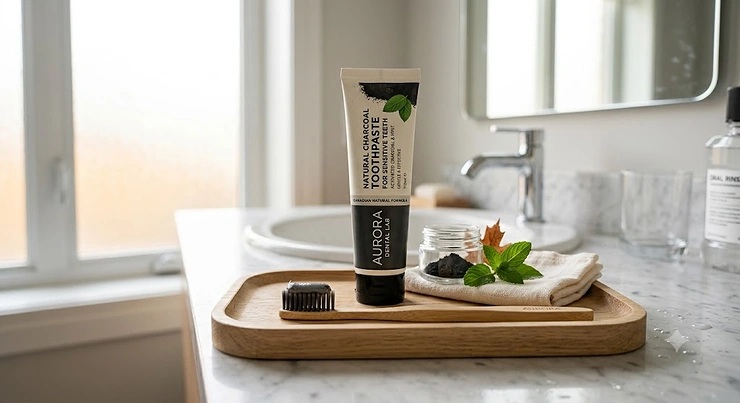
Charcoal toothpaste for sensitive teeth sits at an odd intersection. Activated charcoal is, by nature, a mildly gritty ingredient designed to physically buff away surface stains — and “gritty” is not usually a word dentists pair with “gentle.” Yet a handful of brands have figured out how to fold charcoal into a formula that still respects enamel, using lower-abrasion carbon, added fluoride or hydroxyapatite, and desensitizing agents like potassium nitrate to soften the blow. The other formulas are, frankly, just charcoal with good branding.
Below, we’ve pulled apart seven real, currently available products, checked their ingredient lists and RDA data where it’s published, and read through the aggregated sentiment in genuine customer reviews rather than inventing any. We’ll walk through what actually distinguishes a sensitive-teeth-friendly charcoal toothpaste from a stain-removal gimmick, how the RDA abrasiveness scale works, which desensitizing agents are worth looking for, and where charcoal toothpaste for bad breath claims hold up. Let’s get into it.
What Is Charcoal Toothpaste for Sensitive Teeth?
Charcoal toothpaste for sensitive teeth is a dentifrice that combines activated carbon — used to physically lift surface stains — with ingredients meant to protect or desensitize exposed dentin, such as potassium nitrate, fluoride, or nano-hydroxyapatite. The goal is whitening without the sting that plain charcoal formulas can trigger.
That balancing act matters because the Canadian Dental Association has publicly noted that activated charcoal is probably somewhat abrasive and has no chemical mechanism that would genuinely whiten teeth beyond removing surface stains. That’s not a reason to panic-toss every black tube in your bathroom, but it is a reason to be picky about which one you buy — see our full breakdown in this CBC News investigation into activated charcoal oral care products for more on how these claims hold up under scrutiny.
Quick Comparison Table
| Product | Type | Best For |
|---|---|---|
| Curaprox Black is White | Fluoride + activated carbon | Best overall for sensitive teeth |
| Colgate Total Charcoal | Fluoride + potassium nitrate | Best mainstream sensitivity relief |
| Boka Charcoal Yuzu Mint | Fluoride-free, nano-hydroxyapatite | Best fluoride-free pick |
| Arm & Hammer Essentials Charcoal | Fluoride-free, baking soda base | Best budget low-abrasion option |
| hello Activated Charcoal Epic Whitening | Fluoride-free, vegan | Best everyday budget pick |
| Davids Charcoal Toothpaste | Fluoride-free, sustainable | Best for bad breath and freshness |
| Cali White Activated Charcoal | Fluoride-free, coconut oil base | Best under C$15 CAD |
Looking at the table, the split really comes down to fluoride versus fluoride-free philosophy: Curaprox Black is White and Colgate Total Charcoal lean on decades-old, clinically backed desensitizing chemistry, while Boka Charcoal Yuzu Mint, Davids Charcoal Toothpaste, hello Activated Charcoal Epic Whitening, Arm & Hammer Essentials Charcoal, and Cali White Activated Charcoal bet on gentler mineral or baking-soda systems instead. Neither camp is universally “better” — it depends on whether you want proven desensitizers or a cleaner ingredient list, a theme we’ll keep coming back to.
💬 Just one click — help others make better buying decisions too!😊
Top 7 Charcoal Toothpastes for Sensitive Teeth: Expert Analysis
We picked these seven because they cover every price tier, both fluoride and fluoride-free camps, and represent the products actually turning up in Canadian searches and shopping carts right now — not a hypothetical “ideal” lineup.
1. Curaprox Black is White — lowest published RDA in this roundup
Swiss oral care brand Curaden built this one specifically to solve the sensitivity problem baked into most charcoal pastes. Instead of loose, gritty charcoal powder, it uses nano-sized activated carbon fully integrated into the paste, which adsorbs stain particles rather than scrubbing them off.
That distinction matters in practice: Curaprox Black is White carries a published RDA of 76, made from nano-size carbon particles that are non-abrasive to tooth enamel, and it’s formulated with fluoride plus hydroxyapatite to help reseal exposed dentin tubules. On paper, that’s a meaningfully gentler profile than a typical charcoal-powder toothpaste sitting in the 100+ RDA range.
Based on the ingredient sheet, this is the pick for someone who wants whitening-adjacent results without gambling on an unproven formula. Health Canada has recognized the product for an anticaries indication because of its sodium monofluorophosphate content, with no warnings required regarding staining — a regulatory detail most charcoal brands can’t claim. Reviewers consistently describe the paste as cooling and non-gritty, with several noting it doesn’t trigger the zingy sensitivity spike they got from cheaper charcoal powders.
Pros:
- ✅ One of the lowest published RDA scores in the charcoal category
- ✅ Contains fluoride and hydroxyapatite for dentin protection
- ✅ Health Canada–recognized anticaries formula
Cons:
- ❌ Premium price relative to drugstore charcoal options
- ❌ Smaller tube size than most North American tubes
Expect to pay in the C$20-C$25 range for a 90ml tube at the time of research, though prices fluctuate — check current pricing before buying. For the money, this is the closest thing on our list to a genuinely low-abrasion charcoal toothpaste, and the value verdict is straightforward: worth it if sensitivity is your primary concern.
2. Colgate Total Charcoal — built-in potassium nitrate for nerve calming
Colgate took a different approach: rather than relying purely on gentle charcoal, it paired micro-charcoal particles with the same desensitizing chemistry used in dedicated sensitivity pastes. That’s a meaningful hedge against the enamel-wear complaints that dog fluoride-free charcoal brands.
The formula lists potassium nitrate, stannous fluoride, and sodium fluoride alongside charcoal powder, which is a genuinely unusual combination for a charcoal product — most charcoal pastes skip fluoride entirely. What that means in practice is you’re not choosing between “charcoal” and “cavity protection plus sensitivity relief”; Colgate Total Charcoal tries to give you both in one tube, which is the whole reason it’s on this list instead of a plainer Colgate charcoal SKU.
Aggregated review sentiment on major retail sites is mixed but leans positive: several reviewers report brighter-looking teeth within about a week, while a smaller group flags a gritty texture on first use before the paste settles into their routine. What most buyers overlook is that Colgate hasn’t published an exact RDA figure for this specific SKU, so treat “low abrasion” as a reasonable inference from its ingredient profile rather than a lab-verified number.
Pros:
- ✅ Contains both fluoride and potassium nitrate for sensitivity
- ✅ Widely available at Canadian pharmacies and grocery stores
- ✅ Backed by Colgate’s long clinical testing history
Cons:
- ❌ Some reviewers report a grittier texture than expected
- ❌ Exact RDA value not publicly disclosed for this SKU
Pricing typically falls in the C$8-C$12 range for a standard tube, making it one of the more accessible mid-range picks. Given the built-in desensitizers, this is a genuinely sound choice for anyone nervous about trying charcoal for the first time.
3. Boka Charcoal Yuzu Mint — nano-hydroxyapatite instead of fluoride
Boka built its entire toothpaste line around nano-hydroxyapatite (n-Ha), a biomimetic mineral that mirrors the natural composition of enamel, and its charcoal variant folds activated carbon into that same base.
Here’s what the spec sheet doesn’t say outright but reviewers and dental commentary consistently point to: n-Ha is theorized to physically fill and seal the microscopic tubules that transmit cold and sweet sensations to the nerve, working alongside the charcoal’s stain-lifting action rather than against it. Nano-hydroxyapatite particles deposit into these channels and form a physical mineral barrier that blocks hypersensitivity responses to cold, heat, and sweet stimuli, according to independent product reviews of Boka’s formula family. That’s a genuinely different mechanism from potassium nitrate, which numbs the nerve rather than sealing the channel.
Reviewers consistently describe the texture as smooth and non-gritty compared with charcoal-powder competitors, with the citrus-mint flavour drawing more attention than the whitening results themselves. Based on the spec comparison, this is best suited to buyers who specifically want to avoid fluoride but still want more than “just charcoal and hope.”
Pros:
- ✅ Nano-hydroxyapatite may help reseal exposed dentin
- ✅ Fluoride-free, SLS-free, and vegan formula
- ✅ Smooth, non-gritty texture reported by reviewers
Cons:
- ❌ Premium pricing compared to drugstore charcoal pastes
- ❌ Fluoride-free, so not ideal as your only cavity defence
Expect a price in the C$15-C$18 range per 4oz tube at the time of research. It’s a solid value if remineralization technology matters more to you than a rock-bottom price tag.
4. Arm & Hammer Essentials Whiten + Activated Charcoal — baking soda keeps abrasion in check
Arm & Hammer’s angle is chemistry it’s used for decades: baking soda as the primary cleaning agent, with charcoal folded in as a secondary whitening booster rather than the main abrasive.
That matters because baking soda is a naturally low-abrasion particle compared with many synthetic polishing agents, and one dental review source puts this specific Essentials charcoal formula’s low abrasivity formula at an average RDA of 81 — squarely in the gentle range and well under the ADA’s 250 safety ceiling. The same source notes the charcoal delivers noticeable surface stain removal within days, though it flags the formula as fluoride-free and better suited as an occasional whitening boost than a sole daily toothpaste for cavity protection.
Reviewers are split on texture: some love the natural baking-soda taste, while others find it noticeably gritty compared to gel-based competitors. A common complaint in user reviews is that heavy charcoal staining on the sink and toothbrush bristles takes some getting used to, which is really a charcoal-category issue rather than an Arm & Hammer-specific flaw.
Pros:
- ✅ Relatively low RDA thanks to the baking soda base
- ✅ Noticeable stain removal reported within days
- ✅ Budget-friendly and widely stocked in Canada
Cons:
- ❌ Fluoride-free, so pair with a fluoride rinse if used daily
- ❌ Distinct baking-soda taste isn’t for everyone
Pricing sits comfortably under C$8 CAD at the time of research, making this one of the cheapest ways to try a lower-abrasion charcoal formula.
5. hello Activated Charcoal Epic Whitening Toothpaste — the vegan, SLS-free budget staple
Hello’s charcoal toothpaste built a following well before “charcoal” became a category unto itself, largely on the strength of its clean-ingredient positioning and playful branding.
The formula relies on hydrated silica to polish and clean teeth, charcoal powder to whiten and freshen breath, and coconut oil to soothe and moisturize, with no fluoride, peroxide, or SLS in the mix. A dentist-authored review of the formula noted the texture as on the less abrasive side, not stripping enamel while brushing, with no sensitivity felt during use since there’s no peroxide involved — a useful independent data point, since Hello itself doesn’t publish an RDA figure for this SKU.
What most buyers overlook is that “fluoride-free” isn’t automatically “gentler” — it just means the desensitizing job falls entirely on the silica-to-charcoal ratio rather than an added active ingredient. Reviewers consistently praise the mint flavour and the lack of a harsh foaming sensation, though a few flag the black residue in the sink as a genuine daily annoyance rather than a minor quirk.
Pros:
- ✅ Independently reviewed as less abrasive than average
- ✅ Vegan, SLS-free, peroxide-free formula
- ✅ Playful mint flavour with no artificial sweeteners
Cons:
- ❌ No published RDA value from the manufacturer
- ❌ Black staining in sink and on toothbrush bristles
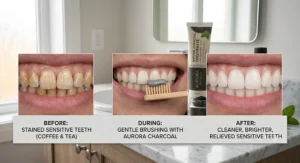
At around C$8-C$10 CAD per tube, this remains one of the most accessible charcoal toothpastes for bad breath and daily whitening upkeep alike.
6. Davids Charcoal Toothpaste — the pick built around fresh breath
Davids leans hardest into the “fresh breath” side of the charcoal equation, positioning its charcoal formula as a companion to its wider Hydroxi line rather than a standalone whitening gimmick.
The company explicitly markets this toothpaste for a bright smile and fresh breath, describing it as gentle on enamel yet tough on surface stains, and recommends pairing it with an alcohol-free rinse for people with sensitive mouths who still want a lasting clean feeling. That combination approach — charcoal toothpaste plus a gentle mouthwash rather than charcoal alone — is a genuinely practical answer to the “does charcoal toothpaste help bad breath” question, since charcoal itself does little for the bacteria that actually cause odour.
Here’s what the marketing copy won’t spell out plainly: charcoal’s stain-adsorbing action doesn’t meaningfully affect the sulfur-producing bacteria behind halitosis, so Davids’ breath-freshness reputation really rests on its mint oil blend and overall clean formulation rather than the charcoal itself. Reviewers do consistently note the metal tube and made-in-USA sourcing as a differentiator from typical plastic-tube competitors, alongside a genuinely minty, non-gritty brushing experience.
Pros:
- ✅ Marketed and formulated with breath freshness in mind
- ✅ Sustainable metal tube packaging
- ✅ Reviewers report a smooth, non-gritty texture
Cons:
- ❌ Premium price point for a fluoride-free formula
- ❌ Charcoal itself won’t fix bacteria-driven bad breath alone
Expect a price around C$18-C$22 CAD at the time of research for the standard tube. If bad breath is your main motivator, this is worth pairing with a proper mouthwash rather than expecting the toothpaste to do all the work.
7. Cali White Activated Charcoal & Organic Coconut Oil Toothpaste — the best-known name under C$15 CAD
Cali White is arguably the product that put charcoal toothpaste on the mainstream map, and it remains one of the most reviewed options in the category by a wide margin.
The ingredient list centres on activated charcoal, diatomaceous earth, tea tree oil, organic coconut oil, xylitol, and peppermint oil, marketed as a chemical-free approach to whitening. In the interest of full honesty, this is also the one product on our list that’s faced formal scrutiny: a class action lawsuit alleged the brand’s marketing omitted material facts about the safety of charcoal in oral care, citing a lack of scientific substantiation on the safety and efficacy of activated charcoal dentifrices. That doesn’t mean the product is unsafe for occasional use, but it does mean you should treat “detoxifying” and “healthy for long-term oral care” claims with real skepticism rather than taking them at face value.
Aggregated review sentiment is genuinely split on the sensitivity question: some reviewers report zero sensitivity and a gentle, foam-free brushing experience, while others — including buyers who specifically sought it out because of pre-existing sensitivity — report gum irritation or discomfort with regular use. That inconsistency is worth weighing heavily if sensitive teeth are your main concern.
Pros:
- ✅ Widely available and heavily reviewed on major retailers
- ✅ Fluoride-free, vegan, sulfate-free formula
- ✅ Genuinely under C$15 CAD at most retailers
Cons:
- ❌ Faced a class-action lawsuit over safety marketing claims
- ❌ Review sentiment on sensitivity and gum irritation is mixed
At under C$15 CAD per tube, it’s an easy impulse buy, but the value verdict comes with a caveat: read the ingredient label yourself and patch-test before committing to daily use if you already deal with sensitivity.
Practical Usage Guide: How to Brush Safely With Charcoal Toothpaste
Getting charcoal toothpaste for sensitive teeth to actually work in your favour is less about which tube you buy and more about how you use it. Here’s what most product packaging skips entirely.
Start slow. For the first two weeks, use your charcoal toothpaste every other brushing session rather than twice daily, alternating with a standard fluoride toothpaste. This gives you a baseline read on whether your teeth react before you commit to full-time use. Use a soft-bristled brush and light pressure — charcoal’s mild grit compounds with brush pressure, and that combination, not the charcoal alone, is usually what causes enamel wear over time.
Watch your two-minute timer closely. Longer or more vigorous brushing sessions with any charcoal-containing paste increase abrasive contact time, which matters more with charcoal than with a standard gel toothpaste. If you notice a black film lingering on your gumline or between teeth, that’s a sign you’re either brushing too long or not rinsing thoroughly — not a reason to scrub harder.
A common first-30-days mistake is skipping fluoride entirely because your charcoal toothpaste doesn’t contain it. If you’ve chosen a fluoride-free option like Boka Charcoal Yuzu Mint, hello Activated Charcoal Epic Whitening, Davids Charcoal Toothpaste, Arm & Hammer Essentials Charcoal, or Cali White Activated Charcoal, consider a separate fluoride rinse at a different time of day to keep cavity protection intact. Finally, don’t judge whitening results before the three-week mark — surface stain removal is gradual, and expecting overnight change is the fastest way to end up over-brushing out of frustration.
Real-World Scenarios: Who Should (and Shouldn’t) Reach for Charcoal
Picture three different people standing in the toothpaste aisle, each with a completely different reason to be there.
The occasional coffee drinker with mild sensitivity. She drinks two cups a day, notices some staining, and gets a mild twinge on cold drinks but nothing dramatic. For her, Colgate Total Charcoal or Curaprox Black is White makes sense — both pair charcoal with proven desensitizing chemistry, so she gets stain removal without gambling her comfort on an unproven fluoride-free formula.
The clean-ingredient shopper with genuinely sensitive teeth. He’s already cut fluoride from his routine for personal reasons and deals with real cold-sensitivity from mild enamel erosion. Boka Charcoal Yuzu Mint is the more sensible pick here, since its nano-hydroxyapatite mechanism is designed specifically to address that erosion rather than just mask it, unlike a plain charcoal-and-coconut-oil formula.
The budget-conscious student trying charcoal for the first time. She’s curious about the trend, has healthy teeth with no diagnosed sensitivity, and doesn’t want to spend more than a coffee run’s worth of money to test it out. Arm & Hammer Essentials Charcoal, hello Activated Charcoal Epic Whitening, or Cali White Activated Charcoal — all comfortably under C$15 CAD — are reasonable low-stakes ways to try the category without a premium commitment.
How to Choose Charcoal Toothpaste for Sensitive Teeth
Picking the right tube comes down to five checkable criteria rather than gut instinct or Instagram testimonials.
- Check for a published or estimated RDA value. Anything under 70 is genuinely low-abrasion and the safest bet for sensitive teeth; values between 70 and 100 are still broadly acceptable for daily use.
- Look for a desensitizing active ingredient. Potassium nitrate, nano-hydroxyapatite, or stannous fluoride each work through a different mechanism, but all three beat “charcoal alone” for sensitivity-specific relief.
- Decide your fluoride stance deliberately, not by accident. Fluoride-free doesn’t automatically mean gentler — it just shifts your cavity protection responsibility elsewhere in your routine.
- Read genuine aggregated reviews, not just star ratings. A 4.5-star average can still hide a vocal minority reporting gum irritation, which matters disproportionately if you already have sensitivity.
- Confirm it’s still in current production and available through a legitimate Canadian retailer. Formulas get discontinued or reformulated more often than people expect in this category.
- Match texture expectations to your brushing habits. If you brush vigorously, a lower-RDA, non-gritty formula like Curaprox Black is White or Boka Charcoal Yuzu Mint reduces your risk of self-inflicted abrasion.
- Check whether it’s on the Canadian Dental Association’s list of accepted products for extra peace of mind — you can browse the current CDA seal of acceptance list before buying.
Understanding the RDA Abrasiveness Scale
RDA, or Relative Dentin Abrasivity, is the closest thing the toothpaste industry has to a universal abrasiveness scorecard, and it’s directly relevant to anyone shopping for charcoal toothpaste for sensitive teeth.
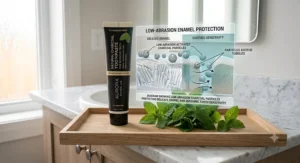
The scale generally runs from 0 to 250, with 0-70 considered low abrasiveness suitable for daily use including people with enamel erosion or gum recession, 70-100 considered medium abrasiveness that’s still broadly safe, and 100-150 considered higher abrasiveness better suited to occasional rather than daily use. Regulators treat 250 as the practical ceiling: the American Dental Association considers an RDA score of 250 or below safe for a lifetime of daily use, though that’s a maximum, not a target for anyone already dealing with sensitivity.
Here’s what most charcoal toothpaste marketing skips entirely: brands rarely print RDA numbers on the box because there’s no legal requirement to disclose them, so the value most consumers rely on comes from third-party lab estimates or dental commentary rather than the packaging itself. Among our seven picks, Curaprox Black is White and Arm & Hammer Essentials Charcoal are the only two with a specific published or estimated figure — 76 and roughly 81 respectively — landing both comfortably in the low-to-medium range. For everything else on our list, treat the absence of a number as a reason to rely more heavily on aggregated review sentiment and ingredient analysis rather than assuming “gentle” marketing language equals a low lab-tested score.
Charcoal Toothpaste vs Traditional Sensitivity Toothpaste
| Factor | Charcoal Toothpaste | Traditional Sensitivity Toothpaste |
|---|---|---|
| Primary mechanism | Adsorbs/scrubs surface stains | Desensitizes nerve or seals tubules |
| Typical RDA range | Often unpublished; 76-100+ when known | Usually published, typically 30-70 |
| Fluoride content | Often absent | Almost always present |
| Best For | Mild staining plus mild sensitivity, e.g. Curaprox Black is White | Moderate-to-severe sensitivity with minimal whitening need |
The core trade-off here is mechanism versus marketing: a dedicated sensitivity toothpaste is engineered from the ground up to calm nerve pain, while a charcoal toothpaste is engineered to lift stains and only secondarily addresses sensitivity if the brand bothered to formulate for it. If your sensitivity is more than occasional — think consistent pain from hot or cold rather than an occasional twinge — a dedicated sensitivity paste alongside occasional charcoal use for stain touch-ups is a more defensible split than expecting one tube to do both jobs perfectly.
✨ Don’t Miss These Exclusive Deals!
🔍 Take your smile confidence to the next level with these carefully selected picks. Click on any highlighted product to check current pricing and availability on amazon.ca. These formulas can help you build a whitening routine your future self will thank you for!
Desensitizing Agents Explained: What Actually Calms Nerve Pain
Understanding what’s doing the heavy lifting against sensitivity helps you read an ingredient label like a professional instead of guessing from front-of-box claims.
Potassium nitrate is the most established desensitizing agent in oral care, working by penetrating the dentin tubules and calming the nerve fibre’s ability to transmit pain signals — it’s the same mechanism used in dedicated sensitivity brands and appears in Colgate Total Charcoal‘s formula. Nano-hydroxyapatite works through an entirely different, more structural route: rather than numbing the nerve, it physically deposits mineral material into and around the exposed tubules, aiming to seal them shut, which is the theory behind Boka Charcoal Yuzu Mint‘s approach.
Stannous fluoride, also present in Colgate Total Charcoal, pulls double duty as both a cavity-fighting fluoride source and a mild desensitizer through tubule occlusion. Sodium monofluorophosphate, found in Curaprox Black is White, is a gentler fluoride delivery system that’s also the ingredient behind that product’s Health Canada anticaries recognition. What most fluoride-free charcoal brands substitute in instead — coconut oil, xylitol, or aloe vera, as seen in Cali White Activated Charcoal and hello Activated Charcoal Epic Whitening — offer soothing and moisturizing benefits but lack the clinical backing of the agents above for actually calming nerve sensitivity.
Common Mistakes That Cause Enamel Wear
Most enamel wear complaints tied to charcoal toothpaste trace back to user behaviour, not just formula choice.
Brushing immediately after acidic food or drink. Enamel is temporarily softened after coffee, citrus, or wine, and brushing with any abrasive paste — charcoal included — during that window accelerates wear. Wait at least 30 minutes.
Assuming “natural” means “low abrasion.” Several fluoride-free, coconut-oil-based charcoal pastes use loose charcoal powder that’s genuinely more abrasive than a fluoride toothpaste with a lower RDA, simply because “natural” ingredients aren’t automatically gentler on a lab bench.
Using a medium or hard-bristled brush with charcoal toothpaste. The combination compounds abrasive contact well beyond what either factor would cause alone — always pair charcoal formulas with a soft brush.
Daily use of a high-grit charcoal powder instead of a formulated paste. Loose charcoal powders, distinct from the pastes reviewed here, tend to carry far less quality control around particle size and are generally the riskiest category for enamel.
Ignoring early sensitivity signals. If a formula like Cali White Activated Charcoal starts causing discomfort, switching to a lower-RDA option such as Curaprox Black is White early prevents compounding damage rather than pushing through it.
Charcoal Toothpaste for Bad Breath: Does It Actually Help?
This is one of the most searched claims in the category, and the honest answer is more nuanced than most product pages let on.
Activated charcoal’s main talent is adsorption — binding to certain compounds and particles on contact — which is genuinely useful for surface stains but only marginally relevant to the sulfur-producing bacteria that cause most bad breath. What actually freshens breath in products like Davids Charcoal Toothpaste and hello Activated Charcoal Epic Whitening is typically the mint oil blend and the general plaque-removal action of brushing itself, not the charcoal component specifically.
That said, charcoal toothpaste for bad breath isn’t a wasted purchase if odour is a secondary concern rather than your primary complaint. Reviewers of Davids Charcoal Toothpaste consistently note a genuinely fresh, lingering mint sensation, and the brand’s own recommendation to pair the toothpaste with an alcohol-free rinse is a more realistic path to lasting freshness than relying on charcoal alone. If persistent bad breath is your main issue, it’s worth ruling out gum disease, dry mouth, or dietary causes with a dentist before assuming a toothpaste swap will solve it — charcoal or otherwise.
Best Charcoal Toothpaste Under $15 CAD
Budget matters, and three products on our list comfortably clear this bar at the time of research.
| Product | Price Range (CAD) | Fluoride | Best For |
|---|---|---|---|
| Arm & Hammer Essentials Charcoal | Under C$8 | No | Lowest-cost low-RDA option |
| hello Activated Charcoal Epic Whitening | C$8-C$10 | No | Everyday budget whitening |
| Cali White Activated Charcoal | Under C$15 | No | Most-reviewed budget name |
Looking at the value math here, Arm & Hammer Essentials Charcoal edges out the other two on a pure cost-per-use basis thanks to its lower price point and a genuinely published RDA estimate that supports its “gentle” positioning. hello Activated Charcoal Epic Whitening sits in a similar price bracket with independently reviewed low abrasion, making it a close second. Cali White Activated Charcoal, while still under the C$15 threshold, carries the added baggage of its ingredient-safety lawsuit, which is worth factoring into your decision even at a bargain price — cheaper isn’t automatically the better long-term value if it means rolling the dice on sensitivity.
Safety, Regulations & Canadian Compliance Guide
Toothpaste sold in Canada falls into one of three regulatory buckets, and which bucket a given charcoal toothpaste lands in tells you a lot about how much scrutiny it’s actually received.
Products containing recognized medicinal ingredients — fluoride compounds, potassium nitrate, and similar actives — typically require a Natural Product Number (NPN) from Health Canada, which involves a review of safety and efficacy evidence before the product can legally be sold. You can verify a licensed product’s status directly through Health Canada’s product licensing resources. Curaprox Black is White is a clear example of this pathway, carrying a Health Canada-recognized anticaries indication tied to its fluoride content. Fluoride-free charcoal pastes without a therapeutic claim, by contrast, are often classified simply as cosmetics, which involves considerably lighter pre-market review — a distinction worth knowing before assuming every tube on the shelf has been vetted equally.
On the professional side, a 2017 literature review in the Journal of the American Dental Association concluded there was insufficient clinical and laboratory data to substantiate the safety and efficacy claims of charcoal and charcoal-based toothpastes, and Canadian dentists have echoed similar caution since. That doesn’t mean every charcoal product is unsafe — it means the category as a whole is thinner on independent clinical evidence than most people assume, which is exactly why RDA transparency, desensitizing ingredients, and genuine aggregated reviews matter more here than in a typical toothpaste comparison.
Frequently Asked Questions
❓ Does charcoal toothpaste damage enamel?
❓ Is charcoal toothpaste safe for daily use?
❓ Can charcoal toothpaste help with bad breath?
❓ What RDA is safe for sensitive teeth?
❓ Does charcoal toothpaste whiten teeth permanently?
Conclusion
Charcoal toothpaste for sensitive teeth isn’t a single product category so much as a spectrum — from genuinely formulated, low-RDA options with real desensitizing science behind them, to plain charcoal powder wearing a trendy black wrapper. Curaprox Black is White and Colgate Total Charcoal sit at the more clinically defensible end thanks to published or well-supported abrasion data and proven desensitizing actives. Boka Charcoal Yuzu Mint offers a credible fluoride-free middle ground built on nano-hydroxyapatite science. Arm & Hammer Essentials Charcoal, hello Activated Charcoal Epic Whitening, Davids Charcoal Toothpaste, and Cali White Activated Charcoal round out the lineup for budget shoppers, bad-breath-focused buyers, and anyone just curious to try the trend without overcommitting.
The single biggest lesson from digging through the real research and real reviews: don’t let “natural” or “charcoal” on the label substitute for actually checking whether a product addresses sensitivity specifically. If your teeth already ache at cold drinks, prioritize a published low RDA and a genuine desensitizing agent over branding every time. Start slow, watch how your teeth respond over the first couple of weeks, and don’t be afraid to switch tubes if something isn’t working for you — your enamel doesn’t grow back, but your toothpaste choice is always reversible.
Recommended for You
- Charcoal Toothpaste vs Whitening Toothpaste: 7 Picks Compared (2026)
- Charcoal Toothpaste 2026: 7 Real Picks, Ranked Honestly
- Essential Oil Toothpaste: 7 Top Picks for Canadians in 2026
Disclaimer: This article contains affiliate links. As an Amazon Associate, I earn from qualifying purchases. If you purchase products through these links, we may earn a small commission at no additional cost to you.
✨ Found this helpful? Share it with your friends! 💬🤗
