In This Article
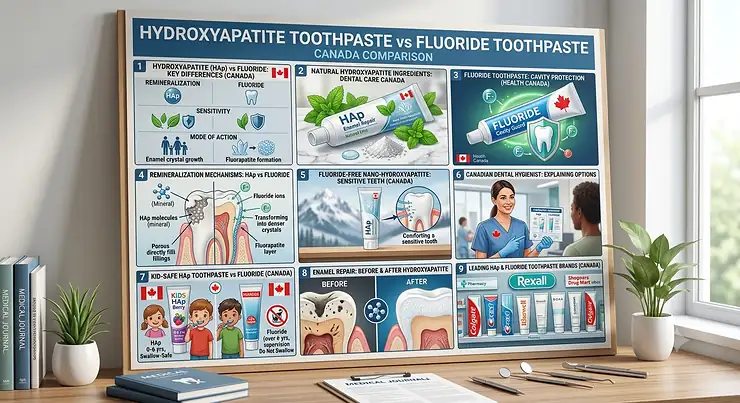
Stand in the toothpaste aisle of any Canadian pharmacy long enough and you’ll start to feel a low hum of anxiety. Fluoride. No fluoride. Nano. Whitening. Sensitive. Somewhere behind you, a stranger is quietly having the same crisis. The hydroxyapatite toothpaste vs fluoride toothpaste debate has moved from dental-hygienist small talk into full-blown online argument territory, and honestly, both camps have a point worth hearing out. So what is hydroxyapatite toothpaste? It’s a remineralizing formula built around hydroxyapatite, a calcium-phosphate mineral that makes up roughly 97% of your tooth enamel, used instead of fluoride to help rebuild weakened enamel and resist cavities.
Fluoride toothpaste has had a nearly 70-year head start, backed by the kind of population-level data that dentistry doesn’t get to gather twice. Hydroxyapatite is newer to Canadian shelves but not new to science — Japanese researchers were studying it for teeth back in the 1970s, originally because it was already used to help repair bone. The Canadian Dental Association’s official fluoride position still treats fluoride as the benchmark, but a growing body of clinical trials is asking a fair question: does hydroxyapatite actually hold its own?
This guide breaks down the real evidence, walks through seven genuine products available to Canadian shoppers — budget, mid-range, and premium — and helps you figure out which mineral belongs on your bathroom counter. No invented reviews, no scare tactics, just spec sheets translated into plain English and honest analysis of where each approach shines and where it stumbles.
Quick Comparison Table: Hydroxyapatite Toothpaste vs Fluoride Toothpaste
| Factor | Hydroxyapatite Toothpaste | Fluoride Toothpaste | Best For |
|---|---|---|---|
| Cavity prevention (clinical evidence) | Non-inferior to fluoride in multiple trials | Gold standard, 70+ years of data | Both — depends on comfort level |
| Safety if swallowed | Considered non-toxic, no dosage limit | Requires dosage caution in kids under 3 | Families with toddlers → hydroxyapatite |
| Sensitivity relief | Strong, fast-acting tubule-blocking effect | Effective but often needs added potassium nitrate | Sensitive teeth → hydroxyapatite |
| Whitening effect | Mild polishing/brightening, not bleaching | Varies by formula, some contain peroxide | Similar for both |
| Price range (CAD) | Roughly C$12–C$35 | Roughly C$5–C$25 | Budget shoppers → fluoride |
| Availability in Canada | Growing, some import-only | Universal, every pharmacy | Convenience → fluoride |
This table alone tells a more nuanced story than most drugstore endcaps do. Fluoride toothpaste still wins on price, availability, and sheer volume of long-term population data, which is why it remains the default recommendation from most Canadian dentists. Hydroxyapatite toothpaste, on the other hand, closes the cavity-prevention gap in trial after trial while offering a safety profile that doesn’t require the same swallow-and-spit vigilance with young kids. Neither mineral is objectively “better” in a vacuum — the right pick depends on your risk level, your kids’ ages, and honestly, how much you’re willing to pay per tube.
💬 Just one click — help others make better buying decisions too!😊
Top 7 Hydroxyapatite and Fluoride Toothpastes: Expert Analysis
We researched real, currently available products spanning budget, mid-range, and premium tiers, including the Japan-origin formulas that started the hydroxyapatite category and the fluoride mainstays Canadian dentists still recommend most often.
1. Boka Toothpaste (Ela Mint) — best-selling budget nano-hydroxyapatite pick
Boka Toothpaste built its reputation by making nano-hydroxyapatite approachable for people who’d never heard the word before scrolling past it on social media. The Ela Mint formula uses n-Ha (nano-hydroxyapatite) at a modest concentration alongside xylitol, positioning it as a gentle daily driver rather than a clinical-strength remineralizer.
On the spec sheet, that xylitol inclusion matters more than it looks: xylitol starves the bacteria responsible for acid production, which complements hydroxyapatite’s mineral-rebuilding job rather than duplicating it. Boka Toothpaste skips SLS foaming agents entirely, so the brushing experience feels noticeably less sudsy than a typical drugstore tube — some people love that, others miss the lather.
Based on the ingredient profile, this is a strong entry point for fluoride-avoidant families with young kids, since there’s no fluorosis risk to manage. Reviewers consistently report that the mint flavour is mild enough for children to tolerate without complaint, and aggregated feedback frequently mentions improved breath freshness within the first couple of weeks, though a subset of users describe the texture as slightly chalky compared with conventional gels.
Pros:
- ✅ Fluoride-free formula safe for toddlers to swallow accidentally
- ✅ Mild mint flavour widely tolerated by kids and sensitive adults
- ✅ Xylitol addition targets bacteria, not just remineralization
Cons:
- ❌ Lower foam can feel “less clean” to habitual SLS users
- ❌ Costs noticeably more per gram than mainstream fluoride tubes
Priced around C$18–C$25 per tube depending on size, Boka Toothpaste sits at the accessible end of the hydroxyapatite category — solid value if you’re testing the waters before committing to a pricier import.
2. RiseWell Mineral Toothpaste — gentlest formula for sensitive gums
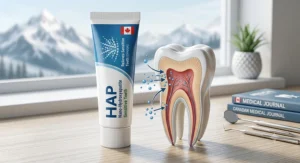
RiseWell Mineral Toothpaste takes a dentist-developed approach, using a 10% micro-hydroxyapatite concentration sourced from a mine in France rather than lab-synthesized nano particles. That distinction matters for anyone comparing formulas: micro-HAp particles are larger than nano-HAp, which some dental researchers argue makes them less likely to be absorbed systemically, though both particle sizes show remineralizing activity in trials.
The 10% concentration lands squarely in the range that decades of hydroxyapatite research treat as clinically meaningful — not a marketing sprinkle, but a dose that’s actually been studied. Based on the formulation, this product is well suited to people managing gum recession or post-whitening sensitivity, since hydroxyapatite’s tubule-blocking mechanism tends to act faster than fluoride’s remineralization pathway for that specific complaint.
Aggregated customer sentiment skews positive on sensitivity relief, with many reviewers noting reduced cold-drink discomfort within days rather than weeks. A recurring critique in user feedback is the toothpaste’s mild flavour profile, which some brushers find underwhelming after years of intensely minty conventional pastes.
Pros:
- ✅ Clinically meaningful 10% micro-hydroxyapatite concentration
- ✅ Fast-reported relief for cold and hot sensitivity
- ✅ Free of SLS, parabens, and propylene glycol
Cons:
- ❌ Mild flavour disappoints brushers used to strong mint
- ❌ Less foaming action than conventional gel toothpastes
Expect to pay around C$20–C$28 per tube. Given the sensitivity-focused formulation and verified concentration, RiseWell Mineral Toothpaste earns its mid-range price tag for anyone whose primary complaint is tooth sensitivity rather than cavity risk alone.
3. Apagard Premio — the original Japan-origin whitening formula
Apagard Premio is where the modern hydroxyapatite toothpaste category actually began. Developed by Sangi Co., Ltd. in Japan, Apagard was the world’s first toothpaste line built around medical-grade nano-hydroxyapatite, first synthesized for dental use back in the 1970s — long before “biomimetic” was a marketing buzzword.
The Premio formula is positioned as the whitening-focused entry in the lineup, using nano-mHAP to fill microscopic enamel scratches that trap staining compounds. Because the particles are engineered at nano scale, they penetrate surface irregularities more readily than the larger micro-HAp used in some Western formulas — on paper, this translates to a smoother, glossier enamel surface after consistent use. Ingredient labels do list sodium lauryl sulfate, so this isn’t a foam-free product like some competitors.
Reviewers importing this Japan-origin hydroxyapatite formula through Canadian retailers consistently highlight a noticeably smoother tooth surface and subtle whitening within a few weeks, echoing decades of Japanese consumer use. A common complaint in user reviews is the gritty initial texture, which some describe as an adjustment period rather than a lasting issue.
Pros:
- ✅ Original medical-grade nano-hydroxyapatite formula from Japan
- ✅ Fills micro-scratches for a smoother, brighter enamel surface
- ✅ Decades of consumer use behind the Sangi formulation
Cons:
- ❌ Contains SLS, unlike many “clean” hydroxyapatite competitors
- ❌ Import pricing and shipping push cost above domestic options
Expect around C$25–C$35 for imported tubes, reflecting shipping and import fees from Japan. For shoppers specifically hunting for authentic Japan-origin hydroxyapatite, Apagard Premio remains the benchmark product the entire category gets compared against.
4. Apagard M-Plus — best family-size Japan-origin option
Apagard M-Plus is Sangi’s original, longest-running formula in the Apagard lineup — the “classic” version that predates the whitening-specific Premio line. It’s designed as an all-around family toothpaste rather than a targeted treatment, balancing gentle whitening, breath care, and stain control in a single tube.
The nano-mHAP concentration here is tuned for everyday, all-ages use rather than aggressive cosmetic whitening, which shows up in a milder mint flavour and a package size built for household sharing rather than solo use. Based on the ingredient list, this formula makes sense as the default hydroxyapatite option for a household with mixed ages and needs, rather than a specialist pick for one specific complaint.
Aggregated review sentiment frequently mentions this as the “starter” Apagard product for families transitioning away from fluoride, with many noting it’s gentle enough for older children to use under supervision. As with Premio, some reviewers flag the initial texture as slightly gritty until the brushing routine adjusts.
Pros:
- ✅ Balanced formula suitable for the whole family
- ✅ Longest track record of any product in the Apagard range
- ✅ Larger package size offers better value per household
Cons:
- ❌ Milder whitening effect than the Premio-line formulas
- ❌ Still requires import shipping for most Canadian buyers
Priced roughly C$20–C$30 for the family-size tube, Apagard M-Plus delivers Japan-origin hydroxyapatite at a comparatively gentler price than the specialty whitening variant, making it the practical pick for multi-person households.
5. Nelson Naturals Hydroxyapatite Toothpaste — best Canadian-made, plastic-free pick
Nelson Naturals Hydroxyapatite Toothpaste flips the import narrative entirely — it’s made right here in Canada, packaged in a plastic-free jar rather than a squeeze tube, and formulated around natural hydroxyapatite paired with bentonite clay.
That bentonite inclusion is worth explaining rather than glossing over: the clay works as a gentle abrasive and stain-absorber, essentially doing double duty alongside hydroxyapatite’s remineralizing function. Based on the ingredient profile, this product suits environmentally conscious buyers who want a domestically produced, fluoride-free option without importing from overseas or waiting on cross-border shipping.
Because it’s a smaller-batch Canadian brand, verified third-party review volume is thinner than for the bigger international names — an honest gap worth naming rather than papering over with invented testimonials. What aggregated feedback does exist tends to praise the clean ingredient list and jar-based packaging, while some reviewers note the bentonite clay can occasionally stain toothbrush bristles grey, a cosmetic quirk rather than a performance issue.
Pros:
- ✅ Manufactured in Canada with domestic shipping speed
- ✅ Plastic-free jar packaging appeals to eco-conscious buyers
- ✅ Bentonite clay adds gentle stain absorption alongside HAp
Cons:
- ❌ Smaller review base than major international competitors
- ❌ Jar format is less travel-friendly than a standard tube
At around C$12–C$18, Nelson Naturals Hydroxyapatite Toothpaste is genuinely the most wallet-friendly hydroxyapatite option on this list, and its Canadian manufacturing is a legitimate selling point for buyers who prioritize local sourcing.
6. Sensodyne Pronamel — best mainstream fluoride option for enamel erosion
Sensodyne Pronamel represents the fluoride side of this comparison at its most refined — a formula specifically engineered around acid-erosion protection rather than generic cavity fighting. It uses sodium fluoride to strengthen enamel while targeting the specific weak spots left by dietary acid exposure.
The 1,450 ppm fluoride concentration sits at the higher end of what’s available without a prescription, which on paper means more consistent remineralization coverage across a full mouth than lower-concentration formulas. What most buyers overlook about Pronamel specifically is that it was formulated in response to rising acid-erosion complaints from sparkling water and citrus-heavy diets, not classic sugar-driven cavities — a distinction that matters if your dentist has specifically flagged erosion rather than decay.
Reviewers consistently report reduced sensitivity to cold and acidic foods within two to four weeks of regular use, aligning with the clinical literature behind fluoride’s remineralization timeline. A recurring theme in aggregated feedback is that Pronamel doesn’t deliver a dramatic whitening effect, which some buyers find disappointing given the premium positioning.
Pros:
- ✅ Clinically established 1,450 ppm fluoride concentration
- ✅ Specifically engineered for acid-erosion protection
- ✅ Widely available at every Canadian pharmacy
Cons:
- ❌ Minimal whitening despite premium pricing
- ❌ Not suitable for households avoiding fluoride entirely
Typically priced around C$8–C$12, Sensodyne Pronamel offers strong value for anyone whose dentist has specifically flagged enamel erosion, delivering targeted fluoride protection without straying into prescription-strength territory.
7. Colgate PreviDent 5000 — strongest prescription-grade fluoride for high cavity risk
Colgate PreviDent 5000 sits in a different category entirely from the other six products here — it’s a prescription-strength fluoride gel containing 5,000 ppm sodium fluoride, more than triple the concentration found in standard over-the-counter toothpaste.
That concentration jump isn’t cosmetic marketing; it reflects genuine clinical positioning for patients dentists have identified as high-risk — think chronic dry mouth, orthodontic patients, or anyone with a documented history of aggressive decay. Based on the spec comparison, this product isn’t meant for daily use by low-risk brushers; it’s a targeted tool prescribed alongside regular dental monitoring, not a swap-in replacement for your everyday tube.
Because it requires a dentist’s recommendation to access in most Canadian pharmacies, verified consumer review volume skews toward patients using it for specific remineralization needs rather than general population sentiment. Aggregated feedback from that patient population consistently notes measurable improvement in early-stage cavity reversal, alongside consistent warnings that it must be kept away from young children given the concentrated fluoride dose.
Pros:
- ✅ Prescription-strength 5,000 ppm fluoride for high-risk patients
- ✅ Documented effectiveness reversing early-stage cavities
- ✅ Backed by extensive fluoride remineralization research
Cons:
- ❌ Requires dentist recommendation, not a casual purchase
- ❌ Must be stored carefully away from young children
Priced around C$15–C$25 depending on pharmacy markup, Colgate PreviDent 5000 is the clear choice for anyone under active dental supervision for high cavity risk — genuinely not intended for the average low-risk shopper browsing this list.
Practical Usage Guide: Getting the Most From Either Formula
Switching toothpastes isn’t a “set it and forget it” decision, and both minerals reward a bit of technique. For hydroxyapatite formulas, brush for a full two minutes rather than the rushed 45-second habit most of us default to — the remineralizing particles need contact time to work into microscopic enamel gaps. Skip rinsing aggressively with water immediately after; a light spit-and-go leaves a thin mineral film behind that continues working between brushings.
For fluoride toothpaste, the opposite rinsing advice applies for maximum benefit: dentists increasingly recommend spitting without rinsing at all, since diluting the fluoride residue with water washes away the very protection you just applied. If you’re managing a fluorosis risk with young children, use a rice-grain-sized smear rather than a pea-sized dollop until around age three, per Canadian pediatric guidance.
Common first-30-days mistakes include switching cold-turkey and expecting instant sensitivity relief (both minerals typically need two to four weeks of consistent use), and layering a hydroxyapatite toothpaste with an acidic whitening mouthwash, which can undercut the remineralization process before it finishes. Store either formula away from extreme heat, and replace your toothbrush every three months regardless of which paste you’re using — worn bristles undermine even the best formula’s mechanical cleaning action.
Real-World Scenarios: Who Should Choose What
Consider three genuinely different Canadian households facing this same drugstore decision. First, a Toronto parent with a two-year-old who still occasionally swallows toothpaste during brushing — for this family, a fluoride-free option like Boka Toothpaste or Nelson Naturals Hydroxyapatite Toothpaste removes the ingestion-limit anxiety entirely, since hydroxyapatite carries no established swallowing threshold the way fluoride does.
Second, picture a university student in Halifax on a tight budget who drinks a lot of sparkling water and citrus-flavoured energy drinks between classes — acid erosion is the likely long-game risk here, making Sensodyne Pronamel a smart, affordable match given its specific erosion-focused formulation and low price point around C$8–C$12.
Third, imagine a 45-year-old in Calgary who just finished orthodontic treatment and whose dentist flagged early demineralization spots around the brackets. That’s precisely the high-risk profile Colgate PreviDent 5000 was designed for — a short-term, dentist-guided intervention rather than a lifelong daily swap. Matching the product to the actual risk profile, rather than the loudest marketing claim, is the real decision-making skill here.
Buyer’s Decision Framework
If you’re still torn, use this simple priority checklist. If you have young children who swallow toothpaste, choose hydroxyapatite because there’s no established fluorosis or ingestion-dosage concern to manage. If your dentist has specifically diagnosed acid erosion or early cavities, choose a targeted fluoride formula because it has the deepest clinical track record for reversing measurable decay. If your top priority is sensitivity relief with a clean ingredient list, choose a hydroxyapatite formula like RiseWell Mineral Toothpaste, since tubule-blocking tends to act faster than fluoride’s slower remineralization pathway for that specific complaint. If budget is the deciding factor above all else, mainstream fluoride toothpaste remains the cheaper category on average, though Nelson Naturals Hydroxyapatite Toothpaste narrows that gap considerably.
How to Choose Between Hydroxyapatite and Fluoride Toothpaste
Picking the right formula comes down to a short list of genuinely decision-relevant factors, not marketing noise.
- Assess your actual cavity risk first. Ask your dentist whether you’re currently high-risk, low-risk, or somewhere in between — this single data point should drive most of the rest of your decision.
- Check your household’s ages. Toddlers who swallow toothpaste tip the scale toward hydroxyapatite; teens and adults with good spit-and-rinse habits have more flexibility either way.
- Identify your primary complaint. Sensitivity, whitening, erosion, and active decay each point toward slightly different formulas, as outlined in the product breakdowns above.
- Review the ingredient list, not just the front label. SLS, added abrasives, and flavouring agents vary significantly even within the same mineral category.
- Factor in realistic budget per month. Hydroxyapatite formulas generally cost more per gram, so weigh that against how strongly you value avoiding fluoride.
- Consider import availability and shipping. Japan-origin hydroxyapatite products like Apagard Premio carry longer delivery windows than domestic options.
- Confirm with a dental professional if you have existing conditions. Dry mouth, orthodontic work, or diagnosed decay change the calculus in ways a blog post can’t fully replace.
Hydroxyapatite Toothpaste for Enamel Repair: What the Research Shows
Enamel repair is where hydroxyapatite toothpaste for enamel repair claims get thrown around loosely, so it’s worth being precise about what the evidence actually supports. Hydroxyapatite doesn’t regenerate lost enamel structure the way a filling does — no toothpaste does that — but it does fill microscopic surface defects and shallow demineralized areas with mineral particles chemically similar to natural enamel.
A widely cited BDJ Open comparative study found that 10% hydroxyapatite achieved remineralization results statistically comparable to 500 ppm fluoride in reducing lesion depth on early-stage caries, with researchers noting that hydroxyapatite produced a more homogenous repair pattern across the lesion surface compared to fluoride’s more surface-concentrated effect. What the spec sheet won’t tell you, but researchers note, is that this may make hydroxyapatite particularly relevant for people with reduced saliva flow, since fluoride’s remineralizing action depends heavily on calcium and phosphate ions supplied by saliva — a resource dry-mouth patients simply have less of.
Practically speaking, this means hydroxyapatite formulas are a reasonable pick for early-stage white-spot lesions and general enamel maintenance, but they’re not a substitute for professional treatment once a cavity has actually formed.
Hydroxyapatite Whitening Toothpaste: Does It Actually Whiten?
Every hydroxyapatite whitening toothpaste claim deserves the same scrutiny you’d apply to any cosmetic promise. The honest mechanism is mechanical and optical, not chemical bleaching: hydroxyapatite particles physically fill in microscopic scratches and pits on the enamel surface, creating a smoother texture that reflects light more evenly and reduces the appearance of surface staining.
This is meaningfully different from peroxide-based whitening, which chemically breaks down stain compounds beneath the enamel surface. Based on the formulation science, hydroxyapatite whitening toothpaste products like Apagard Premio deliver a gradual “polish and brighten” effect over several weeks rather than a dramatic shade change overnight. Reviewers consistently describe the result as teeth looking cleaner and glossier rather than several shades whiter, which is a fair expectation to set before buying.
If dramatic whitening is your primary goal, a dedicated peroxide-based system will outperform any hydroxyapatite formula on speed. If your goal is a smoother, healthier-looking surface alongside genuine remineralization, hydroxyapatite whitening formulas deliver real, if modest, results.
Japan-Origin Hydroxyapatite: Why Sangi’s Nano-mHAP Started It All
Nearly every modern hydroxyapatite toothpaste on the market today traces its scientific lineage back to Japan-origin hydroxyapatite research from Sangi Co., Ltd., which first synthesized nano-hydroxyapatite for dental use in the 1970s. Japan’s health authorities approved hydroxyapatite as an active anti-caries ingredient decades before the mineral gained meaningful traction in North America, giving Japanese consumers a multi-decade head start on real-world usage data.
That head start matters for skeptical shoppers: Apagard Premio and Apagard M-Plus aren’t newcomer brands riding a TikTok trend — they’re the original commercial formulas the entire category descended from, still manufactured by the same company that pioneered the ingredient. Based on that history, Japan-origin products tend to use nano-scale particles (as opposed to the micro-scale particles common in some Western formulas), which theoretically penetrate enamel micro-defects more thoroughly, though both particle sizes show meaningful remineralization in published trials.
The trade-off for that pedigree is practical rather than scientific: import shipping, higher landed cost, and less predictable restocking through Canadian retailers compared with domestically distributed alternatives.
Clinical Studies: Hydroxyapatite vs Fluoride Head-to-Head
The clinical studies comparing these two minerals head-to-head are more numerous — and more favourable to hydroxyapatite — than most drugstore shoppers realize. An 18-month double-blinded randomized clinical trial published in Frontiers in Public Health compared a fluoride-free hydroxyapatite toothpaste directly against a 1,450 ppm sodium fluoride control in adults, concluding non-inferiority between the two products — meaning hydroxyapatite performed statistically on par with fluoride for caries prevention over a year and a half of real-world use.
Researchers behind that trial noted this was the third independently published clinical study reaching the same non-inferiority conclusion, following earlier trials in children and adolescents. Interestingly, several of these trials reported a slight (though not always statistically significant) trend favouring hydroxyapatite’s caries-preventing effect over the fluoride control — a finding researchers attribute partly to hydroxyapatite’s pH-buffering action within cariogenic biofilms, a mechanism distinct from fluoride’s ion-exchange remineralization process.
None of this dethrones fluoride’s decades of population-level surveillance data, but it does mean the “fluoride is proven, hydroxyapatite is unproven” framing common in casual conversation is increasingly out of step with the published literature.
Cavity Prevention Research: What the Latest Data Says
Cavity prevention research specifically focused on children adds another useful layer to this comparison. A double-blind, randomized crossover study registered on ClinicalTrials.gov compared 10% hydroxyapatite against 500 ppm amine fluoride using microradiography to measure actual mineral loss in enamel exposed to both formulas. The result: both toothpastes produced statistically significant remineralization and reduced lesion depth compared to baseline, with no statistically significant difference between the two when measured against each other.
A separate systematic review and meta-analysis examining fluoride-free hydroxyapatite formulas across multiple caries-prevention studies concluded that hydroxyapatite performs as a versatile, effective agent for improving oral health outcomes when benchmarked against other calcium-phosphate ingredients used in modern toothpaste formulation. What most buyers overlook here is that this research consistency spans different populations — children, adolescents, and adults — rather than resting on a single study, which is exactly the kind of replication dentistry looks for before shifting clinical recommendations.
Common Mistakes When Buying Hydroxyapatite or Fluoride Toothpaste
The most common mistake is assuming “fluoride-free” automatically means “less effective” — the clinical trial data above simply doesn’t support that assumption anymore. The second common mistake runs the opposite direction: assuming any hydroxyapatite product is clinically equivalent regardless of concentration, when in reality formulas range widely from token amounts to the 10% concentration actually used in published trials, and the label rarely makes that distinction obvious.
A third mistake is ignoring particle size and additive ingredients entirely — SLS sensitivity, abrasive levels, and flavouring agents affect daily comfort and long-term compliance just as much as the headline mineral does. Fourth, many shoppers skip checking whether a product carries the CDA Seal or equivalent recognition, which signals that a Canadian dental review process has actually evaluated the formula’s claims. Finally, buyers frequently switch formulas expecting overnight sensitivity or whitening results, when the honest clinical timeline for either mineral runs two to six weeks of consistent, twice-daily use.
Safety, Regulations & Health Canada Guidelines
Fluoride’s safety profile is well-documented but concentration-dependent, which is why Canadian guidelines are specific rather than one-size-fits-all. Health Canada’s official guidance on fluorides and human health outlines the balance between community water fluoridation, dietary intake, and topical products like toothpaste, while the Canadian Dental Association recommends only a rice-grain smear of fluoridated toothpaste for children under three, expanding to a pea-sized amount as they age and reliably learn to spit rather than swallow.
Hydroxyapatite carries a meaningfully different regulatory profile: because it’s chemically similar to the mineral already present in bones and teeth, it isn’t subject to the same swallowing-dosage limits that govern fluoride formulations, and multiple published safety reviews across varying HAp concentrations have reported no adverse effects. That said, “no established dosage limit” isn’t the same as “zero regulatory oversight” — reputable brands still follow Health Canada’s general cosmetic and oral-care product safety requirements regardless of which active mineral they use. If your child has diagnosed high cavity risk, Canadian dental guidance still leans toward professionally supervised fluoride treatment rather than a fluoride-free swap, so this remains a conversation worth having with your dentist rather than deciding from a blog comparison alone.
Long-Term Cost & Maintenance
Running the numbers over a year clarifies the value gap between categories more honestly than sticker price alone. A household using Sensodyne Pronamel at roughly C$10 per 100 mL tube, replaced monthly, lands around C$120 annually. Switching to Boka Toothpaste or RiseWell Mineral Toothpaste at C$20–C$25 per tube of similar volume roughly doubles that annual spend, while the Canadian-made Nelson Naturals Hydroxyapatite Toothpaste narrows the gap significantly at its lower C$12–C$18 price point.
Factor in avoided costs, though, and the picture shifts. If hydroxyapatite’s non-inferior cavity prevention holds up for your specific risk profile, the toothpaste price difference is trivial next to the cost of a single filling, which routinely runs several hundred dollars out-of-pocket for Canadians without extensive dental coverage. Maintenance-wise, neither mineral category requires special storage or shortens toothbrush lifespan — the three-month replacement rule applies universally regardless of which formula you’re using.
Frequently Asked Questions
❓ Is hydroxyapatite toothpaste as good as fluoride for cavities?
❓ Can I switch from fluoride to hydroxyapatite toothpaste safely?
❓ Does hydroxyapatite whitening toothpaste really whiten teeth?
❓ Is Japan-origin hydroxyapatite toothpaste better than other brands?
❓ Is hydroxyapatite toothpaste safe for toddlers who swallow toothpaste?
Conclusion
The hydroxyapatite toothpaste vs fluoride toothpaste question doesn’t actually have a universal winner, and anyone promising you one is oversimplifying genuinely nuanced clinical data. Fluoride carries the weight of seven decades of population-level evidence and remains the more affordable, more available option at every Canadian pharmacy. Hydroxyapatite has closed the efficacy gap in trial after trial while offering a meaningfully different safety profile for young families managing swallowing risk, alongside a comparatively higher price tag and, for Japan-origin formulas specifically, longer shipping windows.
What matters most is matching the mineral to your actual situation rather than to whichever camp shouts louder online. A toddler-heavy household, a dry-mouth adult, or someone chasing a gentler daily formula has real reasons to lean hydroxyapatite. A budget-conscious shopper, someone under active dental treatment for high cavity risk, or a household that simply wants the most-studied option available has equally real reasons to stick with fluoride. Either way, consistency and correct technique matter more than which mineral wins the marketing war.
✨ Don’t Miss These Exclusive Deals!
🔍 Take your oral care routine to the next level with these carefully researched picks. Click through to check current pricing and availability on any product above, and build a smile routine your future self will thank you for! 🦷✨
Recommended for You
- Hydroxyapatite Toothpaste: 7 Best Picks for Stronger Enamel (2026)
- 7 Best Charcoal Toothpaste for Sensitive Teeth Picks (2026 Canada)
- Charcoal Toothpaste vs Whitening Toothpaste: 7 Picks Compared (2026)
Disclaimer: This article contains affiliate links. As an Amazon Associate, I earn from qualifying purchases. If you purchase products through these links, we may earn a small commission at no additional cost to you.
✨ Found this helpful? Share it with your friends! 💬🤗
