In This Article
There’s a particular moment that happens to a lot of us in the toothpaste aisle: you flip the tube over, squint at a paragraph of ingredients you can’t pronounce, and wonder whether “natural” actually means anything at all. That flicker of doubt is exactly why cruelty-free plant-based toothpaste has quietly become one of the fastest-growing categories in Canadian oral care. It isn’t a fad dreamed up by a marketing department — it’s a genuine shift in what people expect from a product that goes in their mouth twice a day.
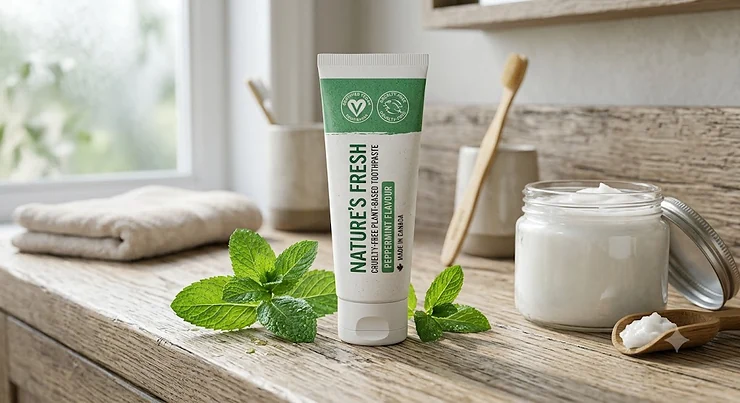
So, what is cruelty-free plant-based toothpaste? In short, it’s toothpaste formulated primarily with plant-derived and mineral ingredients — rather than synthetic detergents, animal-derived glycerin, or propolis — and produced by a company (and its ingredient suppliers) that doesn’t test on animals at any stage of development.
That last part matters more than most shoppers realize, because as of 2023, Health Canada itself now bans cosmetic animal testing outright, which means the Government of Canada’s cosmetic testing ban has effectively raised the floor for every brand selling in this country. That doesn’t mean every “cruelty-free” claim on a shelf is equally trustworthy, though — a legal minimum and a genuine ethical commitment are two different things, and we’ll get into exactly how to tell them apart.
Below, you’ll find seven real, currently available products — budget, mid-range, and premium — each broken down with honest commentary grounded in real specs and aggregated review sentiment, not invented testimonials. We’ll also dig into how plant-based toothpaste stacks up against the conventional stuff, what actually helps with gum health, and how certifications like Leaping Bunny work in practice. Consider this your full decision-making toolkit, not just a shopping list.
Quick Comparison: 7 Cruelty-Free Plant-Based Toothpastes at a Glance
| Product | Best For | Fluoride | Price Range (CAD) |
|---|---|---|---|
| ATTITUDE Fluoride-Free Whitening Toothpaste | Budget-conscious, EWG-verified shoppers | No | C$9–C$12 |
| Green Beaver Hydroxyapatite Extra Whitening Toothpaste | Canadian-made enamel support | No | C$9–C$11 |
| Boka Nano-Hydroxyapatite Whitening Toothpaste | Gum health and remineralization | No | C$16–C$20 |
| Tom’s of Maine Antiplaque & Whitening Toothpaste | Long-time natural-brand loyalists | No | C$7–C$9 |
| Himalaya Botanique Whitening Antiplaque Toothpaste | Ayurvedic ingredient fans | No | C$7–C$9 |
| Burt’s Bees Toothpaste | Simplicity and ADA-recognized formulas | Yes/No options | C$6–C$8 |
| Red Seal Brilliant Mint Whitening Toothpaste | NATRUE-certified natural purists | No | C$10–C$13 |
Looking at the table, the split between fluoride-free and fluoride-containing options is the first fork in the road most buyers hit, and it’s worth noting upfront: fluoride-free doesn’t automatically mean less effective, since hydroxyapatite-based formulas like Boka and Green Beaver lean on a different remineralizing mechanism entirely. Budget shoppers gravitate toward Burt’s Bees, Himalaya Botanique, and Tom’s of Maine, all sitting comfortably under C$9, while the two hydroxyapatite specialists occupy the mid-to-premium end because of their more research-driven formulations. ATTITUDE and Red Seal land in between, offering third-party certification (EWG and NATRUE respectively) as a differentiator worth paying a small premium for.
💬 Just one click — help others make better buying decisions too!😊
Top 7 Cruelty-Free Plant-Based Toothpastes: Expert Analysis
Before the individual breakdowns, here’s the specs side-by-side so you can jump straight to whichever product fits your priorities.
| Product | Key Ingredient Focus | Standout Trait | Price Range (CAD) |
|---|---|---|---|
| ATTITUDE Fluoride-Free Whitening Toothpaste | Hydroxyapatite, green tea extract | Canadian-made, EWG Verified | C$9–C$12 |
| Green Beaver Hydroxyapatite Extra Whitening Toothpaste | Calcium hydroxyapatite 4.25%, papaya enzyme | Ontario-manufactured | C$9–C$11 |
| Boka Nano-Hydroxyapatite Whitening Toothpaste | Nano-hydroxyapatite, aloe, green tea | Gum-health-first formulation | C$16–C$20 |
| Tom’s of Maine Antiplaque & Whitening Toothpaste | Plant-based xylitol, zinc citrate | Longest-standing natural pioneer | C$7–C$9 |
| Himalaya Botanique Whitening Antiplaque Toothpaste | Neem, turmeric, coconut oil | Ayurvedic herbal blend | C$7–C$9 |
| Burt’s Bees Toothpaste | Peppermint oil, hydrated silica | ADA-Accepted formulas available | C$6–C$8 |
| Red Seal Brilliant Mint Whitening Toothpaste | Silica, NATRUE botanicals | Rigorous natural-cosmetics certification | C$10–C$13 |
The spread here tells its own story: three products (Green Beaver, Boka, and to a lesser extent ATTITUDE) build their entire pitch around hydroxyapatite remineralization, while Tom’s of Maine, Himalaya Botanique, and Burt’s Bees stick to the more familiar botanical-and-mild-abrasive formula that’s been around for decades. What most buyers overlook is that price here doesn’t map neatly to effectiveness — it maps mostly to formulation complexity and where the ingredient sourcing happens, since Canadian-manufactured small-batch products like Green Beaver carry different cost structures than mass-imported ones.
1. ATTITUDE Fluoride-Free Whitening Toothpaste — Canadian-made and EWG Verified
The standout here is simple: this is a Quebec-founded brand, and its peppermint whitening formula carries an EWG Verified mark, meaning every ingredient has been screened against the Environmental Working Group’s health-based criteria rather than just a marketing team’s say-so. The formula leans on hydroxyapatite alongside green tea extract, an antioxidant that the brand positions as both a plaque-fighting and enamel-supporting ingredient.
In practice, this means you’re getting a fluoride-free, SLS-free paste designed for people who’ve already decided they want hydroxyapatite in their routine but also care about verified ingredient transparency. Based on the spec comparison with other fluoride-free options on this list, ATTITUDE distinguishes itself less through a dramatically different formula and more through the packaging (cardboard-free) and the third-party ingredient audit, which is a meaningful trust signal in a category full of vague “clean” claims.
Reviewers consistently note the minty flavour is noticeably crisp rather than overly sweet, and several natural-toothpaste roundups highlight the brand’s consistency across its whitening, sensitive, and complete-care lines as a reason families stick with one brand for the whole household. If verified sourcing matters as much to you as the ingredient list itself, this is a genuinely strong starting point — and being Canadian-founded means Canadian regulatory oversight applies from day one.
Pros:
- ✅ EWG Verified — independently audited ingredient list
- ✅ Canadian-founded brand with domestic manufacturing
- ✅ Hydroxyapatite plus green tea for plaque support
Cons:
- ❌ Fluoride-free, so cavity-prone users may want a supplement
- ❌ Smaller 120g tube size than some competitors
At around C$9–C$12, this toothpaste sits at the accessible end of the hydroxyapatite category — the value verdict is strong for anyone who wants third-party verification without paying a premium-brand markup.
2. Green Beaver Hydroxyapatite Extra Whitening Toothpaste — remineralization made in Ontario
Green Beaver has been formulating natural personal-care products out of Hawkesbury, Ontario since 2002, and this particular toothpaste leans hard into that regional identity. Its standout feature is a 4.25% calcium hydroxyapatite concentration paired with 20% xylitol — a combination the brand and independent hydroxyapatite research both point to as effective for enamel remineralization.
The key specs matter in practice here: hydroxyapatite makes up roughly 97% of natural tooth enamel, so a formula built around a bioidentical version of that mineral is working with your teeth’s own chemistry rather than against it, which is the core argument for skipping fluoride altogether. Papaya fruit extract is included specifically for its papain enzyme, which the brand states helps lift surface stains gently rather than through abrasive polishing. Based on the ingredient panel, this reads as a genuinely differentiated formula rather than a fluoride-free paste with a green label slapped on.
Aggregated customer feedback on Amazon.ca skews strongly positive, though it’s worth being transparent that the review pool for this specific product is still modest in size compared to mass-market brands — a common honesty gap in the natural oral care space that’s worth factoring into how much weight you put on any single rating. What most buyers overlook is that a smaller, Canadian-manufactured brand often means shorter supply chains and easier customer-service access if something goes wrong with an order.
Pros:
- ✅ Manufactured in Ontario, Canada, since 2002
- ✅ Clinically-referenced hydroxyapatite concentration
- ✅ Papaya enzyme for gentle, non-abrasive stain removal
Cons:
- ❌ Smaller review sample size than major national brands
- ❌ Not widely stocked outside specialty and online retailers
In the C$9–C$11 range, the value case rests heavily on wanting a genuinely Canadian-made alternative to the big hydroxyapatite names — for that specific priority, it’s hard to beat.
3. Boka Nano-Hydroxyapatite Whitening Toothpaste — the gum-health specialist
Boka built its entire brand identity around nano-hydroxyapatite (n-Ha), a particle-size variant of the same mineral used in the two previous entries, and this whitening formula is explicitly marketed around gum health and enamel repair rather than just cosmetic whitening. The standout feature is the inclusion of an oral health advisory committee — including a dental school dean and a former Colgate R&D executive — which the brand cites as informing its formulation choices, a form of scientific accountability that’s uncommon in the natural toothpaste space.
What this means in practice: the smaller particle size of nano-hydroxyapatite is theorized (and, per the brand, researched) to integrate more effectively into microscopic enamel defects than standard hydroxyapatite, and the formula pairs it with aloe vera, xylitol, and green tea for a rounded oral-microbiome-friendly profile. Here’s what to weigh — this is a US-manufactured product priced noticeably higher than the rest of this list, so you’re paying for formulation specificity and brand-level scientific positioning rather than exotic ingredients.
Reviewers across major retail platforms consistently report strong satisfaction with the mint flavour profile and a perceived reduction in sensitivity after consistent use, with aggregate ratings sitting comfortably above 4.5 out of 5 across tens of thousands of verified purchases — a genuinely large and credible sample size compared to the smaller Canadian brands on this list. If your specific concern is gum health rather than general whitening, this is the product on this list built most directly around that use case.
Pros:
- ✅ Large, consistently strong aggregate review base
- ✅ Formulated with dental-professional input
- ✅ Nano-particle size for enamel micro-defect penetration
Cons:
- ❌ Priciest option on this list at C$16–C$20
- ❌ Manufactured in the US, not Canada
Given the price, the value verdict depends on your priority — if gum health is genuinely your top concern rather than an afterthought, the premium is defensible; if you just want a solid daily fluoride-free paste, cheaper options on this list perform comparably.
4. Tom’s of Maine Antiplaque & Whitening Toothpaste — the natural-oral-care pioneer
Tom’s of Maine has been a household name in natural personal care since the 1970s, long before “clean beauty” was a marketing category, and its Antiplaque & Whitening formula is built around plant-derived xylitol and zinc citrate rather than synthetic whitening agents. The standout feature is genuinely historical: this brand helped define what a natural toothpaste even looks like for a generation of North American shoppers.
Here’s the honesty-first caveat worth stating clearly: Tom’s of Maine confirms its glycerin is plant-sourced and the brand itself maintains a cruelty-free testing policy, but it’s owned by Colgate-Palmolive — a parent company that isn’t considered cruelty-free as a whole, and not every product in the Tom’s of Maine lineup is fully vegan, so label-checking still matters even with a trusted name. That’s the kind of nuance a rewritten Amazon listing would never mention, and it’s exactly why parent-company ownership deserves a look before you assume a subsidiary brand’s ethics apply company-wide.
Reviewers consistently describe the mint flavour as milder and less “medicinal” than mainstream drugstore pastes, which tends to appeal to people transitioning away from conventional toothpaste for the first time. Based on the spec comparison, this is a solid, unremarkable-in-a-good-way entry point rather than a cutting-edge formulation — reliable, widely available, and easy to find in almost any Canadian pharmacy.
Pros:
- ✅ Decades of natural-formulation track record
- ✅ Plant-derived xylitol and zinc citrate whitening system
- ✅ Widely available in Canadian pharmacies and grocery stores
Cons:
- ❌ Owned by Colgate-Palmolive, a non-cruelty-free parent company
- ❌ Not every product line is fully vegan-certified
At C$7–C$9, this is an easy, low-risk starting point for anyone dipping a toe into plant-based toothpaste for the first time, provided you’re comfortable with the parent-company nuance above.
5. Himalaya Botanique Whitening Antiplaque Toothpaste — Ayurvedic botanicals on a budget
Himalaya Botanique brings an entirely different formulation philosophy to this list, drawing on Ayurvedic herbal traditions with neem, turmeric, and coconut oil as its standout combination. Neem has centuries of traditional use for oral hygiene, and turmeric is included for its natural staining-resistance properties despite turmeric itself being a notoriously staining pigment in food — a genuinely interesting formulation choice worth understanding rather than dismissing at face value.
What the spec sheet won’t tell you outright is that this brand’s oral care line is entirely vegan across the board, according to brand disclosures, with the one caveat being that some of Himalaya’s broader skincare and supplement lines contain beeswax or honey — so oral care specifically is a safe vegan bet within this brand’s catalogue, but it’s not a blanket guarantee across everything they sell. That kind of category-specific accuracy matters more than a brand-wide “we’re vegan!” banner.
Aggregated reviewer sentiment frequently highlights the herbal, slightly earthy flavour profile as a genuine departure from mint-dominant toothpaste, which some buyers love and others find takes real adjustment. Reviewers consistently note effective plaque removal and a pleasant lack of the burning-sensation aftertaste some SLS-containing pastes cause, particularly for people with sensitive gums or mouth ulcers.
Pros:
- ✅ Fully vegan oral care line
- ✅ Traditional neem and turmeric formulation
- ✅ SLS-free, gentle on sensitive gum tissue
Cons:
- ❌ Herbal flavour is a genuine adjustment for mint loyalists
- ❌ Turmeric-based formulas can require a brighter toothbrush to spot residue
At roughly C$7–C$9, this is one of the most budget-friendly fully-vegan options on the list, and a genuinely interesting pick for anyone curious about traditional herbal oral care rather than the standard mint-and-mineral formula.

6. Burt’s Bees Toothpaste — simplicity with dental-body recognition
Burt’s Bees brings a straightforward, no-frills formula to this list, built around peppermint essential oil and hydrated silica, with both fluoride and fluoride-free variants available depending on your preference. The standout feature is genuinely notable: certain Burt’s Bees formulas carry ADA Accepted status, meaning they’ve gone through the American Dental Association’s ingredient and efficacy review process — a level of independent scrutiny that most “natural” toothpaste brands never pursue.
In practice, this means you get the reassurance of dental-body-level review alongside the SLS-free, dye-free, artificial-sweetener-free formulation that natural-toothpaste shoppers are typically looking for. Based on the spec comparison, this is arguably the safest “bridge” product on this list for someone whose dentist is skeptical of fluoride-free switching — you can pick the fluoride variant and still avoid the synthetic detergents and artificial flavours found in most drugstore tubes.
Reviewers consistently describe the flavour as clean and unobtrusive rather than intensely minty, and the brand’s decades of trust in the broader natural personal-care market (thanks to its lip balm origins) tends to carry over into buyer confidence with its oral care line, even though Burt’s Bees itself is now owned by Clorox rather than operating fully independently.
Pros:
- ✅ ADA Accepted status on select formulas
- ✅ Both fluoride and fluoride-free options available
- ✅ SLS-free, dye-free, widely trusted brand name
Cons:
- ❌ Owned by Clorox, not an independent small brand
- ❌ Less specialized than hydroxyapatite-focused competitors
At C$6–C$8, this is the most budget-accessible pick on the entire list, and the ADA-review detail alone makes it a genuinely defensible “safe default” for cautious first-time switchers.
7. Red Seal Brilliant Mint Whitening Toothpaste — NATRUE-certified natural purism
Red Seal, a New Zealand-founded natural personal-care brand, closes out this list with a formula that’s earned NATRUE certification — a European natural-cosmetics standard that’s considerably stricter than most self-declared “natural” labelling in North America. The standout feature is exactly that certification: NATRUE audits actual ingredient sourcing and manufacturing processes rather than accepting a brand’s own claims at face value.
What this means practically is that every ingredient in this silica-based whitening formula has been vetted against a documented natural-origin standard, no synthetic colours or artificial flavours are present, and the brand maintains vegan, fluoride-free, paraben-free, and SLS-free status simultaneously — a fairly demanding combination to hit while still producing an effective, pleasant-tasting paste. Based on the spec comparison with the EWG-verified and brand-declared “natural” products on this list, NATRUE arguably represents the single most rigorous third-party bar on this entire roundup.
Reviewer sentiment aggregated from natural-oral-care roundups consistently praises the mint flavour as genuinely “brilliant” rather than muted, which is a common complaint levelled at heavily botanical formulas. The trade-off is availability — as an imported brand, it isn’t stocked in as many Canadian pharmacies as domestic names, so online ordering through Amazon.ca is typically the most reliable path.
Pros:
- ✅ NATRUE certified — rigorous natural-cosmetics standard
- ✅ Vegan, fluoride-free, paraben-free, and SLS-free
- ✅ Strong flavour despite an all-natural formulation
Cons:
- ❌ Limited in-person retail availability across Canada
- ❌ Mid-premium pricing relative to domestic budget options
At C$10–C$13, this is the pick for anyone who treats third-party certification as a non-negotiable — the NATRUE mark alone justifies the modest premium over unaudited “natural” claims.
Price Range & Value Analysis
| Tier | Products | Typical Price (CAD) | Best For |
|---|---|---|---|
| Budget | Burt’s Bees, Himalaya Botanique, Tom’s of Maine | C$6–C$9 | First-time switchers |
| Mid-range | ATTITUDE, Green Beaver, Red Seal | C$9–C$13 | Certification-conscious buyers |
| Premium | Boka | C$16–C$20 | Gum-health-focused users |
Cost-per-use tells a slightly different story than sticker price, though — a C$8 tube used properly at a pea-sized amount twice daily typically lasts six to eight weeks, meaning even the “premium” Boka works out to roughly C$3 per month more than the budget tier once you actually run the numbers. On paper this means the real financial gap between tiers is smaller than it first appears, so the smarter question is rarely “which is cheapest” but rather “which formulation actually addresses what I need” — whitening, sensitivity, or gum support specifically.
Getting Started: A Practical Usage Guide for Switching to Plant-Based Toothpaste
Switching from a conventional SLS-foaming toothpaste to a plant-based, often fluoride-free formula isn’t always a seamless first brush, and knowing what to expect in the first month makes the transition far less confusing.
In the first week, expect noticeably less foam — SLS is a foaming agent, and its absence is often mistaken for the toothpaste “not working,” when in reality foam has no bearing on cleaning effectiveness. Brush for the full two minutes regardless of how little lather you see, since the mechanical action of the brush is doing the actual plaque removal, not the suds.
If you’re switching to a hydroxyapatite formula like Green Beaver or Boka, most brands recommend not rinsing immediately after brushing, letting a thin mineral layer sit on your enamel for a few extra minutes to maximize the remineralization effect — a small habit change that’s easy to forget out of decades-old muscle memory. A common mistake in the first 30 days is judging “whitening” results too early; most plant-based whitening formulas work through gentle stain removal over several weeks rather than the faster (and more abrasive) peroxide-based bleaching found in some conventional products.
For maintenance, store your tube away from direct sunlight and heat, since natural preservative systems are generally less robust than synthetic ones and can shorten shelf stability in a hot bathroom. Most plant-based tubes carry a 12–24 month best-before window once opened — check the batch code on the crimped end of the tube if you’re unsure how fresh your current one is.
Real-World Scenarios: Which Toothpaste Fits Your Life
Sometimes the fastest way to choose is seeing yourself in a specific situation rather than scanning specs in the abstract.
If you’re a university student in Toronto on a tight budget who just wants an easy switch away from mainstream drugstore brands, Himalaya Botanique or Burt’s Bees make the most sense — both sit under C$9, are widely available, and don’t require any habit relearning beyond the flavour adjustment.
If you’re a parent in Vancouver managing sensitive gums after a period of aggressive brushing, Boka or Green Beaver are worth the higher price point specifically because their hydroxyapatite formulations are positioned around remineralization and gentleness rather than abrasive whitening — the kind of targeted formulation a general drugstore aisle rarely offers.
If you’re someone who’s already deep into the clean-beauty and ethical-consumerism space and treats third-party certification as a baseline requirement, ATTITUDE or Red Seal are the obvious picks — EWG Verified and NATRUE certification respectively give you documentation to point to rather than a brand’s own marketing copy.
Your Buyer’s Decision Framework
If cost is your primary constraint, choose Burt’s Bees or Himalaya Botanique, because both stay under C$9 without sacrificing a genuinely SLS-free, cruelty-free formula.
If gum sensitivity or enamel concerns are your main driver, choose Boka or Green Beaver, because hydroxyapatite-based remineralization is specifically formulated around that use case rather than general whitening.
If third-party certification is non-negotiable for you, choose ATTITUDE (EWG Verified) or Red Seal (NATRUE certified), because both have documented, auditable ingredient standards rather than self-declared “natural” claims.
If you want the lowest-risk bridge from a conventional brand, choose Tom’s of Maine, because its decades-long track record and pharmacy availability make it the easiest first step, provided you’re comfortable with its Colgate-Palmolive ownership.
✨ Don’t Miss These Exclusive Deals!
🔍 Take your oral care routine to the next level with these carefully selected picks. Click on any highlighted product to check current pricing and availability on Amazon.ca. These formulas can help you build an ethical, plant-based brushing routine your whole household will stick with!
How to Choose Cruelty-Free Plant-Based Toothpaste
Picking the right tube comes down to seven decision points, roughly in order of importance:
- Verify the certification, not just the label. A “cruelty-free” claim printed on packaging isn’t independently audited by default — look for a named certifier like Leaping Bunny, EWG Verified, or NATRUE.
- Decide on fluoride early. This is a genuinely personal and sometimes dentist-guided decision; hydroxyapatite is the leading fluoride-free alternative, but fluoride still has the longest clinical track record for cavity prevention.
- Match the formula to your actual concern. Whitening, sensitivity, and gum health are different problems with different ideal ingredients — don’t buy a general formula if you have a specific issue.
- Check the full ingredient list for animal-derived items. Glycerin and propolis are the two most common non-obvious animal-derived ingredients that slip into otherwise “natural” toothpaste.
- Consider the parent company, not just the brand name. As with Tom’s of Maine, a cruelty-free subsidiary can still be owned by a company with a mixed animal-testing record.
- Weigh domestic versus imported manufacturing. Canadian-made options like Green Beaver and ATTITUDE typically mean shorter supply chains and more direct customer support.
- Read the actual price per gram, not just the sticker price. Tube sizes vary significantly across this category, and the cheapest-looking option isn’t always the best value per use.
Plant-Based Toothpaste vs Regular Toothpaste
This is the comparison most shoppers actually want answered before they commit to switching, so let’s get specific rather than vague.
| Factor | Plant-Based Toothpaste | Regular (Conventional) Toothpaste |
|---|---|---|
| Common cleaning agent | Silica, baking soda, hydroxyapatite | SLS or SLES foaming detergents |
| Fluoride | Often absent (brand-dependent) | Almost always present |
| Animal testing (typical) | Cruelty-free by design | Varies by brand and parent company |
| Flavour profile | Milder, herbal, or mineral-forward | Strong, often artificially intensified mint |
| Foaming | Minimal to none | High foam volume |
Looking at the table, the biggest practical difference isn’t ethics-related at all — it’s the sensory experience. Conventional toothpaste is engineered for a strong foaming, tingling sensation that many of us associate (incorrectly) with “clean,” while plant-based toothpaste for gum health and general use tends to prioritize gentleness, which can genuinely feel underwhelming during the first few brushes even when it’s working just as well mechanically.
On the cavity-prevention question specifically, conventional fluoride toothpaste still has the deepest body of clinical research behind it, and dentists generally continue recommending fluoride for high cavity-risk patients regardless of brand ethics — a genuinely honest caveat that no toothpaste marketing page will lead with. What most buyers overlook is that “plant-based” and “fluoride-free” aren’t actually the same thing; several products on this list, including select Burt’s Bees formulas, offer plant-based ingredients alongside fluoride, so you don’t necessarily have to choose one priority over the other.
Cruelty-Free Plant-Based Toothpaste for Gum Health
Gum health deserves its own section because it’s frequently treated as an afterthought behind whitening, when in reality it’s arguably the more consequential long-term concern. According to Canada’s public health guidance on gum disease, gingivitis begins with plaque buildup along the gumline and, left untreated, can progress into periodontitis — a condition that damages the bone and tissue supporting your teeth permanently, not just cosmetically.
Here’s what the spec sheet won’t tell you outright: no toothpaste, plant-based or otherwise, substitutes for proper brushing technique and daily flossing when it comes to gum health — the formula supports the routine, it doesn’t replace it. That said, hydroxyapatite-forward formulas like Boka and Green Beaver are specifically positioned around supporting the tissue and enamel interface rather than just masking symptoms with menthol-driven “freshness,” which is a genuinely different design philosophy than a standard whitening paste.
For anyone managing early gum sensitivity or occasional bleeding when brushing, potassium nitrate — found in some Green Beaver and ATTITUDE sensitive-line formulas — is included specifically to calm nerve sensitivity over consistent use, typically over two to four weeks rather than overnight. If bleeding, swelling, or persistent tenderness continues despite a consistent routine and a gum-focused toothpaste, that’s a signal to see a dental professional rather than simply switching products again — toothpaste can support gum health, but it can’t diagnose or treat active periodontal disease on its own.
Leaping Bunny Certification and Animal Testing Policy: How to Verify Real Cruelty-Free Claims
“Cruelty-free” is one of the most under-regulated claims in consumer packaged goods, which is exactly why understanding what Leaping Bunny certification actually verifies matters more than reading the word “cruelty-free” on a box.
What Leaping Bunny Certification Actually Checks
The Leaping Bunny Program, operated by the Coalition for Consumer Information on Cosmetics, requires certified brands to sign a pledge covering every stage of product development, extend that same pledge down through their ingredient suppliers, undergo on-site audits to verify compliance, and recommit annually rather than earning the logo once and keeping it indefinitely. That supplier-level requirement is the detail most consumers miss — a brand can genuinely not test its finished product on animals while still sourcing raw ingredients from a supplier that does, and Leaping Bunny specifically closes that loophole.
Understanding a Brand’s Animal Testing Policy Beyond the Logo
Not every ethical brand pursues Leaping Bunny certification, often for cost or bureaucratic reasons rather than a lack of genuine commitment, so the absence of the logo isn’t automatically disqualifying. What’s worth checking instead is whether a brand publishes a specific, dated animal testing policy on its own website — language like “we have never and will never test on animals, nor do we authorize others to test on our behalf” is meaningfully stronger than a vague “cruelty-free” badge with no elaboration.
It’s also worth noting a genuinely important nuance for cross-border shoppers: brands that sell into markets requiring animal testing by law (most notably mainland China, historically) can lose Leaping Bunny certification even if their North American operations never test on animals, because the certification standard treats any market requiring animal testing as disqualifying for the whole brand. That’s a stricter bar than most consumers realize, and it’s part of why Leaping Bunny is widely considered the gold-standard label in this specific category.
Common Mistakes When Buying Cruelty-Free Plant-Based Toothpaste
Even careful, well-intentioned shoppers fall into a handful of predictable traps in this category.
The first is assuming “natural” and “cruelty-free” are the same claim — they aren’t. A toothpaste can be marketed heavily around botanical ingredients while the parent company still tests elsewhere in its portfolio, which is precisely the Tom’s of Maine-and-Colgate situation covered earlier on this list.
The second is overlooking glycerin’s origin. Glycerin can be derived from either plant oils or animal fat, and most packaging simply says “glycerin” without specifying which — a genuinely frustrating gap in labelling transparency that even careful shoppers regularly miss.
The third is judging efficacy purely by foam volume, a habit built by decades of SLS-heavy marketing that has nothing to do with actual cleaning performance.
The fourth is ignoring fluoride entirely out of an assumption that “natural equals better,” when in reality your individual cavity risk, water fluoridation levels in your municipality, and dental history should inform that decision far more than ideology.
The fifth mistake is trusting review counts without checking their size — a product with a glowing 4.8-star average built on six total reviews carries far less statistical weight than a 4.5-star average built on tens of thousands, and treating those two numbers as equally trustworthy is a genuinely common error.
Ethical Skincare Brands and the Bigger Cruelty-Free Picture
Toothpaste rarely exists in isolation on someone’s bathroom shelf, and the same due-diligence habits that apply here extend naturally to ethical skincare brands more broadly — moisturizers, cleansers, and sunscreens face the exact same “natural” versus “verified” gap.
The parent-company nuance covered earlier with Tom’s of Maine applies just as directly across skincare: plenty of genuinely well-formulated, cruelty-free-labelled skincare lines sit under ownership umbrellas with a mixed animal-testing history, and the only reliable way to know for certain is checking the brand’s specific, standalone certification status rather than assuming ethics trickle down from a subsidiary to its parent, or vice versa.
What’s genuinely encouraging is that Canada’s regulatory environment now backs this up at a national level — with cosmetic animal testing banned outright as of December 2023, every skincare and oral-care brand selling in Canada is operating under the same legal floor, even if their voluntary certifications vary. That’s a meaningfully different landscape than five years ago, and it’s part of why doing this kind of research now yields more trustworthy answers than it would have in the past.
Frequently Asked Questions
❓ Is plant-based toothpaste actually cruelty-free?
❓ Does cruelty-free toothpaste work as well as regular toothpaste?
❓ Is Colgate or Crest cruelty-free?
❓ What ingredient makes toothpaste not vegan?
❓ Where can I buy cruelty-free plant-based toothpaste in Canada?
Conclusion
Choosing a cruelty-free plant-based toothpaste doesn’t have to mean wading through vague marketing claims or guessing whether “natural” actually means anything. The seven products covered here span the real range Canadian shoppers can currently buy — from the budget-friendly familiarity of Himalaya Botanique and Burt’s Bees, through the certification-backed confidence of ATTITUDE and Red Seal, up to the gum-health specialization of Boka and the homegrown formulation of Green Beaver.
The honest takeaway is that no single product on this list is objectively “the best” — the right pick depends entirely on whether your priority is cost, certification, gum sensitivity, or simply an easy first step away from conventional toothpaste. What matters most is applying the verification habits covered throughout this guide: checking for genuine certification rather than a bare “cruelty-free” label, understanding parent-company ownership, and matching the formula to your actual dental concern rather than the flashiest marketing claim on the tube.
Canada’s 2023 cosmetic animal testing ban has raised the baseline for everyone selling here, which means you’re starting from a stronger position than shoppers had even a few years ago — use that, plus the research in this guide, to make a choice you can actually stand behind.
✨ Ready to Make the Switch?
🔍 Check current pricing and availability on any of these seven picks directly on Amazon.ca, and start building an oral care routine that’s honest about what’s actually in the tube — and how it got there!
Recommended for You
- Plant-Based Toothpaste 2026: 7 Vegan Picks Canadians Love
- Organic Whitening Toothpaste Canada: 7 Real Picks (2026)
- Organic Toothpaste vs Natural Toothpaste: 7 Honest Picks (2026)
Disclaimer: This article contains affiliate links. As an Amazon Associate, I earn from qualifying purchases. If you purchase products through these links, we may earn a small commission at no additional cost to you.
✨ Found this helpful? Share it with your friends! 💬🤗
