In This Article
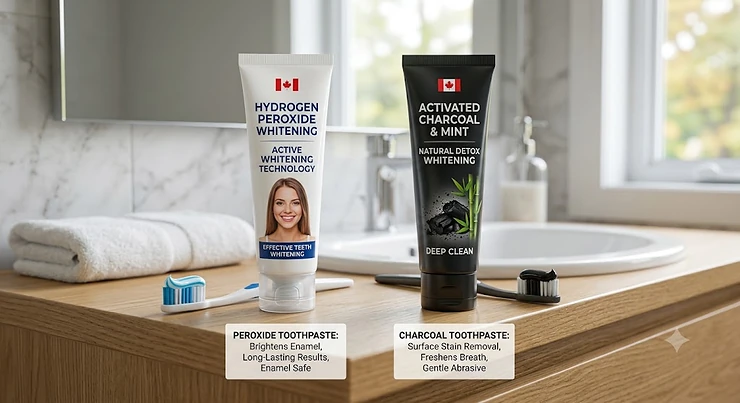
Stand in the toothpaste aisle at your local Shoppers Drug Mart for more than thirty seconds and you’ll spot the split immediately: on one side, glossy tubes promising “science-backed” whitening; on the other, matte black tubes leaning hard into the natural, no-nonsense aesthetic. That’s the peroxide toothpaste vs charcoal toothpaste debate playing out in real time, right there under the fluorescent lights, and it’s a genuinely confusing one to referee on your own.
Here’s the short version before we go deep: peroxide toothpaste uses hydrogen or carbamide peroxide — an actual bleaching agent — to change the colour of your enamel from the inside out. Charcoal toothpaste, meanwhile, relies on the physical grab-and-scrub action of porous carbon to lift surface stains without touching the tooth’s underlying colour at all. One is chemistry. The other is closer to a very fine-grit polish. Neither is inherently “better” — they’re built to solve different problems, and honestly, most of the marketing around both categories oversells what a tube of toothpaste can realistically do in the first place.
What follows is a research-based, Canadian-focused breakdown: seven real products spanning budget to premium, honest analysis of what the research and Canadian dental regulators actually say, and a practical framework for picking the one that fits your teeth, not just your Instagram feed. We’ll cover peroxide toothpaste for whitening, peroxide toothpaste for stain removal, enamel safety, whitening speed, and — because it comes up in every dental office in the country — dentist opinions on DIY whitening.
Quick Comparison Table: Peroxide vs Charcoal at a Glance
Before we get into individual products, here’s the category-level cheat sheet. Think of this as the CliffsNotes version you’d want your dentist to text you while you’re standing in the aisle.
| Category | How It Works | Whitening Depth | Enamel Risk | Best For |
|---|---|---|---|---|
| Peroxide toothpaste | Chemical oxidation bleaches stain molecules below the surface | Intrinsic + extrinsic stains | Low, if used as directed | People wanting measurable colour change |
| Charcoal toothpaste | Porous carbon physically adsorbs and buffs away surface debris | Extrinsic (surface) stains only | Moderate — abrasiveness varies widely by brand | People avoiding peroxide or bleach entirely |
| Baking-soda hybrids | Mild alkaline polish plus, often, added peroxide | Mild to moderate | Low to moderate | Daily drivers wanting gentle, gradual change |
Peroxide products win on raw whitening power because they’re doing actual chemistry — breaking apart the pigmented compounds that have worked their way into your enamel and dentin. Charcoal products can only address what’s sitting on the surface, which is why reviewers who see charcoal “work” are usually seeing coffee and wine residue disappear, not a genuine shade change underneath. That distinction matters more than almost anything else in this whole comparison, and we’ll come back to it constantly.
Just one click — help others make better buying decisions too! 😊
Top 7 Peroxide and Charcoal Toothpastes: Expert Analysis
We pulled together seven real, currently available products — a mix of budget, mid-range, and premium options across both categories — so you can compare like with like. Every product below includes honest, spec-grounded commentary; where we couldn’t verify individual customer quotes, we’ve said so rather than inventing them.
1. Colgate Optic White Renewal — highest peroxide concentration in a Colgate tube
Colgate Optic White Renewal leads with a 3–5% hydrogen peroxide formula, depending on the specific SKU, which Colgate markets as its strongest whitening toothpaste to date. That percentage matters more than it sounds like it should: most drugstore whitening toothpastes hover around 1–2% hydrogen peroxide (or skip it entirely in favour of silica polishing), so Colgate Optic White Renewal is playing a genuinely different game.
In practice, the fluoride content (0.76% sodium monofluorophosphate) means you’re not sacrificing cavity protection for whitening power, which isn’t true of every product on this list. Based on the spec comparison, this is the toothpaste for someone who wants a single tube doing double duty — daily protection and gradual bleaching — without adding a separate whitening step to their routine. Reviewers on major Canadian retail sites consistently mention a “slightly odd” taste that fades with a few uses, and several note visible improvement after roughly four weeks of twice-daily brushing, which lines up with Colgate’s own stated testing window.
Pros:
- ✅ Highest peroxide concentration Colgate sells in a toothpaste format
- ✅ Fluoride included, so cavity protection isn’t traded away for whitening
- ✅ Consistently stocked at well.ca and major Canadian pharmacies
Cons:
- ❌ Higher price tier than standard whitening toothpaste
- ❌ Some users report temporary sensitivity in the first two weeks
Expect to pay in the C$9-C$14 range for a single tube, depending on size and retailer — always check current price, since Colgate runs frequent promotions. For anyone specifically chasing measurable whitening rather than surface polish, this is the strongest value case on the list.
2. Curaprox Black is White — Swiss activated carbon that won’t scratch enamel
Here’s where the charcoal-toothpaste story gets more nuanced than the “charcoal is bad, full stop” narrative suggests. Curaprox Black is White isn’t loose charcoal powder blended into paste — it’s activated carbon integrated at the manufacturing stage, which changes the abrasiveness profile substantially. Its RDA (relative dentin abrasiveness) score sits around 50–76, which is comparable to — or gentler than — many standard whitening toothpastes on the market.
What most buyers overlook about charcoal products generally is that the format matters enormously: loose powder rubbed against enamel is a very different mechanism than carbon bound into a homogeneous paste that adsorbs stains rather than scrubbing them off. Curaprox Black is White also carries a Health Canada Natural Product Number for anticaries protection thanks to its sodium fluoride content, plus added hydroxyapatite for remineralization — features that put real oral-health substance behind the trendy black paste aesthetic. This is honestly the charcoal pick we’d point a skeptical dentist toward first, precisely because it doesn’t ask you to give up fluoride to get the charcoal effect.
Pros:
- ✅ Non-abrasive activated carbon, not loose scrubbing powder
- ✅ Health Canada-recognized anticaries formula with fluoride
- ✅ Hydroxyapatite supports enamel remineralization
Cons:
- ❌ Premium import pricing compared with drugstore charcoal
- ❌ Smaller 90 mL tube empties faster than typical North American sizes
Pricing sits at the premium end of the spectrum — typically in the C$18-C$25 range per tube at Canadian dental-adjacent retailers — so check current price before assuming drugstore-level cost. If you want the charcoal aesthetic without the abrasion anxiety, this is worth the premium.
3. Crest Plus Baking Soda & Peroxide Whitening Toothpaste — best budget pick for daily peroxide whitening
Crest Plus Baking Soda & Peroxide Whitening Toothpaste is the toothpaste equivalent of a reliable used Corolla: not flashy, but it starts every time and does the job. It combines a modest hydrogen peroxide concentration with baking soda’s mild alkaline polish, which is a genuinely sensible pairing — the baking soda helps buff away the surface stains that peroxide alone leaves behind, while the peroxide handles what’s underneath.
Here’s what the spec sheet won’t tell you, but reviewers note repeatedly: the whitening effect is real but gradual, and it’s most noticeable to people who’ve never used a whitening-specific toothpaste before. Multiple aggregated reviews on Walmart and retail platforms describe the formula as “surprisingly effective” for the price point, particularly for coffee and tea drinkers dealing with everyday extrinsic stains. This isn’t a toothpaste that’s going to compete with in-office bleaching, but as an everyday driver for someone who just wants gradual improvement without spending premium dollars, it earns its spot.
Pros:
- ✅ Most affordable peroxide option on this entire list
- ✅ Baking soda and peroxide combination tackles two stain types at once
- ✅ Widely stocked at Walmart and major Canadian grocery chains
Cons:
- ❌ Lower peroxide concentration means slower, subtler results
- ❌ A handful of reviewers describe the mint flavour as stronger than expected
At around C$4-C$7 for a multi-pack tube, this is the entry point for anyone curious about peroxide toothpaste without committing to a premium price. Value-wise, it’s hard to beat for the category.
4. Cali White Activated Charcoal & Organic Coconut Oil Toothpaste — cult-favourite budget charcoal with zero peroxide
If Curaprox Black is White is the clinical, dentist-friendly charcoal option, Cali White Activated Charcoal & Organic Coconut Oil Toothpaste is the crunchy-granola crowd favourite. It skips fluoride, peroxide, and SLS entirely, leaning instead on activated charcoal, diatomaceous earth, and coconut oil for a formula that reads like an ingredient list you could pronounce out loud at a farmers’ market.
The diatomaceous earth is doing meaningful work here — it adds a gentle mechanical polish that complements the charcoal’s adsorption properties, rather than relying on charcoal alone to do all the heavy lifting. Aggregated customer sentiment across major retail platforms is unusually positive for a charcoal product, with tens of thousands of five-star ratings, though it’s worth being honest that star ratings on a bestselling product tend to skew positive regardless of category. What most buyers overlook is that “zero peroxide” is a feature, not a limitation, for the specific audience this product targets — people actively avoiding bleaching agents for personal or sensitivity reasons.
Pros:
- ✅ Completely peroxide-free and fluoride-free formula
- ✅ Diatomaceous earth adds gentle polishing alongside the charcoal
- ✅ Large aggregated review base with consistently strong ratings
Cons:
- ❌ No fluoride means it can’t be your only cavity defence
- ❌ Loose-feeling paste can be messier in the sink than standard formulas
Expect a C$13-C$17 range per tube, which puts it firmly mid-tier for a specialty natural product. If you’re specifically shopping “peroxide toothpaste for whitening” alternatives because you want to avoid bleach entirely, this is one of the better-reviewed options in that lane.
5. Arm & Hammer PeroxiCare Clean Mint — best for gum health alongside whitening
Arm & Hammer PeroxiCare Clean Mint takes a slightly different angle than the other peroxide products here: it’s positioned as much for gum health as for whitening, pairing hydrogen peroxide with the brand’s signature baking soda base. The company’s broader Truly Radiant and Advance White lines lean into “Liquid Calcium Technology” for enamel repair, and the PeroxiCare formulation specifically emphasizes peroxide’s mild antibacterial action around the gumline, not just its stain-lifting effect on enamel.
Based on the spec comparison, this product occupies an interesting middle ground: it’s not chasing the aggressive whitening numbers of Colgate Optic White Renewal, but it’s also not purely cosmetic like some baking-soda-only formulas. Aggregated reviews on major retail platforms are strongly positive — one Amazon listing shows tens of thousands of ratings averaging well above 4.5 stars — with repeat buyers specifically citing the “clean feeling” and gum comfort over pure whitening claims. That’s a useful signal: this is a toothpaste people keep buying for maintenance, not a one-time whitening experiment.
Pros:
- ✅ Combines hydrogen peroxide with baking soda for a two-pronged clean
- ✅ Marketed and reviewed specifically for gum health, not just whitening
- ✅ Reliable multi-pack pricing through subscription ordering
Cons:
- ❌ Stock has been inconsistent at some Canadian retailers
- ❌ Peroxide taste is more noticeable than newer gel-style formulas
Pricing typically falls in the C$5-C$8 range per tube when bought individually, with better per-unit value in multi-packs. Worth a look if gum sensitivity is as much a concern for you as tooth colour.
6. Hello Activated Charcoal Epic Whitening Toothpaste — fluoride-free vegan charcoal formula
Hello Activated Charcoal Epic Whitening Toothpaste built an entire brand identity around being the approachable, lowercase-logo alternative to clinical dental products, and the charcoal formula reflects that positioning. It’s vegan, fluoride-free, alcohol-free, and made with bamboo-sourced charcoal powder — a detail that matters to buyers who care about sourcing transparency in a category that doesn’t always volunteer that information.
What the ingredient list won’t tell you outright is how the formula balances abrasiveness: hydrated silica handles the actual polishing work, while the charcoal powder itself contributes more to the visual and marketing story than to raw whitening mechanics — a nuance the University of Alberta’s dental faculty has pointed out about charcoal products generally. Coconut oil and xylitol soften the brushing experience considerably compared with more austere charcoal formulas, which likely explains its strong repeat-purchase reviews on retail platforms. If you’re going charcoal specifically because you want to sidestep fluoride and synthetic whitening agents, this is one of the more refined options available.
Pros:
- ✅ Vegan, fluoride-free, alcohol-free formula with transparent sourcing
- ✅ Bamboo-derived charcoal supports a more sustainable supply story
- ✅ Coconut oil and xylitol soften the typically gritty charcoal feel
Cons:
- ❌ No fluoride means it shouldn’t be a sole, long-term cavity defence
- ❌ Charcoal residue can stain porous countertops and grout if left unrinsed
Look for it in the C$10-C$13 range for a standard tube. It’s a solid middle-of-the-road charcoal pick for anyone who wants the aesthetic and the “natural” formulation without going full DIY powder.
7. Colgate Baking Soda and Peroxide Whitening Toothpaste — everyday hybrid for gradual whitening
Rounding out the list, Colgate Baking Soda and Peroxide Whitening Toothpaste is the toothpaste most likely to already be sitting in a Canadian bathroom cabinet somewhere. It’s not trying to be Colgate Optic White Renewal — the peroxide concentration is meaningfully lower — but it’s a genuinely sensible everyday hybrid that pairs baking soda’s gentle abrasive polish with a modest whitening boost.
The honest analytical read here: this is a maintenance toothpaste, not a transformation toothpaste. It’s well-suited to someone who already has reasonably light-coloured teeth and wants to prevent new staining while getting a small whitening bump over months of use, rather than someone hoping to erase years of coffee and red wine in a few weeks. Aggregated reviews from Walmart and Influenster consistently describe the “clean, just-left-the-dentist” feeling and note gradual whitening rather than dramatic change — which tracks with what the formula is actually capable of delivering.
Pros:
- ✅ Familiar Colgate formula at a genuinely drugstore price point
- ✅ Fluoride included for everyday cavity protection
- ✅ Gentle enough for long-term daily use without sensitivity concerns
Cons:
- ❌ Whitening effect is gradual and modest, not dramatic
- ❌ Noticeably lower peroxide concentration than the Renewal line
Expect a C$4-C$7 range for a standard tube — genuinely one of the most accessible entries in this whole roundup, and a sensible default if you’re not sure yet which side of the peroxide toothpaste vs charcoal toothpaste debate you land on.
Practical Usage Guide: Getting the Most From Either Toothpaste
Buying the right tube is only half the equation — how you use it determines whether you see results in four weeks or four months. Here’s what dental hygienists generally recommend, adapted for both product types.
For peroxide toothpaste, consistency beats intensity. Brushing three times a day with a peroxide formula doesn’t speed up results proportionally; it mostly just increases the odds of sensitivity. Twice daily, two minutes per session, for the full four-week window most brands test against, is the realistic path to seeing the “removes years of stains” claims actually materialize. Avoid pairing peroxide toothpaste with acidic foods or drinks immediately before or after brushing — the softened enamel surface right after brushing is more vulnerable to erosion from coffee, citrus, or wine in that narrow window.
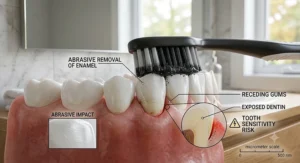
For charcoal toothpaste, the biggest first-30-days mistake is over-brushing out of enthusiasm. Because charcoal relies partly on mechanical action, it’s tempting to scrub harder expecting faster results — that’s exactly backwards, and it’s the behaviour dentists warn about most consistently. A soft-bristled brush, gentle pressure, and two minutes is the ceiling, not the floor. Rinse your sink promptly after use (charcoal stains grout more readily than most people expect), and consider limiting charcoal brushing to three to four times a week rather than every single brushing session, alternating with a standard fluoride toothpaste on the other days to keep cavity protection consistent.
✨ Don’t Miss These Exclusive Deals! 🔍
Take your smile to the next level with these carefully selected products. Click on any highlighted item to check current pricing and availability. These tools will help you create an authentic, confident smile your friends will actually notice!
Real-World Scenarios: Which Toothpaste Fits Your Life
Specs and clinical data only get you so far. Here’s how the decision actually plays out for a few common Canadian buyer profiles.
Consider a 28-year-old grad student in Toronto living on coffee and a tight budget. Frequent coffee staining, twice-daily brushing squeezed between classes and a part-time job, and a drugstore budget under C$10 per tube. Crest Plus Baking Soda & Peroxide Whitening Toothpaste or Colgate Baking Soda and Peroxide Whitening Toothpaste make the most sense here — affordable, genuinely effective against coffee staining specifically, and gentle enough for daily use without a dental budget to fall back on if sensitivity flares up.
Now picture a 45-year-old professional in Calgary with veneers on two front teeth and a general wariness of anything “too chemical” near existing dental work. This is precisely the profile dentists warn about most when it comes to charcoal: Cali White or loose charcoal powders can discolour composite resin and bonding material over time, so a non-abrasive, dentist-adjacent option like Curaprox Black is White — or simply sticking with standard fluoride toothpaste and asking a dentist about professional whitening around existing restorations — is the safer route.
Finally, a health-conscious parent in Vancouver, brushing alongside two kids, who wants to avoid synthetic bleaching agents in a household product but still needs cavity protection for growing teeth. Hello Activated Charcoal Epic Whitening Toothpaste fits the “clean ingredient” preference for the adults in the house, but for kids specifically, a standard fluoride toothpaste remains the dentist-recommended default — charcoal and peroxide whitening formulas generally aren’t marketed or tested for children under twelve.
Peroxide Toothpaste for Whitening vs. Stain Removal: Two Different Jobs
This is the distinction that gets flattened in most marketing copy, and it’s worth untangling properly.
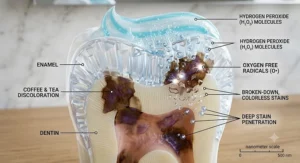
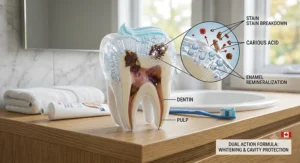
Peroxide toothpaste for whitening is doing genuine chemistry: hydrogen peroxide breaks down into water and oxygen, and that released oxygen reacts with the pigmented molecules (chromogens) that have worked their way into the enamel and the dentin layer beneath it. This is why peroxide can address discoloration that predates your current oral hygiene routine entirely — the yellowing that comes from aging, certain medications, or years of accumulated intrinsic staining. It’s slow, cumulative work, but it’s structural change, not surface polish.
Peroxide toothpaste for stain removal is a related but distinct use case: here, the goal isn’t necessarily changing your baseline tooth colour, it’s preventing and lifting the daily buildup from coffee, tea, red wine, and tobacco that sits on the enamel surface. For this specific job, the mild abrasives paired with peroxide in most formulas (silica, baking soda) often do more practical work than the peroxide concentration itself — which is part of why a lower-peroxide, baking-soda-forward product like Crest Plus Baking Soda & Peroxide Whitening Toothpaste can feel just as satisfying day-to-day as a higher-concentration formula like Colgate Optic White Renewal, even though the underlying chemistry is doing very different amounts of work.
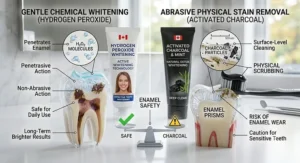
Charcoal toothpaste, by contrast, essentially only competes in the stain-removal lane. It has no mechanism for altering intrinsic tooth colour, which is exactly what the Canadian Dental Association has stated publicly and is worth understanding clearly before you buy based on before-and-after photos that are almost certainly showing surface stain removal, not genuine whitening.
How to Choose Between Peroxide and Charcoal Toothpaste
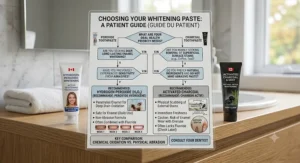
Rather than a vague “it depends,” here’s a concrete, numbered framework for making the call.
- Identify your stain type first. If your teeth have gradually yellowed over years — not from specific foods, just general aging — that’s likely intrinsic staining, and only peroxide realistically addresses it. If it’s specifically coffee-ring, red-wine, or tobacco-related surface discoloration, charcoal or a baking-soda hybrid can genuinely help.
- Check for existing dental work. Veneers, crowns, bonding, and composite fillings don’t respond to peroxide the way natural enamel does, and charcoal particles can discolour porous restoration material over time. If you have significant dental work, talk to your dentist before either category.
- Assess your sensitivity history. If you’ve had sensitivity issues with any whitening product before, start with the lowest peroxide concentration on this list (Colgate Baking Soda and Peroxide Whitening Toothpaste) rather than jumping straight to a 5% formula.
- Decide how much you value avoiding synthetic bleaching agents. Some people have entirely valid personal or medical reasons to avoid peroxide altogether — pregnancy is one commonly cited example where many dentists recommend caution with active whitening agents, though this should always be confirmed with your own dental professional. For that group, a well-formulated charcoal product is the more sensible starting point.
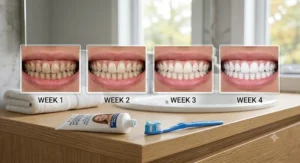
- Set a realistic timeline. Peroxide results typically show over four weeks of consistent twice-daily brushing. Charcoal results, where they occur at all, tend to be noticeable faster because they’re addressing surface residue rather than doing slow chemical work — but the ceiling on how white your teeth can get is much lower.
- Budget for the long game. Whitening toothpaste of either type is a maintenance product, not a one-time fix. Factor the ongoing C$4-C$25 monthly-ish cost (depending on tube size and brand) into your actual oral care budget rather than treating it as a single impulse purchase.
- Don’t skip the dentist check-in. Especially if you’re combining whitening toothpaste with other at-home whitening products (strips, trays, pens), a quick conversation with your dental hygienist can flag interactions or timing issues before they become a sensitivity problem.
Peroxide Toothpaste vs Charcoal Toothpaste: The Head-to-Head Breakdown
| Factor | Peroxide Toothpaste | Charcoal Toothpaste |
|---|---|---|
| Mechanism | Chemical oxidation (bleaching) | Physical adsorption/mild abrasion |
| Addresses intrinsic stains | Yes | No |
| Addresses surface stains | Yes | Yes |
| Fluoride typically included | Usually | Rarely |
| Sensitivity risk | Moderate, dose-dependent | Low to moderate, abrasiveness-dependent |
| Typical price range (CAD) | C$4-C$14 per tube | C$10-C$25 per tube |
Looking at the table, the practical takeaway is that peroxide toothpaste is doing more overall work per tube — it’s addressing both stain categories and usually includes cavity protection — but that extra capability comes with a wider price range and a higher (though still generally low) sensitivity risk when used as directed. Charcoal toothpaste’s narrower job description isn’t necessarily a downside; it’s simply a more limited tool that some buyers genuinely prefer for ingredient or medical reasons. Neither category replaces professional in-office whitening if you’re after dramatic, fast results — both are gradual, maintenance-level tools by design.
Enamel Safety: What the Research Actually Says
Enamel safety is probably the single most search-worthy concern in this entire category, and it deserves a straight answer rather than marketing spin in either direction.
For peroxide, the research consensus — reflected in Health Canada’s guidance on home tooth whitening kits — is that hydrogen peroxide formulas used as directed are enamel-safe for the general population. Health Canada regulates peroxide concentration in cosmetic tooth-whitening products specifically because concentration, not the ingredient itself, is what determines risk. Products sold directly to consumers in Canada are held to different evidentiary standards than in-office professional treatments, which is part of why over-the-counter toothpaste formulas top out at a fraction of the concentration a dentist might use for an in-chair treatment.
For charcoal, the picture is more mixed, and Canadian dental authorities have been notably blunt about it. The Canadian Dental Association has stated plainly that activated charcoal “cannot change the actual colour of a tooth” the way peroxide can, and that the abrasiveness of grainy charcoal pastes “have the potential to harm tooth enamel” — particularly with loose-powder formulations where particle size isn’t tightly controlled. A dental hygiene clinical associate professor at the University of Alberta went further, calling charcoal toothpaste’s whitening claims largely unsubstantiated and noting there’s “no convincing scientific evidence” behind them, while flagging genuine abrasion risk with regular use.
What most buyers overlook is that abrasiveness varies enormously between charcoal products depending on formulation — this is exactly why activated-carbon-in-paste formulas like Curaprox Black is White test at meaningfully lower RDA scores than loose powder or poorly bound charcoal pastes. If enamel safety is your top priority and you’re set on trying charcoal, the format and RDA rating matter more than the ingredient headline on the front of the box.
Whitening Speed: How Fast Does Each Option Actually Work
If you’re asking “how fast” because you have an event coming up, the honest answer might be disappointing: toothpaste, of either category, is the slowest whitening method available, full stop.
Peroxide toothpaste generally follows the timeline the manufacturers themselves test against — twice-daily brushing for roughly four weeks before visible change, with continued gradual improvement over subsequent months. Colgate Optic White Renewal‘s higher peroxide concentration doesn’t dramatically shrink that window; it mostly increases the eventual depth of whitening achieved, not the speed at which it arrives. This is a fundamentally different mechanism from in-office bleaching, which uses concentrations many times higher under professional supervision and can show change in a single session.
Charcoal toothpaste can feel faster in the very short term, purely because it’s removing surface debris rather than doing chemical work — someone with heavy recent coffee staining might notice a visible difference within days of switching to a charcoal formula. But that speed is deceptive: it’s a ceiling effect. Once the surface stains are gone, charcoal has nothing left to offer, and continued use won’t produce further whitening the way continued peroxide use does. If your priority is genuinely fast results and you’re not willing to wait weeks for either category, toothpaste alone — peroxide or charcoal — probably isn’t the right tool, and a conversation with your dentist about professional options makes more sense than switching toothpaste brands repeatedly hoping for a shortcut.
Dentist Opinions on DIY Whitening
This is where the professional consensus gets genuinely useful, because it cuts through a lot of the marketing noise on both sides.
On peroxide specifically, dental professionals are broadly comfortable with over-the-counter formulas used as directed, largely because Health Canada’s regulatory framework already filters out unsafe concentrations before products reach store shelves. The primary caution dentists tend to raise isn’t about the ingredient itself but about overuse — combining a peroxide toothpaste with whitening strips and a whitening mouthwash simultaneously, for example, stacks exposure in a way no single product’s testing accounted for, and that’s when sensitivity complaints spike.
On charcoal, dentist opinions on DIY whitening are noticeably more skeptical, and it’s not a fringe position — it’s the stated view of both the Canadian Dental Association and the American Dental Association. As reported in coverage from the University of Alberta’s School of Dentistry, charcoal toothpaste is widely characterized by dental educators as a marketing trend without strong supporting evidence, carrying real abrasion risk rather than a proven whitening benefit. Individual practicing dentists interviewed in various consumer health segments have echoed this, with some specifically warning patients with veneers, crowns, or fillings to avoid charcoal products altogether because of how charcoal particles can interact with — and discolour — restoration materials over the long term.
The practical synthesis most dentists land on, based on everything above: if you want proven, chemistry-based whitening, peroxide toothpaste used as directed is well-supported. If you’re drawn to charcoal for ingredient-avoidance reasons rather than whitening performance specifically, choose a non-abrasive, professionally formulated option and don’t expect it to outperform peroxide on actual colour change — because Health Canada’s own evidence requirements for whitening products reflect exactly this asymmetry between the two categories.
Common Mistakes When Buying Whitening Toothpaste
A few recurring pitfalls show up across both categories, and most are easy to avoid once you know to look for them.
Buying based on before-and-after photos alone is probably the single biggest mistake. Lighting, filters, and the simple fact that most “after” photos are taken after professional cleaning rather than toothpaste use alone make these comparisons close to meaningless as a buying signal. Look for aggregated review sentiment and ingredient transparency instead of marketing photography.
Assuming higher peroxide percentage always means better results is another common trap — past a certain concentration, you’re mostly increasing sensitivity risk rather than proportionally increasing whitening, which is part of why Colgate Optic White Renewal‘s 3-5% formula and Crest Plus Baking Soda & Peroxide Whitening Toothpaste‘s lower concentration can both be “correct” choices depending on your sensitivity tolerance.
Ignoring fluoride content is a mistake that’s easy to make when you’re focused entirely on whitening. Several charcoal products, including Cali White Activated Charcoal & Organic Coconut Oil Toothpaste and Hello Activated Charcoal Epic Whitening Toothpaste, deliberately skip fluoride, which means they can’t be your sole daily toothpaste without a plan for cavity protection elsewhere in your routine.
Finally, expecting toothpaste to match in-office results is the mistake that generates the most disappointed reviews across every product on this list. Toothpaste is a maintenance and gradual-improvement tool by design and by regulation — it’s simply not permitted to contain the concentrations that produce dramatic, fast results, and no amount of brand marketing changes that underlying chemistry.
FAQ
❓ Which toothpaste whitens teeth faster, peroxide or charcoal?
❓ Is charcoal toothpaste safe for enamel every day?
❓ Can I use peroxide and charcoal toothpaste together?
❓ Do dentists recommend charcoal toothpaste?
❓ How long does it take peroxide toothpaste to show results?
Conclusion
The peroxide toothpaste vs charcoal toothpaste question doesn’t really have a universal winner — it has a right answer for your specific mouth, your specific stains, and your specific tolerance for both chemistry and marketing hype. Peroxide products, led here by Colgate Optic White Renewal at the premium end and Crest Plus Baking Soda & Peroxide Whitening Toothpaste at the budget end, do genuine chemical work and remain the better-evidenced choice when actual colour change is the goal. Charcoal products, with Curaprox Black is White standing out as the most dentist-defensible option and Cali White Activated Charcoal & Organic Coconut Oil Toothpaste leading the budget natural-ingredient lane, are a reasonable choice for people prioritizing ingredient avoidance over maximum whitening power — as long as expectations stay realistic about what surface adsorption can and can’t do.
Whichever direction you land on, the research is consistent on one point: neither category replaces a conversation with your dentist if you have existing restorations, sensitivity history, or genuinely stubborn intrinsic staining. Use this guide as your starting point, not your final word — your own dental professional knows your mouth better than any tube of toothpaste ever will.
Recommended for You
- 7 Best Peroxide Toothpaste Picks for Canadians in 2026
- 7 Best Baking Soda Toothpastes for Sensitive Teeth (Canada, 2026)
- Baking Soda Toothpaste for Whitening: 7 Best Picks (2026)
Disclaimer: This article contains affiliate links. As an Amazon Associate, I earn from qualifying purchases. If you purchase products through these links, we may earn a small commission at no additional cost to you.
✨ Found this helpful? Share it with your friends! 💬🤗 ✨
