In This Article
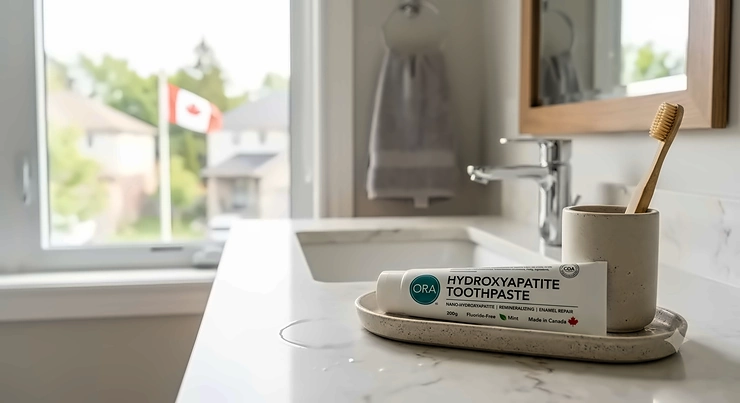
Walk down the toothpaste aisle in any Canadian pharmacy these days and you’ll notice something new wedged between the Crest and the Sensodyne: little tubes promising to rebuild your enamel with a mineral you’ve probably never heard of. Hydroxyapatite toothpaste is a fluoride-free (or fluoride-paired) formula built around calcium hydroxyapatite, the same mineral that makes up roughly 97% of your tooth enamel and about 70% of your dentin. In plain terms, it’s brushing with a diluted version of the actual material your teeth are made from, rather than a chemical that works by a different mechanism entirely.
What’s driving the surge isn’t just clever marketing. A review published by the University of Toronto’s Faculty of Dentistry found that fluoride-free toothpastes containing hydroxyapatite can provide protection roughly equivalent to fluoride formulas, which is a meaningful shift for a product category that spent years being dismissed as wellness-aisle fluff. That doesn’t mean fluoride is obsolete, and it definitely doesn’t mean every hydroxyapatite toothpaste on Amazon.ca performs the same way. Concentration, particle size, and formulation quality vary wildly between brands, and a tube labelled “with hydroxyapatite” can mean anywhere from a token sprinkle to a genuinely therapeutic dose.
This guide breaks down seven real, purchasable hydroxyapatite toothpaste options, from budget-friendly starter tubes to the Japanese formula that arguably started the whole category. We’ll dig into the difference between microcrystalline hydroxyapatite and its nano-sized cousin, walk through how remineralization and biomimetic enamel repair actually work at the enamel surface, and help you figure out which multipack deal is worth your money and which one is just a bigger box. No invented reviews, no fabricated lab-coat theatrics — just real specs, honestly interpreted, so you can make a smarter call than “the tube looked nice.”
Quick Comparison Table
| Product | Hydroxyapatite Type | Best For | Price Range (CAD) |
|---|---|---|---|
| Himalaya Botanique Whitening+ Hydroxyapatite Toothpaste | 10% nano-HAp | Budget-friendly first try | Under C$20 |
| Made by Dentists Professional Enamel Rebuilding (2-Pack) | nano-HAp + fluoride | Multipack deals, cavity-prone brushers | C$25–C$35 |
| Davids Hydroxi Sensitive + Whitening | Nano-HAp (Fluidinova) | Sensitive teeth | C$20–C$28 |
| Boka Ela Mint n-Ha Toothpaste | Undisclosed nano-HAp | Everyday all-rounder | C$20–C$26 |
| RiseWell PRO Mineral Toothpaste | 15% micro + nano-HAp | Highest disclosed concentration | C$22–C$28 |
| Bioniq Classic 20% Hydroxyapatite | 20% bioHAP | Gum-conscious brushers | C$20–C$25 |
| Apagard Premio | Proprietary nano-mHAP | Premium, whitening-focused | C$35–C$50 |
Looking at this lineup, the spread between roughly C$18 and C$50 tells you this category isn’t priced like conventional fluoride toothpaste, and that gap usually comes down to hydroxyapatite concentration, sourcing (France, Italy, Japan), and whether the brand discloses its formula or keeps it proprietary. Himalaya Botanique and Made by Dentists sit at the accessible end for anyone testing the waters, while Apagard Premio‘s import status and decades of Japanese clinical positioning push it toward the premium shelf. If sensitivity is your main complaint, note that Davids Hydroxi and Bioniq Classic both lean into that use case specifically.
💬 Just one click — help others make better buying decisions too!😊
Top 7 Hydroxyapatite Toothpaste Picks: Expert Analysis
Every product below is a real, currently sold item, and every spec comes from manufacturer documentation or aggregated review data — not guesswork. Where a brand keeps its exact hydroxyapatite percentage proprietary (which several do, Boka included), we say so plainly rather than inventing a number.
1. Himalaya Botanique Whitening+ Hydroxyapatite Toothpaste — best low-cost entry point
If you’ve never tried a hydroxyapatite toothpaste and don’t want to gamble C$40 on the experiment, this is where most people should start. Himalaya formulates its Whitening+ line with a disclosed 10% nano-hydroxyapatite concentration, which sits comfortably in the range most clinical studies actually test.
The formula pairs that 10% nHA with papaya and pineapple enzymes for surface-stain removal instead of peroxide, which matters in practice because peroxide-based whiteners are notorious for triggering sensitivity — the exact problem many people are trying to escape by ditching fluoride pastes in the first place. It’s fluoride-free, SLS-free, and vegan, with neem and pomegranate rounding out the gum-care angle. Himalaya has been formulating oral and personal care products since 1930, which gives the brand more manufacturing history than most of the newer nHA-only startups crowding this space, even if hydroxyapatite itself is a newer addition to its lineup.
Aggregated customer sentiment across major retailers runs strongly positive, with reviewers frequently citing reduced sensitivity within the first week and noticeably less coffee staining. A recurring complaint is that the mint flavour reads as mild compared to conventional toothpaste, which some buyers love and others find underwhelming for that “just brushed” tingle.
Pros:
- ✅ Disclosed 10% hydroxyapatite concentration, not a vague proprietary blend
- ✅ Enzyme-based whitening avoids peroxide-related sensitivity
- ✅ Lowest price point of any product on this list
Cons:
- ❌ Mint flavour is noticeably milder than conventional toothpaste
- ❌ Smaller 3 oz/4 oz tubes mean more frequent reorders
Priced under C$20 in most listings, this is the toothpaste to buy if you want to test whether hydroxyapatite works for your mouth before committing to a pricier subscription-model brand.
2. Made by Dentists Professional Enamel Rebuilding ToothpasPte (2-ack) — best multipack deal with fluoride backup
This one is the pragmatist’s pick, and it’s worth calling out specifically for anyone searching Amazon.ca for hydroxyapatite toothpaste multipack deals rather than a single tube. Made by Dentists sells its Professional Enamel Rebuilding formula as a two-pack of 4.2 oz tubes, and rather than forcing you to choose between hydroxyapatite and fluoride, it combines nano-hydroxyapatite with 0.24% sodium fluoride and 5% potassium nitrate for sensitivity relief.
That dual-action approach is the standout feature here. Fluoride works by a different remineralization pathway than hydroxyapatite — it converts enamel’s outer layer into a more acid-resistant fluorapatite crystal — so pairing the two isn’t redundant, it’s complementary. The formula carries ADA (American Dental Association) recognition for its whitening and sensitivity-protection claims, which is a meaningful third-party checkpoint that plenty of “clean” hydroxyapatite brands simply don’t pursue.
Reviewers consistently note that the potassium nitrate component produces faster sensitivity relief than fluoride-free hydroxyapatite pastes alone, since potassium nitrate works on nerve signalling almost immediately while hydroxyapatite’s tubule-blocking effect builds gradually with use. The trade-off, and it’s an honest one, is that anyone specifically avoiding all fluoride for personal reasons should skip this pick entirely.
Pros:
- ✅ Two-tube multipack stretches the cost-per-brush lower than single tubes
- ✅ ADA-recognized dual fluoride-plus-hydroxyapatite formula
- ✅ Potassium nitrate adds faster-acting sensitivity relief
Cons:
- ❌ Contains fluoride, which defeats the purpose for fluoride-avoidant buyers
- ❌ Titanium dioxide in the ingredient list may concern some clean-beauty shoppers
Expect this two-pack to land somewhere in the C$25–C$35 range, which works out to a solid per-tube cost compared with buying single premium tubes individually — genuinely one of the better multipack deals in this category on Amazon.ca.
3. Davids Hydroxi Sensitive + Whitening Toothpaste — best for sensitive teeth
Davids built its entire Hydroxi line around Fluidinova’s NanoXIM nano-hydroxyapatite, sourced from a Portuguese manufacturer that’s become something of a gold standard supplier in this space (RiseWell’s PRO line uses the same source for its nano component). The Sensitive + Whitening formula carries an RDA (Relative Dentin Abrasivity) rating of 101, which sits comfortably within the ADA’s recommended safe range of under 250, meaning it cleans effectively without sandpapering your enamel.
What most buyers overlook about Davids’ sensitivity claim is the mechanism: instead of leaning on potassium nitrate to numb nerve signals the way conventional sensitive toothpastes do, Davids uses nano-hydroxyapatite particles to physically occlude the dentin tubules that expose nerve endings to hot, cold, and sweet triggers. That’s a structural fix rather than a temporary numbing one, which is why some dentists prefer recommending it for long-term sensitivity management rather than quick relief.
Aggregated reviews are strong, with EWG Verified status and a “Made in USA” designation showing up repeatedly as purchase drivers alongside the sensitivity results themselves. A common complaint in user reviews is that results for whitening specifically take several weeks to become visible, since the natural whitening here comes from gentle micro-polishing rather than any bleaching agent.
Pros:
- ✅ Fluidinova NanoXIM sourcing, a widely respected nHA supplier
- ✅ RDA 101 keeps abrasion well within ADA-safe limits
- ✅ Tubule-occlusion approach addresses sensitivity at its source
Cons:
- ❌ Whitening results are gradual, not immediate
- ❌ Premium pricing relative to drugstore sensitivity formulas
Davids typically runs in the C$20–C$28 range depending on tube size (4 oz vs. the larger 5.25 oz), and for anyone whose main motivation is sensitivity rather than whitening, it’s one of the more defensible premium picks on this list.
4. Boka Ela Mint Nano-Hydroxyapatite Toothpaste — best mainstream all-rounder
Boka is arguably the brand most responsible for bringing nano-hydroxyapatite into the North American mainstream, and Ela Mint remains its flagship flavour. The formula is fluoride-free, SLS-free, and paraben-free, and Boka has assembled an Oral Health Advisory Committee of dentists to guide formulation — a detail worth noting given how many competitors in this space skip professional dental input entirely.
Here’s the honest caveat: Boka does not disclose its exact hydroxyapatite percentage, calling it proprietary. Independent reviewers estimate the concentration at roughly 10–15% based on ingredient ordering and paste consistency, which lines up with the range most clinical trials use, but it’s still an estimate rather than a confirmed figure. Buyers who want a guaranteed percentage on the label should look at Himalaya, RiseWell, or Bioniq instead.
What Boka has going for it is scale and trust signals: an aggregated rating around 4.8 out of 5 across thousands of reviews on its own storefront, with customers repeatedly praising the clean taste, the noticeably smoother enamel feel, and the fluoride-free formulation. It’s also worth flagging that in 2025, an industry self-regulatory body found Boka hadn’t substantiated some of its marketing claims with product-specific studies — a compliance issue rather than a safety one, but relevant context for anyone weighing brand claims critically.
Pros:
- ✅ Dentist advisory committee involved in formulation
- ✅ Strong aggregated review scores across thousands of ratings
- ✅ Widely available with kid, sensitive, and probiotic variants
Cons:
- ❌ Exact hydroxyapatite percentage is undisclosed
- ❌ Faced a 2025 advertising self-regulation finding on unsubstantiated claims
At roughly C$20–C$26 per 4 oz tube, Boka sits in the mid-premium tier — reasonable if you value the brand’s dental-advisory backing and don’t mind an estimated rather than confirmed concentration.
5. RiseWell PRO Mineral Toothpaste — highest disclosed hydroxyapatite concentration
RiseWell’s PRO formula is the most transparent product on this list about its numbers, and the numbers are genuinely high. It combines 10% microcrystalline hydroxyapatite, naturally sourced from a mine in France, with 5% nano-hydroxyapatite from Fluidinova, for a combined 15% total hydroxyapatite concentration — the highest disclosed figure of any product reviewed here.
The spec sheet won’t tell you this outright, but the reason RiseWell blends both particle sizes is deliberate: microcrystalline hydroxyapatite particles (roughly 5,000–10,000 nanometres) are large enough to sit on the enamel surface and physically fill in visible pitting, while the nano-sized fraction (under 100 nanometres) can work its way into finer microscopic cracks and dentin tubules that the larger particles can’t reach. Using both sizes together theoretically covers more of the damage spectrum than a single-particle-size formula.
RiseWell is also unusually transparent about what it excludes — SLS and its common derivatives, parabens, and propylene glycol are all explicitly absent. Aggregated reviews frequently mention a noticeably smoother feel on the tongue within days of switching, alongside reduced cold sensitivity. Some users report mild dry mouth when first transitioning from SLS-containing toothpaste, which tracks with SLS’s known role as a foaming and mouthfeel agent that many people don’t realize they’ll miss.
Pros:
- ✅ Highest disclosed combined hydroxyapatite concentration on this list
- ✅ Dual micro- plus nano-particle approach targets different damage sizes
- ✅ Fully transparent exclusion list (no SLS, parabens, propylene glycol)
Cons:
- ❌ Some users report a mild adjustment period (dry mouth, altered mouthfeel)
- ❌ Standard tube size runs smaller than some competitors at a similar price
Expect RiseWell PRO to run C$22–C$28 for a 3.4 oz tube — a fair price given it’s the only product here that publishes both its particle sizes and its combined percentage.
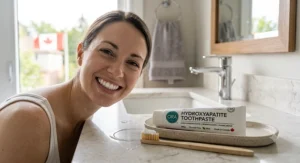
6. Bioniq Classic 20% Hydroxyapatite Toothpaste — best for gum-conscious brushers
Manufactured by Germany’s Dr. Wolff Group, Bioniq Classic advertises a full 20% bioHAP concentration, tied with the highest labelled figure in this entire roundup. The formula is fluoride-free and SLS-free, and it’s positioned around both enamel and gum care rather than enamel alone, which sets it apart from most of the nHA-only competitors.
Based on the spec comparison, 20% is a substantial jump from the 10% baseline most clinical trials use, and higher concentrations generally correlate with more visible short-term smoothness and stain resistance, though the relationship isn’t perfectly linear — past a certain concentration, the added hydroxyapatite mostly changes paste texture rather than delivering proportionally more remineralization. Bioniq also offers a Plus variant formulated with hyaluronic acid and lactoferrin specifically for gum moisture and health, a feature that most straight enamel-focused competitors don’t bother with.
Customer sentiment aggregated from retailer reviews is generally favourable, with the “clinically tested” branding and European manufacturing pedigree cited as trust factors. A recurring theme in reviews is that the paste has a noticeably different, slightly gritty texture compared to North American formulas, which some buyers describe as feeling more “mineral” and others simply find takes getting used to.
Pros:
- ✅ Highest labelled hydroxyapatite concentration tied for first on this list
- ✅ Plus variant adds hyaluronic acid and lactoferrin for gum care
- ✅ European (German) manufacturing with clinical testing claims
Cons:
- ❌ Distinctive gritty texture takes some adjustment
- ❌ Long ingredient list includes several preservatives some clean-label shoppers avoid
Bioniq typically retails in the C$20–C$25 range per 3.44 oz tube, making it one of the better value plays for anyone specifically prioritizing gum health alongside enamel remineralization.
7. Apagard Premio — the original, premium Japanese import
No hydroxyapatite toothpaste roundup is complete without Apagard, because this is where the whole category began. Sangi Co. launched the world’s first hydroxyapatite toothpaste in Japan in 1980, and by 1993 Japan’s Ministry of Health and Welfare had approved the company’s proprietary Medical Hydroxyapatite as an anti-caries ingredient — a regulatory track record no other brand on this list can match, measured in decades rather than years.
Premio is Sangi’s flagship consumer formula, containing 1.4 times the nano-mHAP concentration of the entry-level M-Plus line, though — consistent with Apagard’s pattern across its whole range — the company doesn’t publish an exact percentage. What Apagard does disclose is particle size: its nano-mHAP averages around 50 nanometres, genuinely nano-scale and smaller than several competitors’ undisclosed particles. The formula is marketed around three functions — plaque removal, filling microscopic enamel fissures, and remineralizing early mineral loss — with an added whitening pearl ingredient (hydrolyzed conchiolin) that’s unique to this brand.
Here’s what the spec sheet won’t tell you but import buyers should weigh carefully: because Apagard is manufactured in Japan and typically reaches Canadian shoppers through import retailers or Amazon.ca third-party sellers, pricing runs noticeably higher than domestically manufactured competitors, and packaging is entirely in Japanese, which some first-time buyers find disorienting even though the tube size and dosing are self-explanatory. Reviewers who’ve used it long-term consistently describe a genuine, gradual whitening effect and smoother enamel feel that they rate above most North American alternatives.
Pros:
- ✅ Longest clinical and regulatory track record in the category (since 1980)
- ✅ Smallest disclosed particle size at roughly 50 nanometres
- ✅ Unique whitening pearl ingredient not found in competing formulas
Cons:
- ❌ Import pricing and Japanese-only packaging add friction for Canadian buyers
- ❌ Exact hydroxyapatite percentage remains undisclosed, like most competitors
Apagard Premio generally runs C$35–C$50 for a single 105 g tube through import sellers, though multi-packs can bring the per-tube cost down meaningfully — a legitimate premium pick for anyone who wants the category’s original formula rather than a newer imitator.
Top Hydroxyapatite Toothpaste Brands in Canada
Zooming out from individual products, a handful of brands dominate what’s actually available and shippable to Canadian addresses right now. Boka and Davids lead on North American manufacturing and retail distribution, both frequently stocked through Amazon.ca with reasonable shipping times. RiseWell and Himalaya round out the accessible US-manufactured tier, with Himalaya specifically standing out for having built decades of manufacturing infrastructure well before hydroxyapatite became trendy.
Apagard represents the import tier — genuine Japanese manufacturing with the longest track record, but slower shipping and higher landed cost. Bioniq, out of Germany’s Dr. Wolff Group, occupies a similar import-adjacent European position, though its European manufacturing base means somewhat more consistent Amazon.ca stock than Japan-only Apagard. Made by Dentists rounds out the list as the hybrid-formula specialist, useful specifically for buyers who want fluoride’s cavity protection alongside hydroxyapatite’s remineralization rather than choosing one mechanism exclusively.
One filtering criterion worth applying across all of these brands: does the company disclose its hydroxyapatite concentration, and does it specify particle type (nano vs. micro)? RiseWell, Himalaya, and Bioniq all publish concrete numbers. Boka and Apagard keep their formulas proprietary. Neither approach is automatically better — proprietary blends aren’t necessarily weaker — but transparency does let you compare products on an apples-to-apples basis rather than trusting marketing copy alone.
Microcrystalline vs. Nano-Hydroxyapatite: What’s the Difference?
This is the single most confusing terminology issue in the entire category, and it’s worth untangling properly since it directly affects which product actually suits your needs. Microcrystalline hydroxyapatite (sometimes just called micro-HAp) refers to particles in the 5,000–10,000 nanometre range — visible under a standard microscope, sourced through mining and refining processes like the French-mined material RiseWell uses in its Mineral line. Nano-hydroxyapatite (nHAp or n-Ha) refers to particles under 100 nanometres, typically manufactured synthetically through controlled precipitation processes, like Fluidinova’s NanoXIM used by both Davids and RiseWell’s PRO formula.
The practical difference in practice comes down to where each particle size can physically reach. Microcrystalline particles are large enough to sit on the enamel surface and mechanically fill in larger surface pitting and rough patches, essentially smoothing the topography you can feel with your tongue. Nano-hydroxyapatite particles are small enough to migrate into microscopic fissures, the interprismatic spaces between enamel rods, and open dentin tubules — the same passages that expose nerve endings and cause sensitivity. Because of this, most higher-end formulas (RiseWell PRO being the clearest example on this list) deliberately combine both sizes rather than relying on just one.
There’s also a regulatory and safety dimension worth flagging honestly. Nano-scale particles below 100 nanometres technically fall under nanomaterial safety frameworks in several jurisdictions, which is why the European Union’s Scientific Committee on Consumer Safety conducted a dedicated 2024 assessment specifically addressing whether nano-hydroxyapatite particles could penetrate tissue harmfully. Their conclusion found the ingredient safe in toothpaste up to concentrations of 29.5%, with no evidence of systemic absorption at typical usage levels — reassuring context, though it’s still worth knowing that “nano” triggers extra regulatory scrutiny that “micro” formulations don’t.
How to Choose Hydroxyapatite Toothpaste
Given how much variation exists between brands, working through a short checklist beats grabbing whatever tube has the prettiest packaging. Here’s the reasoning dentists and formulation reviewers actually apply:
- Check the disclosed concentration first. Anywhere from 5% to 20% hydroxyapatite shows up across real products; higher isn’t automatically better, but a completely undisclosed percentage means you’re trusting the brand’s marketing rather than a verifiable spec.
- Match particle type to your primary concern. Nano-hydroxyapatite targets sensitivity and microscopic damage more effectively; microcrystalline particles excel at surface smoothing and visible whitening feel.
- Decide your fluoride stance deliberately, not by default. If you have a high cavity risk history, a hybrid formula like Made by Dentists’ fluoride-plus-hydroxyapatite approach may outperform a fluoride-free-only pick.
- Check the RDA (abrasivity) rating when available. Anything under 250 is considered ADA-safe for daily use; Davids’ RDA of 101 is on the gentler end of that range.
- Factor in your actual budget honestly. A C$45 import tube used inconsistently delivers less benefit than a C$18 tube used correctly twice daily — consistency beats concentration in the long run.
- Look for third-party recognition where it exists. ADA approval, EWG Verified status, or peer-reviewed clinical backing all add a layer of accountability beyond brand claims.
- Consider multipack economics if you’re committing long-term. A two- or three-pack, like Made by Dentists’ bundle, typically lowers your cost-per-tube meaningfully compared to buying singles repeatedly.
Practical Usage Guide: Getting the Most From Your Hydroxyapatite Toothpaste
Switching toothpaste types isn’t a “set it and forget it” swap, and a few practical habits noticeably improve your results in the first month. Start by brushing for the full two minutes, twice daily — hydroxyapatite needs contact time with enamel surfaces to actually redeposit into microscopic gaps, and a rushed 30-second brush undermines even the highest-concentration formula on this list.
Avoid rinsing aggressively with water immediately after brushing. Just like fluoride toothpaste, hydroxyapatite works best when a thin residual layer stays on your teeth for a few minutes post-brush, so a quick spit-and-go approach without a big water rinse lets more mineral actually bond to the enamel surface. If you’re transitioning from an SLS-containing conventional toothpaste, expect a short adjustment window — commonly one to two weeks — where the paste feels less foamy and your mouth feels different; this is a texture change, not a sign the product isn’t working.
Common first-30-days mistakes worth avoiding: switching back and forth between fluoride and hydroxyapatite formulas inconsistently (pick one primary daily toothpaste and stick with it for at least six to eight weeks before judging results), storing tubes with caps off in humid bathrooms (which can affect texture and shelf stability over time), and expecting visible whitening results within days rather than the several weeks most formulas actually require. Pair your toothpaste switch with basic maintenance: replace your toothbrush every three months regardless of paste type, and keep flossing daily since hydroxyapatite addresses enamel surface chemistry, not interdental plaque removal.
Real-World Scenarios: Who Should Actually Switch
The coffee-drinking commuter with cold sensitivity: If you’re grabbing a large coffee every morning and wincing every time you follow it with a cold drink, a nano-hydroxyapatite-forward option like Davids Hydroxi or RiseWell PRO addresses the tubule-occlusion mechanism directly, and the gentle enzyme or micro-polishing whitening handles the coffee staining without peroxide-triggered sensitivity spikes.
The budget-conscious family testing the waters: For a household trying hydroxyapatite for the first time without committing to premium pricing across multiple family members, Himalaya Botanique offers a disclosed concentration at the lowest price point on this list, making it easy to buy two or three tubes for different bathrooms without a big financial commitment.
The cavity-prone brusher who still wants fluoride’s track record: If your last three dental check-ups all mentioned new cavities, dropping fluoride entirely is a real risk — Made by Dentists’ hybrid formula lets you add hydroxyapatite’s remineralization benefits without abandoning fluoride’s decades of caries-prevention evidence, and the multipack format keeps ongoing cost manageable.
Problem → Solution: Common Hydroxyapatite Toothpaste Issues
Problem: Mouth feels “too clean” or oddly dry after switching. This usually traces back to the absence of SLS, the foaming agent conventional toothpaste relies on for that squeaky-clean sensation. Solution: give it two weeks before judging; most reviewers across every brand on this list report the sensation normalizing.
Problem: No visible whitening after a week. Nearly every product here whitens through gradual micro-polishing or enzyme action rather than bleaching, so results build over four to six weeks of consistent use. Solution: stick with a single product for the full window before switching again, since brand-hopping resets the process.
Problem: Ongoing sensitivity despite switching. Not every hydroxyapatite formula targets sensitivity equally; concentration and particle size both matter. Solution: move to a formula specifically engineered for sensitivity, like Davids Hydroxi, or a hybrid with potassium nitrate like Made by Dentists, rather than assuming hydroxyapatite alone will solve it.
Problem: Uncertainty about cavity protection without fluoride. This is a legitimate concern, not an overreaction. Solution: if you have a documented cavity-prone history, either choose a hybrid fluoride-plus-hydroxyapatite formula or discuss a professional fluoride varnish schedule with your dentist alongside your fluoride-free daily toothpaste.
Problem: Confusion over which concentration or particle size to buy. Solution: default to a disclosed-concentration product in the 10–15% range with nano particles for sensitivity focus, or add a microcrystalline component if surface smoothing and whitening feel matter more to you.
Hydroxyapatite Toothpaste vs. Fluoride Toothpaste
This comparison generates more online debate than almost any other oral care question, so it’s worth walking through the actual evidence rather than picking a side emotionally. Fluoride has an enormous research base behind it — the Canadian Dental Association’s position on fluoride remains that fluoride makes teeth more resistant to decay and can even reverse tooth decay that has already started, backed by more than fifty years of accumulated research. That’s a genuinely deep evidence base that no hydroxyapatite brand can currently match in volume.
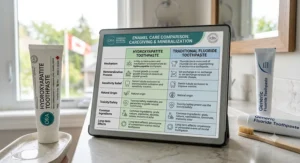
| Factor | Fluoride Toothpaste | Hydroxyapatite Toothpaste |
|---|---|---|
| Mechanism | Converts enamel to acid-resistant fluorapatite | Physically redeposits enamel-identical mineral |
| Evidence base | Decades of large-scale studies | Growing, smaller but promising trial base |
| Best For | Documented cavity-prone brushers | Sensitivity, fluoride-avoidant users |
| Regulatory status in Canada | Long-established, CDA-endorsed | Health Canada approved as anti-cavity since 2015 |
Interpreting that table honestly: fluoride’s evidence base is larger simply because it’s been studied for longer, not necessarily because hydroxyapatite is inferior. A well-designed 18-month clinical trial comparing the two directly found hydroxyapatite toothpaste was not statistically inferior to a 1,450 ppm fluoride toothpaste for preventing new decay in adults, which is a meaningful head-to-head result even though it’s one study rather than fifty years of accumulated data. The honest takeaway is that both mechanisms work, they work differently, and your personal risk profile — cavity history, sensitivity, fluoride sensitivity or avoidance preference — should drive the choice more than category loyalty.
That’s the conclusion from an 18-month double-blinded randomized clinical trial published in Frontiers in Public Health comparing the two formulas head-to-head, and it’s a reasonable summary of where the current evidence actually sits — not a verdict that fluoride is obsolete, but confirmation that hydroxyapatite is a legitimate alternative rather than a wellness-aisle gimmick.
✨ Ready to try a switch that’s actually backed by real research? Compare the picks above and pick the one that matches your specific concern, not just the prettiest tube.
How Remineralization and Biomimetic Enamel Repair Actually Work
Remineralization is the process by which lost minerals get redeposited into enamel that’s been softened or micro-damaged by acid exposure — from food, drinks, or plaque bacteria byproducts. Your saliva already does this constantly at a baseline level, which is why enamel isn’t in a permanent state of decline just from normal eating. Hydroxyapatite toothpaste essentially supplements that natural process by delivering additional bioavailable mineral directly to the tooth surface during brushing, rather than relying solely on saliva’s slower, passive redeposition.
Biomimetic enamel repair is the more precise term for what’s actually happening at a microscopic level: because synthetic hydroxyapatite shares the same crystal structure as natural tooth enamel, it doesn’t just coat the surface like some whitening agents do — it can integrate into microscopic gaps and fissures in a way that’s structurally compatible with the surrounding tooth material. That’s meaningfully different from a product that simply masks damage cosmetically. What most marketing copy won’t tell you is that this repair is limited to the outer, non-living enamel layer; it can’t reverse a cavity that’s already penetrated into dentin, and it’s not a substitute for professional dental treatment on existing decay.
In everyday terms, this translates to a few tangible outcomes reviewers across every brand on this list report consistently: a smoother feel when running your tongue across your teeth after a few weeks of use, reduced twinges from hot or cold exposure as tubules gradually fill, and in many cases a subtle natural whitening effect as micro-roughness that traps stain particles gets smoothed over. None of these effects happen overnight — expect a four-to-eight-week timeline for noticeable change, consistent with how gradually biological remineralization has always worked, with or without added hydroxyapatite.
Common Mistakes When Buying Hydroxyapatite Toothpaste
The single biggest mistake is assuming every tube labelled “hydroxyapatite toothpaste” delivers a therapeutic dose. Some budget or novelty products list hydroxyapatite far down the ingredient list in trace amounts, essentially riding the trend without matching the concentration used in actual clinical research. Always check whether the brand discloses a percentage, and be skeptical of formulas that mention hydroxyapatite only in marketing copy without an ingredient-panel confirmation.
A second common error is confusing “natural” or “fluoride-free” marketing with automatic superiority. Fluoride-free doesn’t inherently mean better for your teeth — it means better for a specific subset of users (fluoride-sensitive individuals, people managing fluorosis risk in young children, or those with a personal preference to avoid it). Buyers with active, documented cavity risk who switch away from fluoride without a genuine replacement strategy can end up worse off, not better.
Third, plenty of shoppers get pulled in by concentration numbers alone without checking particle size or sourcing quality. A 20% concentration of poorly manufactured hydroxyapatite may underperform a well-formulated 10% nano product with proven sourcing, like Fluidinova’s NanoXIM. Finally, don’t overlook practical logistics — Amazon.ca listings for import brands like Apagard sometimes ship from third-party sellers with variable delivery timelines, so check seller ratings and shipping estimates before assuming Prime-speed delivery on every hydroxyapatite listing.
Long-Term Cost & Multipack Value Analysis
| Purchase Pattern | Approx. Monthly Cost (CAD) | Notes |
|---|---|---|
| Single premium tube (e.g., Apagard Premio) | C$35–C$50 per tube, ~6–8 weeks per tube | Highest per-use cost, longest track record |
| Standard single tube (e.g., Boka, RiseWell PRO) | C$20–C$28 per tube, ~5–6 weeks per tube | Mid-range cost-per-use |
| Multipack (e.g., Made by Dentists 2-pack) | C$25–C$35 for two tubes, ~10–12 weeks combined | Lowest cost-per-use in this comparison |
Running the math on cost-per-use rather than sticker price changes the value picture considerably. A C$50 Apagard Premio tube used correctly (pea-sized amount, twice daily) typically lasts six to eight weeks, working out to roughly C$1.50–C$2 per week. A Made by Dentists two-pack at C$30 covering ten to twelve weeks works out closer to C$0.60 per week — a meaningfully lower ongoing cost despite the lower per-tube sticker price advantage looking smaller at first glance.
This is where multipack deals genuinely earn their keep on Amazon.ca: buying two or three tubes of the same formula in a single order not only lowers cost-per-use but also avoids the common mistake of running out and grabbing a random conventional toothpaste as a stopgap, which interrupts the consistent daily use that remineralization actually depends on. If you’ve settled on a formula that works for you after a single-tube trial, switching to that brand’s multipack option is one of the simplest ways to control long-term oral care spending without sacrificing the product that’s actually delivering results.
Safety, Regulations & Health Canada Guidance
Hydroxyapatite’s regulatory status in Canada is more established than many buyers realize. A fluoride-free nano-hydroxyapatite toothpaste received Health Canada approval as an anti-cavity product back in 2015, which means this isn’t an unregulated wellness product slipping through a loophole — it’s gone through the same Natural Health Products framework Health Canada applies to oral care claims generally.
On the safety side specifically for nano-scale particles, the European Union’s Scientific Committee on Consumer Safety completed a dedicated 2024 review addressing whether nano-hydroxyapatite could pose systemic absorption risks, and found no evidence of harmful tissue penetration at concentrations up to 29.5% — well above what any product on this list actually contains. That said, most manufacturers, including several reviewed here, include a standard caution against swallowing and recommend keeping products out of reach of children under six, consistent with general toothpaste safety practice rather than any hydroxyapatite-specific concern.
For readers weighing fluoride’s own safety profile against hydroxyapatite as part of this decision, Health Canada’s page on fluoride and oral health states plainly that fluoride has been scientifically proven to strengthen tooth enamel, reduce mouth acidity, and rebuild minerals that make teeth stronger, and confirms that aside from dental and skeletal fluorosis, no other health risks have been proven to be related to fluoride, with skeletal fluorosis specifically described as extremely rare in Canada. In practice, this means the safety conversation isn’t “fluoride is dangerous, hydroxyapatite is safe” — both ingredients carry solid safety profiles when used as directed, and the choice between them should rest on personal risk factors and preference rather than fear of either ingredient.
Hydroxyapatite Toothpaste for Different Audiences
For kids: Because hydroxyapatite is safe if swallowed (unlike fluoride, which requires supervised use and spit-don’t-swallow habits in young children), several brands on this list, including Himalaya and Boka, offer dedicated kids’ formulas. This can simplify bathroom routines for parents managing multiple children at different fluoride-supervision stages.
For seniors managing root sensitivity: As gums recede with age, exposed root surfaces lack the protective enamel layer entirely, making sensitivity more pronounced. A nano-hydroxyapatite formula focused on tubule occlusion, like Davids Hydroxi, addresses this mechanism specifically, though anyone with significant gum recession should still involve their dentist in choosing a long-term strategy.
For orthodontic patients: Braces create more surface area and crevices where demineralization risk increases. A higher-concentration option like Bioniq Classic or RiseWell PRO provides more available mineral for the increased surface area braces expose, though maintaining rigorous brushing technique around brackets still matters more than toothpaste choice alone.
For frequent coffee or wine drinkers: Staining concerns point toward formulas combining hydroxyapatite with gentle enzymatic whitening rather than peroxide, making Himalaya Botanique or Davids Hydroxi reasonable picks that won’t spike sensitivity the way peroxide-based whitening often does for heavy stain-fighters.
Frequently Asked Questions
❓ Does hydroxyapatite toothpaste actually work as well as fluoride?
❓ Is hydroxyapatite toothpaste safe for kids in Canada?
❓ How long does it take to see remineralization results?
❓ What's the difference between nano and microcrystalline hydroxyapatite?
❓ Can I use hydroxyapatite toothpaste with braces or after whitening treatments?
Conclusion
Hydroxyapatite toothpaste has earned its spot on Canadian shelves through genuine research backing, not just clever branding, and the seven products covered here span a real range of concentrations, particle sizes, and price points to fit different needs. If you’re testing the category for the first time, Himalaya Botanique offers a disclosed 10% concentration at the lowest cost of entry. If sensitivity is your main driver, Davids Hydroxi and its tubule-occlusion approach deserve serious consideration. If you want the highest disclosed concentration on the market, RiseWell PRO‘s combined 15% micro-plus-nano formula is hard to beat, and if you’re not ready to give up fluoride entirely, Made by Dentists’ hybrid multipack lets you have both mechanisms working together.
None of these products are magic, and none replace regular dental check-ups or professional care for existing decay. What they do offer, when chosen deliberately based on your actual concentration, particle-size, and budget needs rather than whichever tube has the trendiest packaging, is a genuinely evidence-backed way to support the remineralization process your enamel is already trying to do on its own. Match the product to your specific concern from the guide above, give it the full six-to-eight-week window most formulas need, and you’ll have a fair, honest read on whether hydroxyapatite earns a permanent spot in your bathroom.
Recommended for You
- 7 Best Charcoal Toothpaste for Sensitive Teeth Picks (2026 Canada)
- Charcoal Toothpaste vs Whitening Toothpaste: 7 Picks Compared (2026)
- Charcoal Toothpaste 2026: 7 Real Picks, Ranked Honestly
Disclaimer: This article contains affiliate links. As an Amazon Associate, I earn from qualifying purchases. If you purchase products through these links, we may earn a small commission at no additional cost to you.
✨ Found this helpful? Share it with your friends! 💬🤗
